





































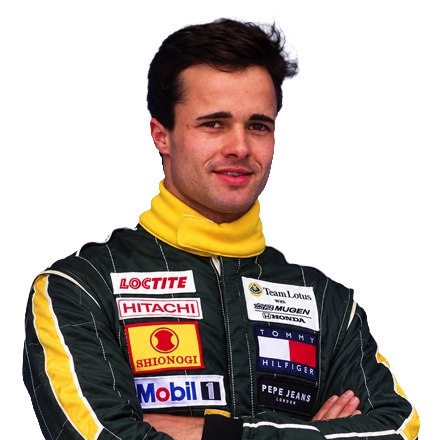
Pedro Lamy became the first Portuguese driver to score a Formula One World Championship point, then built a much longer and more successful career in endurance racing. Born José Pedro Mourão Nunes Lamy Viçoso in Aldeia Galega da Merceana, Alenquer, on 20 March 1972, he progressed rapidly through the junior single-seater categories.
Driver Bio
| Nationality | Portuguese |
| Birthplace | Aldeia Galega, Portugal |
| Born | 20 March 1972 |
| First Grand Prix | 1993 Italian Grand Prix |
| Last Grand Prix | 1996 Japanese Grand Prix |
| Years Active | 1993–1996 |
| Current/Last Team | Minardi |
He won the Portuguese Formula Ford title in his first season in 1989, aged seventeen. With management support from Domingos Piedade, he moved into Formula Opel Lotus and won the championship at his second attempt in 1991. The following year, driving for Willi Weber, he beat Marco Werner to the German Formula Three title.
Victory in the Masters of Formula Three at Zandvoort and second place at Macau reinforced his reputation. In 1993 he joined Crypton for International Formula 3000, won at Pau and finished just one point behind champion Olivier Panis. His rise towards F1 was both rapid and convincingly supported by results.
Lotus gave him the final four Grands Prix of 1993 after Alex Zanardi was injured. Lamy remained for the opening four rounds of 1994, but a major testing accident at Silverstone left him with broken legs and a broken wrist. Recovery kept him out of racing for more than a year.
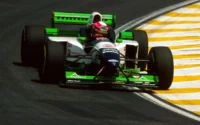
A comeback arrived with Minardi during the second half of 1995, replacing Pierluigi Martini. At the Australian Grand Prix in Adelaide, Lamy recovered from a spin to finish sixth. The point was Portugal’s first in the World Championship and Minardi’s only one that season.
He continued with the financially stretched team in 1996, but the season brought no further points. His F1 career ended after 32 starts, with the Adelaide result standing as its statistical high point. Sports cars would provide far more sustained opportunities to win.
In 1998 Lamy became FIA GT’s GT2 champion with an Oreca Viper. A spell in the DTM with the works Mercedes team proved less satisfying, while endurance racing increasingly became the centre of his career. Nürburgring 24 Hours wins with Zakspeed in 2001 and 2002 were followed by the V8Star championship in 2003.
The major results continued in 2004: another Nürburgring victory, this time with BMW, and the Le Mans Series GTS title in Larbre’s Ferrari 550. In 2005 he won at the Nürburgring again, joined Aston Martin‘s works programme for Sebring and Le Mans, and also raced in FIA GT with Larbre.
He was announced as part of Portugal’s A1 Grand Prix plans in 2005, but his involvement was confined to testing while Álvaro Parente took the race seat. Aston Martin’s American Le Mans Series and Le Mans programme occupied him in 2006, before Peugeot recruited him for its diesel-powered 908 effort.
Lamy won the Le Mans Series LMP1 championship in 2007 with Peugeot, adding a major prototype title to his GT achievements. A fifth Nürburgring 24 Hours victory, with BMW in 2010, brought him level with Marcel Tiemann’s then-record tally. Success across different manufacturers had become a defining feature of his endurance career.
In 2012 he drove Larbre’s Corvette C6.R in the World Endurance Championship’s GTE Am category, extending a long association with both the team and international GT racing. By this stage, the single F1 point represented an important national milestone within a record much larger than his Grand Prix years.
Lamy’s career combined a rapid junior rise, recovery from serious injury and an enduring capacity to win in different cars. The F3 and F3000 performances explain why F1 teams noticed him; the championships and repeated victories in Germany’s great 24-hour race explain why sports-car racing became his most productive home.
Grand Prix Stats
| Race Entries | 32 |
| Race Starts | 32 |
| Did Not Start | 0 |
| Best Race Start | 14th |
| Best Race Finish | 6th |
| Retirements | 15 |
| First-Lap Retirements | 5 |
| Not Classified | 0 |
| Disqualified | 0 |
| Did Not Qualify | 0 |
Qualifying
| Qualifying Sessions | – |
| Reached Q3 | – |
| Q2 Eliminations | – |
| Q1 Eliminations | – |
| Did Not Qualify | 0 |
Points
| Points Scored | 1 |
| Points Finishes | 1 |
| Most Points in a Single Season | 1 (1995) |
| Seasons with Points | 1 |
Stats by Season
| Year | Constructor | Entries | Starts | Wins | Podiums | Poles | Fastest Laps | Front Rows | DNF | Best Start | Best Result | Pts Finishes | Points | Championship |
|---|---|---|---|---|---|---|---|---|---|---|---|---|---|---|
| 1993 | Lotus | 4 | 4 | 0 | 0 | 0 | 0 | 0 | 4 | 18 | 11 | 0 | 0 | NC |
| 1994 | Lotus | 4 | 4 | 0 | 0 | 0 | 0 | 0 | 1 | 19 | 8 | 0 | 0 | NC |
| 1995 | Minardi | 8 | 8 | 0 | 0 | 0 | 0 | 0 | 2 | 14 | 6 | 1 | 1 | 18th |
| 1996 | Minardi | 16 | 16 | 0 | 0 | 0 | 0 | 0 | 8 | 17 | 9 | 0 | 0 | NC |
Teammates & Qualifying Head-to-Head
| Teammate | Years | Races | Qualifying H2H |
|---|---|---|---|
| Johnny Herbert | 1993, 1994 | 8 | 0-8 |
| Luca Badoer | 1995 | 8 | 2-6 |
| Giancarlo Fisichella | 1996 | 8 | 1-7 |
| Tarso Marques | 1996 | 2 | 0-2 |
| Giovanni Lavaggi | 1996 | 6 | 6-0 |