








































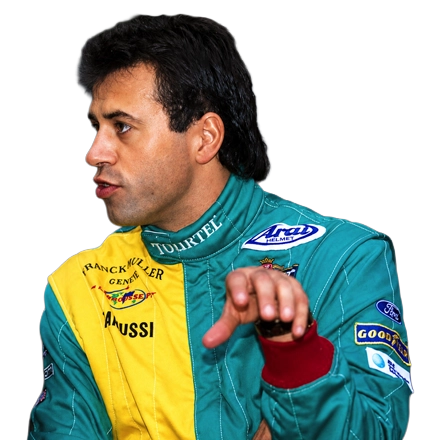
Jean-Denis Delétraz (born 1 October 1963) is a Swiss racing driver whose career took an unusual route from Formula Ford and Formula 3000 to a brief Formula One spell, before he found far greater success in endurance racing. He made three Formula One Grand Prix starts across 1994 and 1995, then went on to become a two-time Le Mans class winner and a front-running FIA GT competitor.
Driver Bio
| Nationality | Swiss |
| Birthplace | Geneva, Switzerland |
| Born | 1 October 1963 |
| First Grand Prix | 1994 Australian Grand Prix |
| Last Grand Prix | 1995 European Grand Prix |
| Years Active | 1994–1995 |
| Current/Last Team | Pacific |
Delétraz showed flashes of promise early in his career, taking two victories in Formula Ford before moving into the French Formula Three Championship between 1985 and 1987. His progress was steady rather than spectacular, and he finished 14th in the 1987 standings.
The next step was International Formula 3000, where Delétraz competed from 1988 to 1991. His best season came immediately: in 1988 he scored two third-place finishes. He never matched that form again, and after buying the FIRST Racing team in 1990, his results dried up completely. The operation also ran into off-track trouble in 1991, when it was temporarily impounded by an Italian court following legal action from teammate Giovanni Bonanno.
Delétraz then moved into touring cars and Porsche Supercup competition. In 1994 he joined the works SEAT team in the French Touring Car Championship, scoring a best result of fifth at Nogaro and finishing 13th overall.
His Formula One break came later that year, though it was driven as much by economics as results. Larrousse, struggling financially, needed drivers who could bring sponsorship money, and Delétraz replaced Érik Comas for the season-ending Australian Grand Prix.
He qualified 25th, ahead of Domenico Schiattarella’s Simtek, but the race itself was a difficult one. Delétraz quickly fell away from the field and was eventually ten laps down before retiring with gearbox failure on lap 57. His pace attracted heavy criticism, including from BBC commentator Jonathan Palmer, who questioned whether he belonged in Formula One at all.
Even so, Delétraz returned in 1995, this time with another cash-strapped team, Pacific. He was originally announced for the final five rounds of the season, replacing shareholder-driver Bertrand Gachot.
His first appearance came in Portugal, where gearbox problems left him last in qualifying and 12 seconds off pole position. In the race, he fell rapidly behind the field and retired after 14 laps with cramp in his left arm.
The Nürburgring produced his only Formula One finish. Delétraz qualified more than nine seconds off pole and eventually came home 15th and last, seven laps behind the winner.
His planned run to the end of the season was cut short. After payment issues arose, Pacific brought Gachot back, with team boss Keith Wiggins making it clear that Delétraz would not be retained on performance alone.
Those heavily spread-out qualifying performances became part of the wider debate around minimum speed standards in Formula One. When the 107% qualifying rule was introduced for 1996, some fans informally dubbed it the “Delétraz rule”, although that was never its official name.
Fortunately for Delétraz, Formula One proved to be only a small and unrepresentative part of his career. He moved decisively into sports car and GT racing, where his results improved dramatically.
In 1995 he began competing in the BPR Global GT Series and at the 24 Hours of Le Mans. The following year, he returned to FIRST Racing, now co-owning the operation with Fabien Giroix, and spent two seasons campaigning a McLaren F1 GTR.
When the BPR series evolved into the FIA GT Championship, FIRST ran the works Lotus Elise GT1 programme in 1997. After a short break from full-time competition, Delétraz returned with a Ferrari 550 Maranello in 2000.
Then came his first major Le Mans success. In 2001, Delétraz won the LMP675 class at the 24 Hours of Le Mans, surviving a race in which almost the entire class field retired. He also finished fifth overall, matching the best overall result of his Le Mans career.
He defended that class victory in 2002, benefiting from a late suspension failure for the leading Welter-Peugeot. That same season, he partnered Andrea Piccini in a BMS Scuderia Italia Ferrari 550, scoring four FIA GT victories and finishing fifth in the championship.
The pair switched to a works Lister Storm in 2003 and scored two podiums before withdrawing midway through the season. Delétraz later returned to the FIA GT Championship with DAMS and other teams, remaining a regular presence in international GT racing.
A strong 2006 season with Phoenix Racing and Andrea Piccini brought podium finishes at Brno, Oschersleben, Spa and Dijon, followed by victory in the season-ending Dubai 500km. The results carried the pair to second in the championship standings.
For 2007, Phoenix switched to the Chevrolet Corvette C6.R, and Delétraz teamed with Mike Hezemans. The partnership scored four podiums and two major victories: overall honours at the Spa 24 Hours, shared with Marcel Fässler and Fabrizio Gollin, and a win at Nogaro.
He remained with Phoenix in 2008, now alongside Fässler full-time, and the pair won both street races at Bucharest in addition to scoring three further podiums.
Delétraz was still competing at world championship level in 2012, entering the inaugural FIA World Endurance Championship season in an LMP2 Lola B12/80 with Gulf Racing Middle East. The team finished seventh in the class standings.
His Le Mans record ultimately included appearances between 1995 and 2012, with two class victories in 2001 and 2002 and best overall finishes of fifth in 1995 and 2001.
Delétraz also passed the racing gene on to the next generation. His son, Louis Delétraz, became a successful professional driver in his own right and, by 2026, held the record for the most championship titles in the European Le Mans Series.
Jean-Denis Delétraz’s Formula One career is often remembered for the wrong reasons, but it tells only a tiny part of the story. In endurance racing he proved far more accomplished, becoming a Le Mans class winner, Spa 24 Hours victor and regular FIA GT front-runner over a career that lasted well beyond his three Grand Prix appearances.
Grand Prix Stats
| Race Entries | 3 |
| Race Starts | 3 |
| Did Not Start | 0 |
| Best Race Start | 24th |
| Best Race Finish | 15th |
| Retirements | 2 |
| First-Lap Retirements | 0 |
| Not Classified | 0 |
| Disqualified | 0 |
| Did Not Qualify | 0 |
Qualifying
| Qualifying Sessions | 3 |
| Reached Q3 | 0 |
| Q2 Eliminations | 0 |
| Q1 Eliminations | 0 |
| Did Not Qualify | 0 |
Stats by Season
| Year | Constructor | Entries | Starts | Wins | Podiums | Poles | Fastest Laps | Front Rows | DNF | Best Start | Best Result | Pts Finishes | Points | Championship |
|---|---|---|---|---|---|---|---|---|---|---|---|---|---|---|
| 1994 | Larrousse | 1 | 1 | 0 | 0 | 0 | 0 | 0 | 1 | 25th | Ret | 0 | 0 | NC |
| 1995 | Pacific | 2 | 2 | 0 | 0 | 0 | 0 | 0 | 1 | 24th | 15th | 0 | 0 | NC |
Stats by Constructor
| Constructor | Years | Entries | Starts | Wins | Podiums | Poles | Fastest Laps | Front Rows | DNF | Best Start | Best Result | Pts Finishes | Points |
|---|---|---|---|---|---|---|---|---|---|---|---|---|---|
| Larrousse | 1994 | 1 | 1 | 0 | 0 | 0 | 0 | 0 | 1 | 25th | Ret | 0 | 0 |
| Pacific | 1995 | 2 | 2 | 0 | 0 | 0 | 0 | 0 | 1 | 24th | 15th | 0 | 0 |
Teammates & Qualifying Head-to-Head
| Teammate | Years | Races | Qualifying H2H |
|---|---|---|---|
| Hideki Noda | 1994 | 1 | 0-1 |
| Andrea Montermini | 1995 | 2 | 0-2 |