



































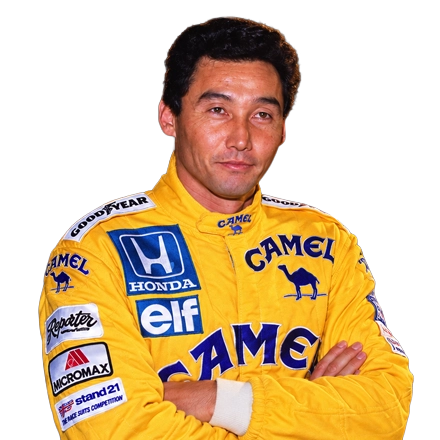
Satoru Nakajima (born 23 February 1953) is a Japanese former racing driver and motorsport executive who competed in Formula One from 1987 to 1991.
Driver Bio
| Nationality | Japanese |
| Birthplace | Okazaki, Japan |
| Born | 23 February 1953 |
| First Grand Prix | 1987 Brazilian Grand Prix |
| Last Grand Prix | 1991 Australian Grand Prix |
| Years Active | 1987–1991 |
| Current/Last Team | Tyrrell |
Nakajima dominated Japanese Formula Two during the 1980s, winning a then-record five championships and 21 races. He later became the first Japanese driver to contest a complete Formula One season, joining Ayrton Senna at Lotus in 1987.
Across 80 Grand Prix entries, Nakajima recorded a fastest lap and twice finished fourth. After retiring, he concentrated on Nakajima Racing, the team he had founded in 1984 and developed into a multiple championship-winning force in Formula Nippon and a long-running entrant in Super Formula and Super GT.
Early life
Nakajima was born into a farming family living near Okazaki in Aichi Prefecture. He first drove as a young teenager, secretly practising in the family garden while his older brother offered instructions and kept watch for their father.
The experience made an immediate impression. Nakajima found the feeling behind the wheel exhilarating and decided that racing was what he wanted to pursue.
Japanese racing
After finishing school and obtaining his driving licence, Nakajima began competing at Suzuka in 1973. He won the circuit’s rookie series that same year.
Nakajima progressed to Japanese Formula Two in 1977 and earned his first victory the following season. His breakthrough championship arrived in 1981, beginning an extraordinary period of domestic dominance. Powered by Honda V6 engines, he won five titles in six seasons between 1981 and 1986.
Across ten Japanese Formula Two campaigns, Nakajima accumulated 21 victories. He also gained international experience through appearances in the World Sportscar Championship and All Japan Endurance Championship, together with a season in International Formula 3000.
Formula One
Lotus and Honda
Honda initially attempted to place Nakajima at Williams for 1986 as Nigel Mansell’s replacement. Team owner Frank Williams refused, believing that retaining proven race winner Mansell alongside double World Champion Nelson Piquet offered a stronger chance of winning the Constructors’ Championship.
When Renault withdrew from Formula One after 1986, Lotus needed a new engine supplier. Honda agreed to provide its turbocharged V6 on the condition that Nakajima replaced Johnny Dumfries in the team’s second car.
Nakajima consequently joined Ayrton Senna at Lotus for 1987. At 34, he was among the oldest rookies of Formula One’s modern era, but his appearance at the Brazilian Grand Prix made him the first Japanese driver to embark on a full World Championship campaign.
He scored immediately in only his second start, finishing sixth at San Marino. His strongest result followed at Silverstone, where he took fourth place in the British Grand Prix.
Senna comprehensively outperformed him, leading critics to argue that Nakajima owed his seat primarily to Honda. Nevertheless, the Japanese newcomer completed his first season with seven championship points and demonstrated enough ability to remain with Lotus.
Difficult 1988 campaign
Nelson Piquet replaced Senna as Nakajima’s teammate for 1988, while Lotus retained the Honda turbo engine that powered McLaren to 15 victories from 16 races. The works relationship did little to rescue an uncompetitive Lotus chassis.
Nakajima scored his only point of the year with sixth place at the Brazilian opener. He also failed to qualify in Monaco and Detroit—the only occasions from the engine’s 1983 debut to the end of the turbo era that a Honda V6-powered car missed the grid.
There were still flashes of pace, and Nakajima occasionally pushed reigning champion Piquet. His most remarkable qualifying performance came at his home Grand Prix under deeply difficult circumstances.
Only half an hour before Friday practice at Suzuka, Nakajima learned that his mother had died that morning. He nevertheless competed and qualified sixth, matching Piquet’s lap time to the thousandth of a second. The Brazilian started fifth only because he had recorded the time first. Nakajima had been quicker on Friday, earning considerable respect within the paddock.
Life without Honda
Lotus retained Nakajima for 1989 even after Honda ended its engine partnership with the team. Nakajima continued to display Honda branding on his overalls, but the Lotus 101 was now powered by a Judd V8.
The season was erratic for both Nakajima and Piquet. At the Belgian Grand Prix, neither driver qualified—the first time in Lotus’s 30-year history that the team had failed to place a car on the grid.
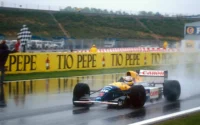
The low point was followed by one of Nakajima’s finest races. In a rain-soaked Australian Grand Prix, he spun early and ended the opening lap in last place. From there, he charged back through the field to finish fourth and record the race’s fastest lap.
Nakajima crossed the line just 4.648 seconds behind Riccardo Patrese’s third-placed Williams. The performance equalled his career-best result and drew praise even from former critics, including 1976 World Champion and BBC commentator James Hunt.
Tyrrell
Nakajima moved to Tyrrell for 1990, accompanied by the promise that the team would receive Honda V10 engines the following season.
Driving alongside rising French star Jean Alesi, Nakajima scored points in the United States, Italy and Japan. His total of three was overshadowed by Alesi’s 13, which included runner-up finishes in Phoenix and Monaco.
Tyrrell received the Honda engines for 1991, serviced by Mugen, and paired Nakajima with Stefano Modena. Nakajima opened the year by finishing fifth in Phoenix, earning the final two points of his Formula One career.
Modena scored ten points to Nakajima’s two, and the Japanese veteran left Grand Prix racing at the end of the season.
Honda’s prototype Formula One project
Nakajima remained closely involved with Honda after retiring from competition. The company had begun developing a complete Formula One car of its own, rather than serving solely as an engine supplier.
Honda chief executive Nobuhiko Kawamoto publicly acknowledged the project in October, and the RC100 was presented to the media in February 1993 with Nakajima behind the wheel. The chassis subsequently passed the required FISA crash tests and could therefore have formed the basis of a World Championship entry.
Two additional versions followed. The RC101 was intended for crash testing, while the RC101B was developed as a potential racing model. Nakajima conducted the 101B’s first public test at Suzuka in January 1994.
Honda ultimately abandoned the proposed works team as the consequences of Japan’s asset-price collapse took hold. The company instead concentrated on American engine programmes in CART and, later, the Indy Racing League.
Nakajima Racing
Nakajima had established his own team in 1984 while still competing, initially entering March chassis privately in Japanese Formula Two. The operation won three consecutive championships between 1984 and 1986.
After leaving the cockpit, Nakajima focused fully on developing the organisation. Nakajima Racing became a major presence in Japanese single-seater competition, winning four Formula Nippon Teams’ Championships between 1999 and 2009.
Its drivers also secured three Formula Nippon crowns: Tom Coronel in 1999, Toranosuke Takagi in 2000 and Ralph Firman in 2002.
The team continued into the Super Formula era and also maintained a programme in Super GT, extending Nakajima’s involvement in Japanese motorsport long beyond his own driving career.
Personal life
Nakajima continued to live in his family home near Okazaki. Both of his sons followed him into professional racing.
Kazuki Nakajima competed in Formula One for Williams during the 2007–2009 period before building a successful endurance career with Toyota Gazoo Racing. He retired after the 2021 FIA World Endurance Championship season and moved into a management position with Toyota.
His younger son, Daisuke, raced in British Formula Three during 2009 and 2010 before switching to sports cars and competing in Super GT. He retired at the conclusion of the 2019 season.
Grand Prix Stats
| Race Entries | 80 |
| Race Starts | 74 |
| Did Not Start | 1 |
| Best Race Start | 6th |
| Best Race Finish | 4th |
| Retirements | 37 |
| First-Lap Retirements | 3 |
| Not Classified | 2 |
| Disqualified | 0 |
| Did Not Qualify | 5 |
Qualifying
| Qualifying Sessions | 80 |
| Reached Q3 | 0 |
| Q2 Eliminations | 0 |
| Q1 Eliminations | 0 |
| Did Not Qualify | 5 |
Fastest Laps
| Fastest Laps | 1 |
| First Fastest Lap | 1989 Australian Grand Prix |
| Last Fastest Lap | 1989 Australian Grand Prix |
| Win + Fastest Lap | 0 |
| Most Consecutive Fastest Laps | 0 |
| Most Fastest Laps in a Season | 1 |
| Seasons with Fastest Laps | 1 |
Points
| Points Scored | 16 |
| Points Finishes | 10 |
| Most Points in a Single Season | 7 (1987) |
| Seasons with Points | 5 |
Stats by Season
| Year | Constructor | Entries | Starts | Wins | Podiums | Poles | Fastest Laps | Front Rows | DNF | Best Start | Best Result | Pts Finishes | Points | Championship |
|---|---|---|---|---|---|---|---|---|---|---|---|---|---|---|
| 1987 | Lotus | 16 | 16 | 0 | 0 | 0 | 0 | 0 | 5 | 11 | 4 | 4 | 7 | 11th |
| 1988 | Lotus | 16 | 14 | 0 | 0 | 0 | 0 | 0 | 6 | 6 | 6 | 1 | 1 | 16th |
| 1989 | Lotus | 16 | 13 | 0 | 0 | 0 | 1 | 0 | 7 | 12 | 4 | 1 | 3 | 21st |
| 1990 | Tyrrell | 16 | 15 | 0 | 0 | 0 | 0 | 0 | 10 | 9 | 6 | 3 | 3 | 15th |
| 1991 | Tyrrell | 16 | 16 | 0 | 0 | 0 | 0 | 0 | 9 | 10 | 5 | 1 | 2 | 15th |
Teammates & Qualifying Head-to-Head
| Teammate | Years | Races | Qualifying H2H |
|---|---|---|---|
| Ayrton Senna | 1987 | 16 | 0-16 |
| Nelson Piquet | 1988, 1989 | 32 | 4-28 |
| Jean Alesi | 1990 | 16 | 0-16 |
| Stefano Modena | 1991 | 16 | 1-15 |