




















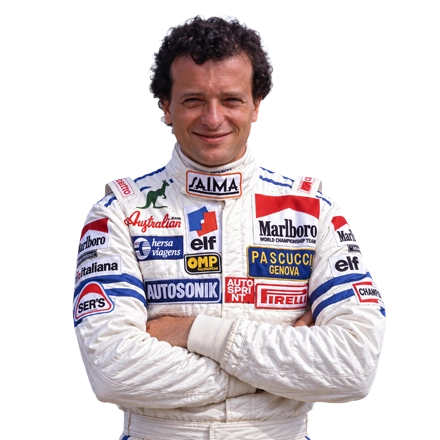
Mauro Baldi’s Formula One career produced points but no podiums; endurance racing brought him a world title and victories at Le Mans, Daytona and Sebring. Born in Reggio Emilia on 31 January 1954, the Italian began with rallying in 1972 before moving into Renault 5 competition in 1975.
Driver Bio
| Nationality | Italian |
| Birthplace | Reggio Emilia, Italy |
| Born | 31 January 1954 |
| First Grand Prix | 1982 South African Grand Prix |
| Last Grand Prix | 1985 San Marino Grand Prix |
| Years Active | 1982–1985 |
| Current/Last Team | Spirit |
Single-seaters revealed his potential. A Formula Three win at Monaco in 1980 was followed by the 1981 European F3 championship, secured with eight victories. That record carried him into F1 with Arrows in 1982, before a move to Alfa Romeo for 1983. Fifth at Zandvoort was the best championship result of his Grand Prix career.
Benetton‘s arrival as Alfa’s sponsor coincided with a change of line-up, and Baldi lost his seat. He continued with Spirit during 1984 and 1985, but the small team offered limited opportunities. Sports cars were already becoming important alongside F1, with drives for the Martini-backed Lancia programme in 1984 and 1985.
Baldi joined Richard Lloyd Racing’s Porsche operation in 1986, then moved to Sauber-Mercedes in 1988. In 1990 he and Jean-Louis Schlesser won the World Sportscar Championship, the greatest sustained championship achievement of Baldi’s career. Peugeot followed in 1991 and 1992, keeping him among the leading prototype drivers.
There were still occasional links to F1. A proposed appearance for Coloni in the 1989 Italian Grand Prix, replacing Enrico Bertaggia, was blocked by Mercedes motorsport chief Jochen Neerpasch. Baldi also tested the Lamborghini-powered car developed for the Modena project in 1990, but did not resume a Grand Prix racing career.
His finest individual endurance result arrived in 1994. Sharing the Dauer 962 with Yannick Dalmas and Hurley Haywood, Baldi won the Le Mans 24 Hours outright. It added the sport’s most famous endurance race to an already substantial record of prototype success.
In 1998, victory at Daytona with Doran Racing and a Sebring win alongside Arie Luyendyk and Didier Theys completed the classic endurance treble of Le Mans, Daytona and Sebring. He won Daytona again with Doran in 2002.
Baldi’s record illustrates how a driver’s most rewarding career can develop beyond F1. The European F3 title established his speed, and the Grand Prix years provided experience, but the world championship and the three great endurance victories made him one of his era’s most accomplished sports-car racers.
Grand Prix Stats
| Race Entries | 41 |
| Race Starts | 36 |
| Did Not Start | 0 |
| Best Race Start | 7th |
| Best Race Finish | 5th |
| Retirements | 19 |
| First-Lap Retirements | 1 |
| Not Classified | 1 |
| Disqualified | 0 |
| Did Not Qualify | 5 |
Qualifying
| Qualifying Sessions | 41 |
| Reached Q3 | 0 |
| Q2 Eliminations | 0 |
| Q1 Eliminations | 0 |
| Did Not Qualify | 5 |
Points
| Points Scored | 5 |
| Points Finishes | 4 |
| Most Points in a Single Season | 3 |
| Seasons with Points | 2 |
Stats by Season
| Year | Constructor | Entries | Starts | Wins | Podiums | Poles | Fastest Laps | Front Rows | DNF | Best Start | Best Result | Pts Finishes | Points | Championship |
|---|---|---|---|---|---|---|---|---|---|---|---|---|---|---|
| 1982 | Arrows | 15 | 11 | 0 | 0 | 0 | 0 | 0 | 3 | 16 | 6 | 2 | 2 | 22nd |
| 1983 | Alfa Romeo | 15 | 15 | 0 | 0 | 0 | 0 | 0 | 10 | 7 | 5 | 2 | 3 | 16th |
| 1984 | Spirit | 8 | 7 | 0 | 0 | 0 | 0 | 0 | 3 | 20 | 8 | 0 | 0 | NC |
| 1985 | Spirit | 3 | 3 | 0 | 0 | 0 | 0 | 0 | 3 | 24 | – | 0 | 0 | NC |
Teammates & Qualifying Head-to-Head
| Teammate | Years | Races | Qualifying H2H |
|---|---|---|---|
| Brian Henton | 1982 | 3 | 2-1 |
| Marc Surer | 1982 | 12 | 2-10 |
| Andrea de Cesaris | 1983 | 14 | 1-13 |