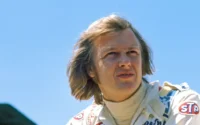





























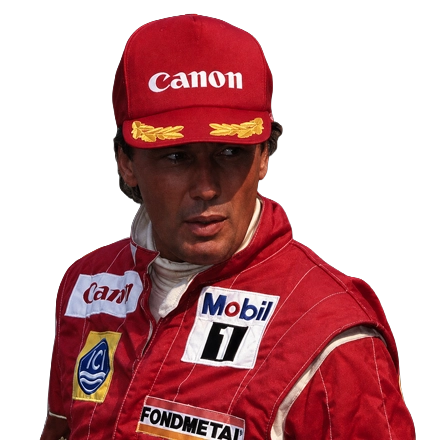
Born on 12 September 1948, Jean-Louis Schlesser is one of France’s most versatile and accomplished racing drivers. Over a career spanning several decades, he has competed at the highest level in circuit racing, sports cars, touring cars and cross-country rallying, earning success in almost every discipline he tackled.
Schlesser is also the nephew of former Formula One driver Jo Schlesser, but carved out a distinguished career entirely on his own. Although he made just two Formula One race appearances, he remains forever linked to one of the sport’s most famous moments after his collision with Ayrton Senna at the 1988 Italian Grand Prix. That incident denied McLaren a perfect season, making Monza the only race of the 1988 Formula One campaign not won by the dominant team.
Driver Bio
| Nationality | French |
| Birthplace | Nancy, France |
| Born | 12 September 1948 |
| First Grand Prix | 1983 French Grand Prix |
| Last Grand Prix | 1988 Italian Grand Prix |
| Years Active | 1983, 1988 |
| Current/Last Team | Williams |
Early career
Jean-Louis Schlesser spent much of his childhood in Morocco before returning to France, where he completed his studies and military service. His racing career began in the early 1970s after attending the famous racing school at Le Mans, initially competing in a variety of rally events before switching his focus to circuit racing.
In 1976, Schlesser graduated into Formula Three, dividing his time between the French and European championships over the next six seasons. One of his standout achievements came in 1978, when he shared the French Formula Three title with future four-time Formula One World Champion Alain Prost.
While building his single-seater career, Schlesser also expanded into sports car racing from 1977, proving equally competitive in endurance events. His first appearance at the 24 Hours of Le Mans came in 1981, where he produced an outstanding performance by finishing second alongside Philippe Streiff and Jacky Haran.
Touring cars became another important part of his programme from 1980, when he entered the French Supertouring Championship. He stepped up to Formula Two in 1982, although the move proved less successful than his Formula Three campaigns. Despite those challenges, Schlesser’s reputation remained strong enough to open the door to Formula One while he continued racing sports cars and touring cars.
Formula One
Before making his Formula One debut, Schlesser worked extensively as a test driver for Williams, gaining valuable behind-the-scenes experience with one of the sport’s leading teams.
His first opportunity to race an F1 car came in 1983, when he secured a drive with the RAM team in a March-RAM 01 powered by a Cosworth engine. His debut arrived at the non-championship Race of Champions at Brands Hatch, where he qualified last among the 13 starters before recovering to finish sixth.
A week later, Schlesser attempted to qualify for his home Grand Prix at Paul Ricard. However, after posting the slowest qualifying time among the 29 entrants, he failed to secure a place on the grid.
Although Formula One opportunities disappeared for the next five years, Schlesser remained closely involved with Williams as a test driver while continuing to enjoy success in sports car racing.
1988 Italian Grand Prix
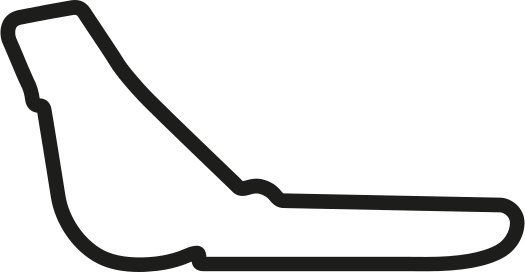
Schlesser’s most famous Formula One appearance came at the 1988 Italian Grand Prix at Monza.
Williams called him in as a late replacement for an ill Nigel Mansell, giving Schlesser his first World Championship Grand Prix start just one day before his 40th birthday. He qualified 22nd in a field where only 26 of the 31 entrants made the grid.
During the race, Schlesser climbed to 11th while Ayrton Senna comfortably led in his McLaren. With only three laps remaining, Senna caught Schlesser while attempting to lap him for a second time.
Approaching the tight Rettifilo chicane, Schlesser drifted wide, expecting Senna to pass on the inside. As he locked his brakes and tried to keep the Williams on the circuit, he turned back towards the apex. The move resulted in contact between Schlesser’s left-front wheel and Senna’s right-rear tyre.
The impact broke the McLaren’s rear suspension, sending Senna spinning into retirement. The incident handed Ferrari a memorable one-two finish at Monza through Gerhard Berger and Michele Alboreto, just weeks after the death of company founder Enzo Ferrari.
The collision also prevented McLaren from completing one of Formula One’s greatest seasons with victory in every race. Monza would prove to be the team’s only defeat of the entire 1988 World Championship, with Alain Prost already out of contention after retiring earlier in the race.
Following the race, Schlesser maintained that he did not believe the accident was entirely his responsibility. Nevertheless, he later made an emotional apology to Senna over the incident.
More than two decades later, at the 2013 Monaco Grand Prix, McLaren chairman Ron Dennis jokingly reintroduced himself by saying Schlesser was “the man who ruined my life and our perfect record back in 1988.” Schlesser replied that the defeat had simply kept McLaren “hungry” for future success.
Touring car and sports car racing
Away from Formula One, Schlesser built one of the strongest résumés in international sports car racing.
His first major touring car success came in 1985, when he won the French Touring Car Championship driving the Tom Walkinshaw Racing (TWR) Rover Vitesse. At the same time, he became a regular driver for the factory-backed TWR Jaguar team in the World Sportscar Championship.
The following season he expanded his touring car programme into the British Touring Car Championship, once again racing a TWR Rover Vitesse.
Schlesser’s career reached new heights in 1988 after joining the works Sauber–Mercedes team full-time. That season he won the German Supercup and finished runner-up in the World Sportscar Championship.
He went one better in 1989, securing the World Sportscar Championship title before successfully defending the crown in 1990, sharing championship honours with teammate Mauro Baldi.
His final World Sportscar Championship campaign came in 1991, where one of his teammates was a young Michael Schumacher, who was just beginning his rise to Formula One stardom.
Schlesser also demonstrated his versatility by winning the Classic Masters title at the 1994 Race of Champions.
Off-road racing
Having first sampled the Paris-Dakar Rally in 1984, Schlesser committed himself to cross-country rallying from 1989, beginning what would become arguably the most successful chapter of his career.
Never content with simply driving someone else’s machinery, Schlesser began designing and building his own competition buggies in 1992 for Dakar, European bajas and other desert rally raids.
His first creation, the Porsche-powered Schlesser Original, made an immediate impact by winning the Baja Portugal 1000 on its debut. Remarkably, Schlesser defeated the factory Citroën entries in a two-wheel-drive buggy while competing without a navigator.
Over the following years, Schlesser collected numerous overall victories and two-wheel-drive class wins before claiming outright success in the 1999 Granada-Dakar Rally and successfully defending his title in the 2000 Paris-Dakar-Cairo Rally.
Victory appeared within reach again in 2001, but his hopes were dashed after receiving a one-hour penalty for unsportsmanlike conduct following incidents involving his closest rival during the penultimate stage.
Even as factory teams invested heavily in four-wheel-drive machinery, Schlesser’s innovative buggies remained competitive. He returned to the Dakar podium with third overall in 2004, repeated the achievement in 2007, won multiple stages and regularly challenged the major manufacturers.
His team entered three cars for the 2008 Dakar Rally, but the event was cancelled because of terrorist security concerns. The team did not return when the rally moved to South America in 2009.
Schlesser’s dominance in rally raid competition extended far beyond Dakar. He won the FIA Cross Country Rally World Cup every year from 1998 to 2002, collected multiple 2WD FIA Cross Country Rally World Cup titles, and then achieved another remarkable streak by winning every edition of the Africa Eco Race from its inaugural event in 2009 through 2014.
Grand Prix Stats
| Race Entries | 2 |
| Race Starts | 1 |
| Did Not Start | 0 |
| Best Race Start | 22nd |
| Best Race Finish | 11th |
| Retirements | 0 |
| First-Lap Retirements | 0 |
| Not Classified | 0 |
| Disqualified | 0 |
| Did Not Qualify | 1 |
Qualifying
| Qualifying Sessions | 2 |
| Reached Q3 | 0 |
| Q2 Eliminations | 0 |
| Q1 Eliminations | 0 |
| Did Not Qualify | 1 |
Stats by Season
| Year | Constructor | Entries | Starts | Wins | Podiums | Poles | Fastest Laps | Front Rows | DNF | Best Start | Best Result | Pts Finishes | Points | Championship |
|---|---|---|---|---|---|---|---|---|---|---|---|---|---|---|
| 1983 | RAM | 1 | 0 | 0 | 0 | 0 | 0 | 0 | 0 | – | – | 0 | 0 | NC |
| 1988 | Williams | 1 | 1 | 0 | 0 | 0 | 0 | 0 | 0 | 22 | 11 | 0 | 0 | NC |
Stats by Constructor
| Constructor | Years | Entries | Starts | Wins | Podiums | Poles | Fastest Laps | Front Rows | DNF | Best Start | Best Result | Pts Finishes | Points |
|---|---|---|---|---|---|---|---|---|---|---|---|---|---|
| RAM | 1983 | 1 | 0 | 0 | 0 | 0 | 0 | 0 | 0 | – | – | 0 | 0 |
| Williams | 1988 | 1 | 1 | 0 | 0 | 0 | 0 | 0 | 0 | 22 | 11 | 0 | 0 |
Teammates & Qualifying Head-to-Head
| Teammate | Years | Races | Qualifying H2H |
|---|---|---|---|
| Eliseo Salazar | 1983 | 1 | 0-1 |
| Riccardo Patrese | 1988 | 1 | 0-1 |