




























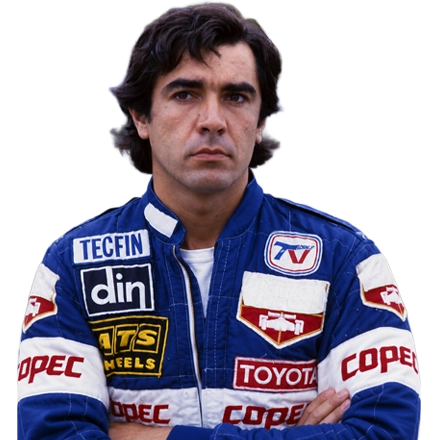
Eliseo Salazar Valenzuela (born 14 November 1954) is a Chilean former racing driver whose remarkably varied career encompassed Formula One, endurance racing, Indy cars, rallying and the Dakar Rally. He competed in Formula One from 1981 to 1983 and remains the only Chilean to have raced in the World Championship.
| Born | Eliseo Salazar Valenzuela 14 November 1954 Santiago, Chile |
| Nationality | Chilean |
|---|---|
| Active years | 1981–1983 |
| Teams | MarchMarch, Ensign, ATS, RAM |
| Entries | 37 (24 starts) |
| Championships | 0 |
| Wins | 0 |
| Podiums | 0 |
| Career points | 3 |
| Pole positions | 0 |
| Fastest laps | 0 |
| First entry | 1981 United States Grand Prix West |
| Last entry | 1983 Belgian Grand Prix |
Salazar made his Grand Prix debut at the 1981 United States Grand Prix West. Across 37 Formula One events, he scored three championship points. That relatively brief spell was only the opening act of a three-decade international career that later took him into American open-wheel racing and sports cars. He also became Chilean national rally champion in 1984 and 1985.
Career
Formula One: 1981–1983
Salazar’s path towards Formula One gathered momentum in the 1980 British Formula One Championship. Driving a Williams FW07, he won the BRDC International Trophy at Silverstone and earned his opportunity on the World Championship grid with March in 1981.
The arrangement did not last the full season. Salazar switched to Ensign midway through the year and secured his first championship point with sixth place at the Dutch Grand Prix.
For 1982, he moved to ATS. His strongest Formula One result came at the San Marino Grand Prix, where he finished fifth. Only seven teams contested the race amid the bitter political struggle between FISA and FOCA, but the points counted all the same.
Salazar’s most famous F1 moment arrived later that season in Germany, though not through a result he would have chosen. While being lapped, he collided with race leader Nelson Piquet and eliminated both cars. Piquet climbed from his stricken Brabham, marched over to Salazar and began punching and kicking him, creating one of Formula One’s most replayed confrontations.
A final campaign followed with RAM Racing in 1983. Salazar entered six Grands Prix, but the uncompetitive car allowed him to qualify only twice. He finished 14th at Jacarepaguá, then retired at Long Beach after suffering gearbox trouble.
Chile’s severe economic crisis during the early 1980s made sponsorship increasingly difficult to secure, forcing Salazar away from Formula One. Occasional appearances in International Formula 3000 and the South American Formula Three Championship brought limited success. Back home, however, he found fresh momentum in rallying and hill-climbing, winning the 1985 Chilean hill-climb championship in a Toyota Corolla XT.
Sports prototypes: 1988–1990
By the late 1980s, Salazar had turned towards the FIA World Sports Prototype Championship. His standout result came at the 1988 Fuji 1000 Kilometres, where he won the C1 class in a factory Spice SE88C-Ford.
A connection with Tom Walkinshaw then opened the door to Jaguar’s Silk Cut works team and the 24 Hours of Le Mans. Salazar shared a Jaguar XJR-9 with brothers Alain and Michel Ferté in 1989, bringing the car home eighth.
The following year produced a far stranger Le Mans story. Salazar spent several hours driving Jaguar’s No. 3 XJR-12, the car that would ultimately win the race. During the event, however, he was asked to surrender his place to Martin Brundle, whose original No. 1 Jaguar had retired after 14 hours with electrical problems. Salazar transferred to the No. 4 car, only for that machine to suffer mechanical failure at the 20-hour mark.
Brundle took the chequered flag in the No. 3, while Salazar—despite contributing to its successful run—was left outside the official winning crew. His sportsmanship during the reshuffle reportedly earned him Autosport magazine’s 1990 Sportsman of the Year award.
America: 1994–2002
A spell away from competition led Salazar into Chilean television, where he co-hosted Video Loco, the country’s version of America’s Funniest Home Videos, on Canal 13. Racing soon called him back.
In 1994, he joined Gianpiero Moretti in the Ferrari-Momo factory squad for the IMSA World Sports Car championship. Racing the new Ferrari 333 SP across the 1994 and 1995 seasons, Salazar collected victories and podium finishes. His performances were strong enough to revive an open-wheel career that had appeared finished more than a decade earlier.
Dick Simon Racing signed him for the 1995 CART Indy Car World Series. Salazar’s Indianapolis 500 debut was immediately memorable: starting last in 33rd position, he drove the No. 7 Cristal-Copec-Mobil 1 Lola-Cosworth all the way to fourth.
When American open-wheel racing split into CART and the newly established Indy Racing League in 1996, Salazar chose the IRL. He became one of the series’ leading regulars and recorded four top-ten finishes at the Indianapolis 500. His finest Speedway result came in 2000 with A. J. Foyt Enterprises, when he both started and finished third in a G-Force powered by an Oldsmobile Aurora engine.
Salazar claimed his only IRL victory at Las Vegas Motor Speedway in 1997 while driving for Team Scandia. That season also brought his lone appearance in a NASCAR-sanctioned event. He finished 17th in a Craftsman Truck Series road-course race at Watkins Glen.
His most productive IRL seasons were 2000 and 2001. Salazar placed fourth in the 2000 championship after recording five top-five results, then finished fifth in the standings the following year.
A serious testing accident at Indianapolis in 2002 forced him to miss several races. After considering his future, Salazar retired from Indy-car competition and returned his attention to sports cars. He subsequently raced in the American Le Mans Series with a Porsche 911 GT3 and a Ferrari 360.
Rallying, historic single-seaters and Dakar
Salazar returned to Chile and joined Hyundai’s official Rally Mobil squad in 2004. He contested the national championship in an N3-class, two-litre Hyundai Coupé GK.
In November 2005, he made a late appearance in the inaugural Grand Prix Masters race after replacing former Formula One world champion Alan Jones. Salazar remained in the series for its two 2006 events, held in Qatar and England.
Another rallying step followed in 2007. Driving an ING Team Mitsubishi Lancer Evolution IX, he moved into Rally Mobil’s faster N4 category and finished fifth in the class during his first season. In 2008, he established his own three-car team, fielding a trio of Lancer Evolution IXs in the same championship.
Meanwhile, Salazar had set himself an unusual motorsport target: to become the first driver to compete in the Monaco Grand Prix, the 24 Hours of Le Mans, the 24 Hours of Daytona, the Indianapolis 500 and the Dakar Rally.
He signed a preliminary agreement with Jean-Louis Schlesser to drive one of his buggies in the 2008 Lisboa–Dakar Rally, but was unable to secure sponsorship. The point became academic when the event itself was cancelled.
Salazar finally reached the Dakar in 2009, driving a McRae Prototype and finishing 88th. Plans for the 2010 edition placed him with Team Dakar USA in a third Hummer H3 alongside the entries of team owner Robby Gordon and French driver Eric Vigouroux.
Still keen to introduce new forms of competition at home, Salazar helped bring autocross—also known as solo racing—to Chile in 2013. The country’s first event was staged at Santiago’s Estadio Monumental on 6 April. That September, he travelled to Lincoln, Nebraska, to compete in the Sports Car Club of America Solo National Championships, driving a C Prepared Ford Mustang.
Personal life
Salazar’s son, also named Eliseo, was born on 15 May 2001. Motorsport arrived early: the younger Eliseo attended his first Indianapolis 500 when he was just eight days old.
Formula One World Championship
| Year | Entrant | Chassis | Engine | 1 | 2 | 3 | 4 | 5 | 6 | 7 | 8 | 9 | 10 | 11 | 12 | 13 | 14 | 15 | 16 | WDC | Pts |
|---|---|---|---|---|---|---|---|---|---|---|---|---|---|---|---|---|---|---|---|---|---|
| 1981 | March Grand Prix Team | March 811 | Ford Cosworth DFV 3.0 V8 | USW DNQ | BRA DNQ | ARG DNQ | SMR Ret | BEL DNQ | MON DNPQ | 18th | 1 | ||||||||||
| Ensign Racing | Ensign N180B | ESP 14 | FRA Ret | GBR DNQ | GER NC | AUT Ret | NED 6 | ITA Ret | CAN Ret | CPL Ret | |||||||||||
| 1982 | Team ATS | ATS D5 | Ford Cosworth DFV 3.0 V8 | RSA 9 | BRA Ret | USW Ret | SMR 5 | BEL Ret | MON Ret | DET Ret | CAN Ret | NED 13 | GBR DNQ | FRA Ret | GER Ret | AUT DNQ | SUI 14 | ITA 9 | CPL DNQ | 22nd | 2 |
| 1983 | RAM Automotive Team March | RAM March 01 | Ford Cosworth DFV 3.0 V8 | BRA 15 | USW Ret | FRA DNQ | SMR DNQ | MON DNQ | BEL DNQ | DET | CAN | GBR | GER | AUT | NED | ITA | EUR | RSA | NC | 0 | |
Teammates & Qualifying Head-to-Head
| Teammate | Years | Races | Qualifying H2H |
|---|---|---|---|
| Derek Daly | 1981 | 6 | 4-2 |
| Manfred Winkelhock | 1982 | 16 | 3-13 |
| Jean-Louis Schlesser | 1983 | 1 | 1-0 |