




















The 1982 FIA Formula One World Championship began on 23 January and concluded on 25 September, over 16 race weekends. At the end of the campaign, Keke Rosberg secured the World Drivers’ Championship, while Ferrari claimed the Constructors’ Championship.
Season
The season opened amid significant political tensions within the sport. At the South African Grand Prix, the opening round of the championship, drivers staged a strike as part of the broader FISA–FOCA conflict, a power struggle between governing bodies and team organisations over control of Formula One. The dispute continued later in the year, culminating in a partial boycott at the San Marino Grand Prix, where several teams refused to participate.
Tragically, the 1982 season was overshadowed by a series of fatal accidents and serious injuries. Gilles Villeneuve, one of Ferrari’s star drivers, was killed during qualifying for the Belgian Grand Prix, and just weeks later Riccardo Paletti lost his life in a crash at the start of the Canadian Grand Prix. Another major incident involved Didier Pironi, who had been leading the championship when he suffered a devastating crash during qualifying for the German Grand Prix, an accident that ended his Formula One career. These tragedies, along with several other serious incidents during the season, prompted the FIA to introduce new safety regulations for 1983 in an effort to improve driver protection. Motorsport journalist Nigel Roebuck later described the year as “an ugly year, pock-marked by tragedy, by dissension, by greed, and yet, paradoxically, it produced some of the most memorable racing ever seen.”
Despite the turbulence of the season, Keke Rosberg emerged as the eventual World Drivers’ Champion. Driving for Williams, Rosberg achieved the title through remarkable consistency rather than outright dominance. He won only a single race, the Swiss Grand Prix, yet consistently scored points throughout the year. By the end of the season, he secured the championship five points ahead of Didier Pironi and John Watson. Rosberg thus became only the second driver in F1 history to win the championship with just one victory during the season, following Mike Hawthorn in 1958.
The 1982 championship was notable for its extraordinary unpredictability. A total of eleven different drivers from seven teams won races, and no driver managed more than two victories throughout the season. At one stage, there was an unprecedented sequence of nine different race winners in nine consecutive Grands Prix, stretching from the Monaco Grand Prix to the Swiss Grand Prix.
In the Constructors’ Championship, Ferrari secured the title despite the difficult circumstances surrounding the team. After Villeneuve’s death, Ferrari replaced him with Patrick Tambay, while Pironi’s injury later in the season led to the return of 1978 World Champion Mario Andretti. Through consistent results, Ferrari accumulated enough points to win the championship, finishing five points ahead of McLaren, with Renault in third place.
Interestingly, Williams, the team that fielded Drivers’ Champion Keke Rosberg, finished only fourth in the Constructors’ Championship, just behind McLaren. This outcome made the 1982 season unique in Formula One history. Since the Constructors’ Championship was introduced in 1958, it remains the only time that the team of the World Drivers’ Champion finished outside the top three in the Constructors’ standings.
1982 Formula 1 Race Calendar
The following rounds were included on the provisional calendars but were cancelled:
| Grand Prix | Circuit | Original date |
|---|---|---|
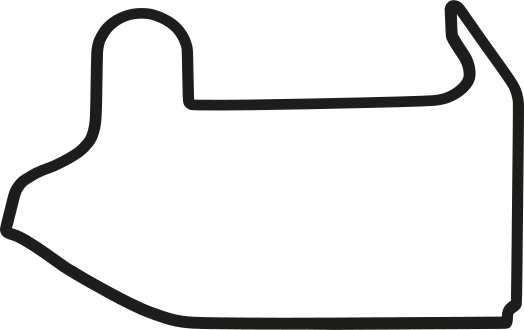
| Argentine Grand Prix | Autódromo Juan y Oscar Gálvez, Buenos Aires | 7 March |
| Spanish Grand Prix | Circuito Permanente Del Jarama, Madrid | 27 June |
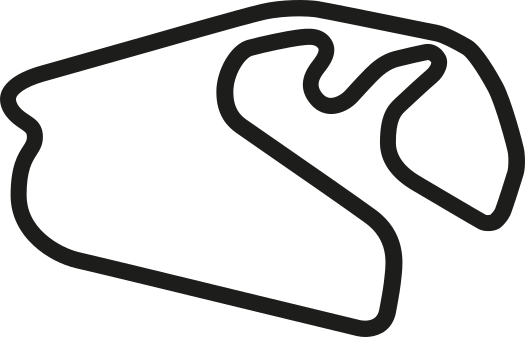
The Australian Grand Prix was a reserve race to be held at Ravenhall, on the outskirts of Melbourne, on 3 October.
The Argentine Grand Prix, originally scheduled for 7 March, was cancelled after several sponsors withdrew their support following uncertainty created by the drivers’ strike at the season’s opening race. The event was also affected by political unrest in Argentina, which further contributed to its removal from the calendar.
The Spanish Grand Prix was initially excluded from the schedule for a number of reasons. Drivers had expressed dissatisfaction with the Circuito del Jarama, which hosted the race the previous year. Additionally, the organisers had failed to pay the required fees for the 1981 season. Although the race was later reinstated for 27 June after the organisers settled their debts with the Formula One Constructors’ Association (FOCA), teams continued to protest against the venue. Concerns over the circuit’s narrow layout, dangerous conditions, and outdated facilities ultimately led to the event being cancelled.
Compared to the 1981 season, two new races were added to the calendar: the Detroit Grand Prix and the Swiss Grand Prix. Because motor racing had been banned in Switzerland since the 1955 Le Mans disaster, the Swiss Grand Prix was held at the Dijon-Prenois circuit in France. With the addition of Detroit, the United States hosted three Grands Prix in a single season. This remained the only instance of a country hosting more than two races in one season until 2020, when Italy also staged three Grands Prix.
1982 Formula 1 Race Results
2Didier Pironi set the fastest time in qualifying, but did not start the race after an accident during practice. Pole position was left vacant on the grid, but Pironi is still considered to have held pole position.
1982 Formula 1 Standings
Driver standings
| Pos | Driver | Nationality | Car | PTS |
|---|---|---|---|---|
| 1 | Keke Rosberg | FIN | Williams Ford | 44 |
| 2 | Didier Pironi | FRA | Ferrari | 39 |
| 2 | John Watson | GBR | McLaren Ford | 39 |
| 4 | Alain Prost | FRA | Renault | 34 |
| 5 | Niki Lauda | AUT | McLaren Ford | 30 |
| 6 | Rene Arnoux | FRA | Renault | 28 |
| 7 | Patrick Tambay | FRA | Ferrari | 25 |
| 7 | Michele Alboreto | ITA | Tyrrell Ford | 25 |
| 9 | Elio de Angelis | ITA | Lotus Ford | 23 |
| 10 | Riccardo Patrese | ITA | Brabham BMW | 21 |
| 11 | Nelson Piquet | BRA | Brabham BMW | 20 |
| 12 | Eddie Cheever | USA | Ligier Matra | 15 |
| 13 | Derek Daly | IRL | Williams Ford | 8 |
| 14 | Nigel Mansell | GBR | Lotus Ford | 7 |
| 15 | Carlos Reutemann | ARG | Williams Ford | 6 |
| 15 | Gilles Villeneuve | CAN | Ferrari | 6 |
| 17 | Andrea de Cesaris | ITA | Alfa Romeo | 5 |
| 17 | Jacques Laffite | FRA | Ligier Matra | 5 |
| 19 | Mario Andretti | USA | Ferrari | 4 |
| 20 | Jean-Pierre Jarier | FRA | Osella Ford | 3 |
| 20 | Marc Surer | SUI | Arrows Ford | 3 |
| 22 | Manfred Winkelhock | GER | ATS Ford | 2 |
| 22 | Eliseo Salazar | CHI | ATS Ford | 2 |
| 22 | Bruno Giacomelli | ITA | Alfa Romeo | 2 |
| 22 | Mauro Baldi | ITA | Arrows Ford | 2 |
| 26 | Chico Serra | BRA | Fittipaldi Ford | 1 |
Team standings
| Pos | Team | PTS |
|---|---|---|
| 1 | Ferrari | 74 |
| 2 | McLaren Ford | 69 |
| 3 | Renault | 62 |
| 4 | Williams Ford | 58 |
| 5 | Lotus Ford | 30 |
| 6 | Tyrrell Ford | 25 |
| 7 | Brabham BMW | 22 |
| 8 | Ligier Matra | 20 |
| 9 | Brabham Ford | 19 |
| 10 | Alfa Romeo | 7 |
| 11 | Arrows Ford | 5 |
| 12 | ATS Ford | 4 |
| 13 | Osella Ford | 3 |
| 14 | Fittipaldi Ford | 1 |