



























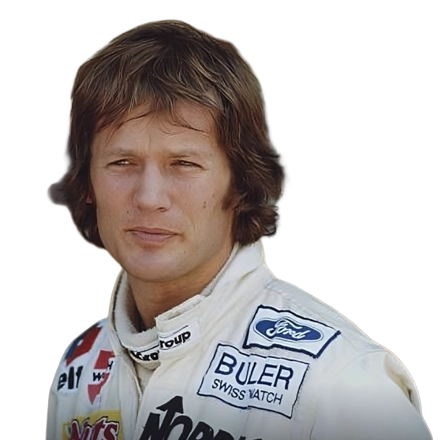
Marc Surer (born 18 September 1951) is a Swiss former racing and Formula One driver who later became a familiar voice in motorsport broadcasting. His Formula One career stretched from 1979 to 1986, during which he competed in 88 Grands Prix and scored 17 World Championship points.
| Born | 18 September 1951 Arisdorf, Switzerland |
|---|---|
| Spouses | Jolanda Egger (m. 1986; div. 1993) Christina Surer (m. 1997; div. 2000) Silvia Renée Arias (m. 2011) |
| Nationality | Swiss |
| Active years | 1979 – 1986 |
| Teams | Ensign, ATS, Theodore, Arrows, Brabham |
| Entries | 88 (82 starts) |
| Championships | 0 |
| Wins | 0 |
| Podiums | 0 |
| Career points | 17 |
| Pole positions | 0 |
| Fastest laps | 1 |
| First entry | 1979 Italian Grand Prix |
| Last entry | 1986 Belgian Grand Prix |
Born in Arisdorf, Switzerland, Surer came to motorsport relatively late, beginning kart racing at the age of 20. With circuit racing in Switzerland banned in the aftermath of the 1955 Le Mans disaster, anyone serious about building a racing career had little choice but to look beyond the country’s borders. For Surer, that meant Germany.
He moved there in 1974 and entered Formula Vee, quickly demonstrating that his late start had done little to blunt his natural speed. After finishing runner-up in the 1976 German Formula Three Championship, he climbed into European Formula Two and became part of the celebrated BMW Junior Team. By 1979, Surer had reached the top of the F2 ladder, winning the European Formula Two Championship for BMW in a works March-BMW.
That same year brought his Formula One debut, with Ensign at the 1979 Italian Grand Prix. A move to ATS followed for 1980, beginning a Formula One career that would include spells with Ensign, Theodore, Arrows, and Brabham. Surer never had machinery capable of making him a regular Grand Prix winner, but his speed earned him considerable respect — particularly when circumstances gave him an opportunity to show what he could do.
Racing career
Surer’s competitive story began with karting in 1972. Switzerland’s prohibition on circuit racing, introduced following the catastrophic 1955 Le Mans accident, meant he needed to travel if he wanted to progress, and in 1974 he relocated to Germany. His first major step came in Formula Vee, where he finished second in the German championship.
By 1976, Surer had graduated to Formula Three. His performances attracted the attention of Jochen Neerpasch, one of the most influential figures in BMW’s motorsport programme. Neerpasch recruited Surer to the BMW Junior Team, putting him alongside two other emerging talents, Eddie Cheever and Manfred Winkelhock.
The programme accelerated Surer’s career. Moving into Formula Two, he finished runner-up in the European championship in 1978. One year later he went one better, taking the 1979 European Formula Two title in a works March-BMW and establishing himself as one of the leading young drivers outside Formula One.
Formula One arrived before the end of that championship-winning year, although Surer’s early experiences at the top level were anything but straightforward.
He made his Grand Prix debut for Ensign at the 1979 Italian Grand Prix before joining ATS for the following season. At Kyalami during qualifying for the 1980 South African Grand Prix, Surer suffered a major accident and broke his legs. It was a brutal interruption just as his Formula One career was getting started.
Remarkably, South Africa would prove dramatic for him again. Racing for Ensign at Kyalami in 1981, Surer endured another difficult outing, but his season soon produced one of the defining performances of his Grand Prix career.
At the 1981 Brazilian Grand Prix, he drove the Ensign to fourth place — the team’s best Formula One result — and, even more impressively, recorded the fastest lap of the race. In machinery rarely expected to trouble the front runners, it was a striking demonstration of what Surer could produce when opportunity and circumstance aligned.
He subsequently raced for Theodore before finding greater stability with Arrows, where he spent several seasons and became an established Formula One presence. His continuing relationship with BMW would also play an important role in the next stage of his career.
With BMW support behind him, Surer joined Brabham for the 1985 season. The move placed him with one of Formula One’s most significant teams of the era and reunited him with BMW power. He returned to Arrows in 1986, but what might have been another full Formula One campaign was cut short by an accident away from Grand Prix racing.
During the 1986 ADAC Hessen-Rallye, Surer was competing in a Ford RS200 when he suffered a devastating crash. Surer was seriously injured, while his friend and co-driver Michel Wyder was killed. The accident effectively brought Surer’s Formula One racing career to an end midway through the 1986 season.
His association with motorsport, however, was nowhere near finished.
BMW retained Surer and put his considerable experience to use in a succession of roles. He worked as a driver and coach and later became involved at management level as a director of motorsport activities. Rather than disappearing from competition after his Formula One career, he remained an important part of BMW’s racing operation.
Surer also enjoyed further success in touring cars. In 1994 and 1995, working alongside Johnny Cecotto and Joachim Winkelhock, he was part of BMW’s successful campaigns in the German Super Touring Car Championship.
His career then took another turn — from the cockpit to the commentary box.
In 1996, Surer began covering Formula One as a television commentator for what became Sky Sport Germany, with the broadcaster previously operating as DF1 and Premiere. He worked alongside lead commentator Jacques Schulz, and the pairing became a long-running part of German-language Formula One television coverage.
When Schulz stepped away before the 2013 Formula One season, Surer remained with the broadcaster and continued his commentary work alongside Sascha Roos. He stayed in the role until 2017, meaning that his involvement with Formula One ultimately extended far beyond his seven-year career as a Grand Prix driver.
Across his Formula One career, Surer entered 88 Grands Prix and accumulated 17 World Championship points. The raw statistics tell only part of the story: much of his career was spent driving cars unlikely to challenge for victories, while performances such as Brazil 1981 demonstrated the speed he possessed when given the chance.
Formula One all-time ranking
Surer’s Formula One record received an unusual reassessment decades after he had stopped racing.
In 2016, an academic study attempted to separate the contribution of the driver from that of the machinery in Formula One. Using mathematical modelling to estimate the relative influence of car and driver on results, the researchers produced an all-time ranking of Formula One competitors.
The model placed Marc Surer 17th among the greatest Formula One drivers of all time.
It was a striking position for a driver who never won a Grand Prix and whose conventional career statistics could easily cause him to be overlooked. The study’s conclusion reflected the central difficulty in comparing Formula One drivers from different teams and eras: results are inevitably influenced by the competitiveness and reliability of the cars available to them.
For Surer, whose career included several drives for teams operating away from the front of the grid, the mathematical assessment painted a considerably stronger picture than his 17 championship points alone might suggest.
Personal life
Away from racing, Surer’s personal life has occasionally attracted attention of its own.
He has twice been married to former Playboy models. His first marriage was to Playmate Jolanda Egger. He later married Swiss racing driver and former model Christina Surer, with their marriage lasting from 1997 until 2000.
On 3 December 2011, Surer married his longtime partner Silvia Renée Arias.
From a late start in karting to a European Formula Two championship, Formula One, a serious rallying accident, touring-car success, BMW management responsibilities and more than two decades as a television motorsport expert, Surer built one of the more varied careers of his generation.
He may never have enjoyed the Grand Prix victories his ability hinted were possible, but his career became about considerably more than Formula One statistics. Surer survived an unforgiving period of the sport, produced memorable performances in modest machinery and then successfully translated his experience behind the wheel into a second career explaining Formula One to millions of viewers.
Complete Formula One World Championship results
| Year | Entrant | Chassis | Engine | 1 | 2 | 3 | 4 | 5 | 6 | 7 | 8 | 9 | 10 | 11 | 12 | 13 | 14 | 15 | 16 | WDC | Points |
|---|---|---|---|---|---|---|---|---|---|---|---|---|---|---|---|---|---|---|---|---|---|
| 1979 | Team Ensign | Ensign N179 | Cosworth V8 | ARG | BRA | RSA | USW | ESP | BEL | MON | FRA | GBR | GER | AUT | NED | ITA DNQ | CAN DNQ | USA Ret | NC | 0 | |
| 1980 | Team ATS | ATS D3 | Cosworth V8 | ARG Ret | BRA 7 | NC | 0 | ||||||||||||||
| ATS D4 | RSA DNS | USW | BEL | MON | FRA Ret | GBR Ret | GER 12 | AUT 12 | NED 10 | ITA Ret | CAN DNQ | USA 8 | |||||||||
| 1981 | Ensign Racing | Ensign N180B | Cosworth V8 | USW Ret | BRA 4 | ARG Ret | SMR 9 | BEL 11 | MON 6 | ESP | 16th | 4 | |||||||||
| Theodore Racing Team | Theodore TY01 | FRA 12 | GBR 11 | GER 14 | AUT Ret | NED 8 | ITA DNQ | CAN 9 | CPL Ret | ||||||||||||
| 1982 | Ragno Arrows | Arrows A4 | Cosworth V8 | RSA | BRA | USW | SMR | BEL 7 | MON 9 | DET 8 | CAN 5 | NED 10 | GBR Ret | FRA 13 | GER 6 | AUT Ret | ITA Ret | 21st | 3 | ||
| Arrows A5 | SUI 15 | CPL 7 | |||||||||||||||||||
| 1983 | Arrows Racing Team | Arrows A6 | Cosworth V8 | BRA 6 | USW 5 | FRA 10 | SMR 6 | MON Ret | BEL 11 | DET 11 | CAN Ret | GBR 17 | GER 7 | AUT Ret | NED 8 | ITA 10 | EUR Ret | RSA 8 | 15th | 4 | |
| 1984 | Barclay Nordica Arrows | Arrows A6 | Cosworth V8 | BRA 7 | RSA 9 | BEL 8 | FRA Ret | MON DNQ | CAN Ret | DET Ret | 20th | 1 | |||||||||
| Arrows A7 | BMW Str-4 t/c | SMR Ret | DAL Ret | GBR 11 | GER Ret | AUT 6 | NED Ret | ITA Ret | EUR Ret | POR Ret | |||||||||||
| 1985 | Olivetti Racing | Brabham BT54 | BMW Str-4 t/c | BRA | POR | SMR | MON | CAN 15 | DET 8 | FRA 8 | GBR 6 | GER Ret | AUT 6 | NED 10 | ITA 4 | BEL 8 | EUR Ret | RSA Ret | AUS Ret | 13th | 5 |
| 1986 | Barclay Arrows BMW | Arrows A8 | BMW Str-4 t/c | BRA Ret | ESP Ret | SMR 9 | MON 9 | BEL 9 | CAN | DET | FRA | GBR | GER | HUN | AUT | ITA | POR | MEX | AUS | NC | 0 |
Teammates & Qualifying Head-to-Head
| Teammate | Years | Races | Qualifying H2H |
|---|---|---|---|
| Jan Lammers | 1980 | 3 | 3-0 |
| Harald Ertl | 1980 | 1 | 1-0 |
| Mauro Baldi | 1982 | 12 | 10-2 |
| Chico Serra | 1983 | 4 | 4-0 |
| Alan Jones | 1983 | 1 | 1-0 |
| Thierry Boutsen | 1983, 1984, 1986 | 31 | 13-18 |
| Nelson Piquet | 1985 | 12 | 1-11 |