



















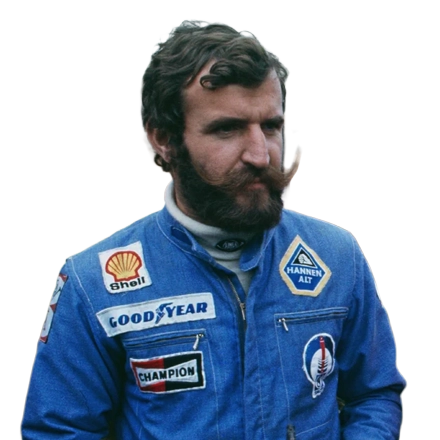
Harald Ertl (31 August 1948 – 7 April 1982) was an Austrian racing driver, touring car champion and motorsport journalist who competed in Formula One between 1975 and 1980. While he never scored World Championship points, Ertl built a respected career across Formula Two, touring cars and the Deutsche Rennsport Meisterschaft (DRM), where he claimed the 1978 championship. He is also remembered for his bravery in helping rescue Niki Lauda from his burning Ferrari during the 1976 German Grand Prix.
Driver Bio
| Nationality | Austrian |
| Birthplace | Zell am See, Austria |
| Born | 31 August 1948 |
| Died | 7 April 1982 |
| First Grand Prix | 1975 German Grand Prix |
| Last Grand Prix | 1980 German Grand Prix |
| Years Active | 1975–1978, 1980 |
| Current/Last Team | ATS |
Early Life
Born in Zell am See, Austria, on 31 August 1948, Ertl attended the same school as several future Formula One stars, including Jochen Rindt, Helmut Marko and Niki Lauda.
Instantly recognisable thanks to his distinctive Imperial-style moustache and full beard, Ertl combined his racing career with work as a respected motorsport journalist, becoming one of the best-known personalities in German-speaking motorsport during the 1970s.
Early Racing Career
Ertl began his competitive career in Formula Vee in 1969, purchasing his own Austro Vau chassis. He enjoyed immediate success, winning six races despite suffering a dramatic rollover at the Nürburgring.
The following year he finished runner-up in the European Formula Vee Cup driving a Kaimann before progressing to Formula Three. Although results were modest, he steadily built experience by competing throughout Germany, France and Britain.
At the same time, Ertl began racing touring cars, making his debut in the European Touring Car Championship in 1971 with Alfa Romeo. A third-place finish in the Monza 4 Hours hinted at his potential before he joined the factory-supported BMW Alpina team for the 1972 Deutsche Rennsport Meisterschaft (DRM).
Over the next few seasons he successfully balanced Formula Three, Formula Super Vee, Formula Two and touring car racing. A notable breakthrough came in 1973 when he and Derek Bell secured overall victory in the prestigious RAC Tourist Trophy.
In 1975, while competing in Formula Two with Fred Opert Racing, Ertl achieved his first podium finish. Strong performances, together with sponsorship from German brewery Warsteiner, provided the financial backing needed to make the step into Formula One.
Formula One Career
Ertl made his Formula One World Championship debut at the 1975 German Grand Prix, driving a privately sponsored Hesketh 308 in distinctive Warsteiner colours.
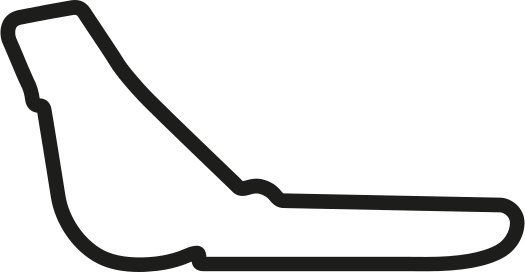
He finished eighth in his first Grand Prix before recording further top-ten finishes at Monza later that season. Encouraged by those performances, he remained with Hesketh for 1976, although the team struggled against increasingly competitive opposition.
Despite frequent mechanical failures and qualifying difficulties, Ertl produced several determined performances, narrowly missing a championship point with seventh place at the 1976 British Grand Prix.
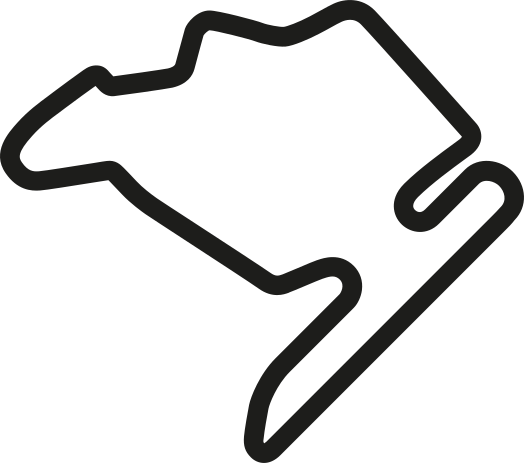
Two weeks later, during the German Grand Prix at the Nürburgring, Ertl became part of one of the most courageous moments in Formula One history. Following Niki Lauda‘s horrific first-lap accident, Ertl was one of four drivers who stopped to help pull the reigning World Champion from his burning Ferrari, an act widely praised throughout the sport.
He continued with Hesketh into 1977 before making a handful of appearances in a privateer Ensign and team ATS. His final Formula One attempt came at the 1980 German Grand Prix, after which he concentrated fully on touring car racing.
Deutsche Rennsport Meisterschaft
Away from Formula One, Ertl enjoyed far greater success in Germany’s premier touring car championship.
Returning to the Deutsche Rennsport Meisterschaft in 1977, he initially raced a Schnitzer-developed Toyota Celica Turbo before moving back to BMW machinery.
His finest season came in 1978, when driving for Schnitzer Motorsport he won five races and secured the Deutsche Rennsport Meisterschaft title, defeating some of Europe’s strongest Group 5 competitors.
Ertl switched to Zakspeed for the following two seasons to drive the spectacular Ford Capri Turbo. Although reliability often prevented him from converting strong qualifying performances into victories, he remained one of the championship’s fastest drivers, regularly claiming pole positions and race wins.
Journalism and Engineering
Alongside his racing commitments, Ertl established himself as a respected motorsport journalist, combining technical knowledge with first-hand racing experience. His dual role as both competitor and writer made him a familiar and trusted figure throughout European motorsport.
His engineering understanding also contributed to his success behind the wheel, particularly in the technically demanding Group 5 touring car era.
Death
Ertl stepped away from international competition during 1981 but planned to return the following year in the Renault 5 Turbo Cup.
Tragically, those plans never materialised. On 7 April 1982, he was travelling with members of his family in a Beechcraft Bonanza aircraft when engine failure caused it to crash near Hohenahr, close to Giessen, Germany.
Ertl was killed instantly along with the pilot, his brother-in-law Jörg Becker-Hohensee, and his young niece. His wife Vera and son Sebastian survived the accident with injuries. He was 33 years old.
Complete Formula One World Championship results
| Year | Entrant | Chassis | Engine | 1 | 2 | 3 | 4 | 5 | 6 | 7 | 8 | 9 | 10 | 11 | 12 | 13 | 14 | 15 | 16 | 17 | WDC | Pts |
|---|---|---|---|---|---|---|---|---|---|---|---|---|---|---|---|---|---|---|---|---|---|---|
| 1975 | Warsteiner Brewery | Hesketh 308 | Ford Cosworth DFV 3.0 V8 | ARG | BRA | RSA | ESP | MON | BEL | SWE | NED | FRA | GBR | GER 8 | AUT Ret | ITA 9 | USA | NC | 0 | |||
| 1976 | Hesketh Racing | Hesketh 308D | Ford Cosworth DFV 3.0 V8 | BRA | RSA 15 | USW DNQ | ESP DNQ | BEL Ret | MON DNQ | SWE Ret | FRA Ret | GBR 7 | GER Ret | AUT 8 | NED Ret | ITA 16 | CAN DNS | USA 13 | JPN 8 | NC | 0 | |
| 1977 | Hesketh Racing | Hesketh 308E | Ford Cosworth DFV 3.0 V8 | ARG | BRA | RSA | USW | ESP Ret | MON DNQ | BEL 9 | SWE 16 | FRA DNQ | GBR | GER | AUT | NED | ITA | USA | CAN | JPN | NC | 0 |
| 1978 | Sachs Racing | Ensign N177 | Ford Cosworth DFV 3.0 V8 | ARG | BRA | RSA | USW | MON | BEL | ESP | SWE | FRA | GBR | GER 11 | AUT Ret | NED DNPQ | NC | 0 | ||||
| ATS Engineering | ATS HS1 | ITA DNQ* | USA | CAN | ||||||||||||||||||
| 1980 | Team ATS | ATS D4 | Ford Cosworth DFV 3.0 V8 | ARG | BRA | RSA | USW | BEL | MON | FRA | GBR | GER DNQ | AUT | NED | ITA | CAN | USA | NC | 0 | |||
Teammates & Qualifying Head-to-Head
| Teammate | Years | Races | Qualifying H2H |
|---|---|---|---|
| Hector Rebaque | 1977 | 2 | – |
| Marc Surer | 1980 | 1 | – |