

























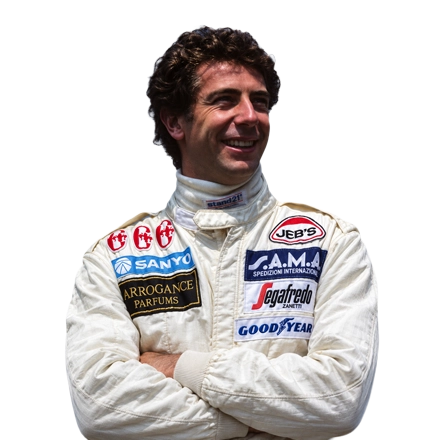
Johnny Cecotto became a motorcycle world champion at 19, scored a Formula One point for Theodore and later collected major touring-car titles. Few careers cover quite so much ground.
Driver Bio
| Nationality | Venezuelan |
| Birthplace | Caracas, Venezuela |
| Born | 25 January 1956 |
| First Grand Prix | 1983 Brazilian Grand Prix |
| Last Grand Prix | 1984 British Grand Prix |
| Current/Last Team | Toleman |
By reaching Formula One after competing at the highest level of motorcycle racing, Cecotto joined a small group whose best-known members included John Surtees and Mike Hailwood. The comparison concerns the breadth of their careers: Cecotto’s own championship successes came in motorcycles and touring cars, while his Grand Prix car-racing opportunity ended much earlier than he had intended. The Venezuelan’s reputation was established on two wheels, but his achievements on four ensured that the second half of his racing life was much more than a footnote.
Born Johnny Alberto Cecotto Persello in Caracas on 25 January 1956, he grew up around motorcycles. His parents were Italian immigrants, and his father, a national champion on a Norton 500, ran a motorcycle shop. Competition was close at hand, as were the machines and mechanical knowledge needed to begin.
Cecotto raced equipment including a Honda CB750 and Kawasaki triples before developing a relationship with Yamaha importer Venemotos. A TZ350 helped him win a national championship in 1973, aged 17, and he repeated that success in 1974. His helmet design paid tribute to Jarno Saarinen, who had died in 1973, with two pointed red stripes becoming part of Cecotto’s own racing identity.
International appearances began to broaden his experience. He won the South American championship, decided in a single event at Interlagos in 1974 and travelled to the major American and European meetings. The 1974 Daytona race brought 35th place, while mechanical problems ended his Imola appearance after five laps. The following year’s visit to Daytona would be a very different story.
Riding a Yamaha TZ750 in the 1975 Daytona 200, Cecotto qualified among established stars including Kenny Roberts, Gene Romero, Teuvo Länsivuori and Steve Baker. Fluid beneath his machine on the grid then threatened to end the challenge before it began. Once the problem was identified as water overflow, he was allowed to start, but from the back rather than his hard-earned position near the front.
What followed made his name in America. He passed roughly half the field on the opening lap, reached 26th by lap three, 18th by lap five and tenth by lap ten. On lap 50 he passed Giacomo Agostini for third. Rising temperatures forced him to ease his pace, leaving Romero and Baker ahead, but the recovery had supplied the race with one of its defining performances.
Its reputation endured. When an American Motorcyclist Association panel considered fifty years of Daytona racing in 1991, Cecotto’s ride was selected as the outstanding performance. For a teenager still establishing himself internationally, it had been an extraordinary introduction. A month later he won the Imola Formula 750 race, with Agostini suffering engine trouble and Roberts withdrawing because of a wrist injury.
His first Grand Prix meeting, at Paul Ricard in France, was even more decisive. Cecotto won the 250cc race and set fastest lap, then led throughout the 350cc event to beat Agostini by about 25 seconds. An intended limited European programme expanded as backing became available for a full campaign, including an ex-Agostini Yamaha TZ350.
The 1975 350cc championship developed into a contest between the young Venezuelan and one of motorcycle racing’s most established champions. Cecotto won in France, Italy and Finland, while Agostini won in Spain. The title went to Cecotto, who at 19 became the youngest motorcycle Grand Prix world champion at that time. That age record stood until Loris Capirossi won the 125cc crown in 1990.
Cecotto also challenged in the 250cc category. Two wins helped him finish fourth in the championship, just two points behind Dieter Braun. The final position could have been higher: he led other races before accidents or mechanical trouble intervened. Even allowing for those setbacks, his first full world championship campaign had produced an exceptional return.
Daytona in 1976 added another major victory. This time he was a factory Yamaha rider, and tyre wear became central to his duel with Roberts. Roberts encountered a puncture with nine laps remaining. Cecotto continued despite a late signal to pit, and reached the finish with his own tyre badly deteriorated. A year after the dramatic recovery drive, he had won the race outright.
The tyre problem had developed well before the final laps. Roberts began slowing on lap 33 of the 52-lap race, and the later failure nearly caused him to lose control. Cecotto’s crew signalled him with three laps remaining, but he continued. Examination of his tyres afterwards showed how little margin had remained. The victory depended on reaching the finish as much as on the pace that had established the leading pair.
The Grand Prix season was more complicated. He declined an offer to ride a Suzuki 500 and stayed with Venemotos, using a Yamaha YZR500 previously raced by Agostini. Second in France suggested immediate promise in the premier category, but falls and mechanical problems followed. After the Italian round he abandoned the 500cc campaign, finishing only 20th in the standings.
His 350cc title defence also failed, with Walter Villa taking the championship for Harley-Davidson. The season exposed the practical difficulties of trying to sustain a demanding international programme.
Those difficulties were not confined to the rider. Yamaha mechanic Vince French later described delays caused by entry paperwork, garage arrangements and equipment not being ready when required. Such problems could reduce valuable practice time before Cecotto even began working on the motorcycle’s performance. They form part of the explanation for a season in which a rapid rider and a championship-winning background did not translate into consistent results. Cecotto had the speed to win major races, but the results were no longer arriving with the remarkable regularity of 1975.
A serious accident at the 1977 Austrian Grand Prix caused a further interruption. Cecotto was involved in a four-rider collision in which Hans Stadelmann died. After recovering from his injuries, he returned strongly enough to finish second in Sweden, just 2.9 seconds behind Barry Sheene, then won the 500cc races in Finland and Czechoslovakia. He also won the Czech 350cc event.
Despite missing races, Cecotto finished fourth in the 1977 500cc championship. The results established him as a contender in the top class, rather than solely a champion of the smaller categories. His strongest premier-class championship placing arrived the following year.
In 1978 he won at Imola again and defeated Roberts by just a tenth of a second in the Dutch TT. Four podiums, offset by four mechanical retirements, left him third in the 500cc standings behind Roberts and Sheene. Another world title came in Formula 750, where three wins and three second places gave him the championship despite Roberts winning four races.
It was a useful demonstration of the difference between winning the most races and winning a championship. Cecotto’s second places supported his victories, giving him the overall advantage. The following year reversed the lesson: five Formula 750 wins were not enough to compensate for the results lost elsewhere, and he finished only third in the standings.
Injury disrupted 1979. A damaged kneecap at the Salzburgring kept him out for much of the season, and he rode the final four races in pain as Roberts secured another 500cc title. In Formula 750, Cecotto won five times but inconsistent results elsewhere left him third overall. Winning speed remained available; a complete championship campaign was becoming harder to assemble.
When Yamaha withdrew its factory support for 1980, Cecotto continued as a privateer, using a Bimota-Yamaha in the 350cc class and a production-based 500cc machine. A third Imola victory matched Roberts’s tally at the event. He also won the French 350cc Grand Prix and finished fourth in the French 500cc race, but reliability continued to limit his results.
He ended the year fourth in the 350cc championship and seventh in the 500cc standings, then retired from motorcycle racing at just 24. Two world titles, major international victories and successful performances in several engine classes already formed a substantial career. Cecotto, however, was preparing to begin another one.
The transition to cars started with Minardi in Formula Two in 1980. By 1982 he was a serious European F2 championship contender in a March-BMW, winning three races and finishing level on points with Corrado Fabi. The title was decided on the tie-break, leaving Cecotto runner-up by the narrowest competitive margin.
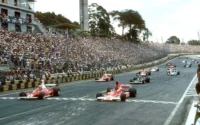
Formula One followed in 1983. His first appearance came on 13 March, and in only his second race, at Long Beach, he finished sixth for Theodore to score a championship point. The result suggested a promising conversion from motorcycles to the most demanding category of car racing, but the team’s financial difficulties limited what followed. Theodore missed the final two rounds.
For 1984 Cecotto joined Toleman alongside Ayrton Senna. The pairing offered a new opportunity, but his F1 career ended during qualifying for the British Grand Prix. An accident at Westfield left him with both legs broken, and he never returned to a Grand Prix grid. His record comprised 23 entries and one point; not every entry had produced a race start.
That point remained a significant Venezuelan benchmark until Pastor Maldonado‘s later F1 career, which included victory in the 2012 Spanish Grand Prix. Cecotto’s own focus moved elsewhere after his recovery, towards cars that looked closer to those on the road but demanded no less precision in competition.
BMW became central to his touring-car career. With Schnitzer in 1985, he finished second at the Spa 24 Hours alongside Dieter Quester and Markus Oestreich. At Bathurst, sharing a BMW 635 CSi with Roberto Ravaglia, he also finished second overall, an impressive result on his first visit to the demanding Mount Panorama circuit.
The pair shared the race’s Rookie of the Year award, and the BMW was the same car Cecotto had raced at Spa. During practice, former motorcycle rival Gregg Hansford explained that motorcycles also raced at Mount Panorama. Cecotto was surprised by the prospect of tackling the course on two wheels. Coming from a rider with world titles and major international wins, the reaction offered a telling illustration of the circuit’s demands.
For 1986 he switched to RAS Sport’s Volvo 240 Turbo programme with Thomas Lindström. Two wins, at Hockenheim and Zolder, plus two second places and two thirds helped him finish eighth in the European touring-car series. The season also brought victory in Macau’s Guia race and an InterTEC 500 win at Fuji with Anders Olofsson. His ability to adapt was now being demonstrated across very different touring cars.
The inaugural World Touring Car Championship in 1987 put him back in a BMW, this time an M3 for CiBiEmme alongside Gianfranco Brancatelli.
Volvo had withdrawn at the end of 1986, prompting another change of manufacturer. Brancatelli brought his own strong touring-car record as a joint winner of the 1985 European title. Their Dijon victory came in the 500-kilometre de Bourgogne, the third round of the new world series, and gave the partnership a major early result. A win at Dijon was the clearest success. At Bathurst they finished seventh overall but were the leading crew registered for world championship points, an important distinction in an event with a broad and competitive entry. Cecotto finished eighth in the championship with 158 points.
Further national and international titles followed. He became Italian touring-car champion in 1989 and was a major DTM contender during his 1988–92 spell in the series, finishing runner-up with Schnitzer in 1990. His racing calendar continued to combine championship campaigns with the major endurance events, drawing on experience built across several forms of competition.
That versatility brought victory at the Spa 24 Hours in 1990 and the Nürburgring 24 Hours in 1992. He later added the 1997 Mil Milhas in Brazil. These were substantial achievements in their own right, requiring a different approach from a Grand Prix sprint or a motorcycle race, and they helped establish Cecotto as a leading touring-car and endurance performer.
The German Super Touring Cup supplied another pair of championships, in 1994 and 1998. Between those successes he contested the British Touring Car Championship for BMW in 1995, taking his touring-car career into another fiercely competitive national series. His name had become associated with BMW machinery across much of Europe, although the earlier Volvo results demonstrated that his success was not confined to one marque.
A further change of car produced more titles at the beginning of the next decade. Driving an Irmscher Opel Omega in V8Star, Cecotto won the championship in both 2001 and 2002. The powerful silhouette cars were a long way from the small motorcycles of his youth, but the outcome was familiar: another competitive category mastered, and another pair of championship trophies.
In later years, attention increasingly turned towards the racing careers of his sons, Johnny Jr and Jonathan. Their progress extended a family connection to the sport that had begun with Cecotto’s father and the motorcycle business in Caracas. By then, the elder Johnny had accumulated a record that could not sensibly be reduced to a single championship or type of vehicle.
His Formula One spell was short and ended through injury just as he was gaining experience. Around it sits a much larger story: a teenage motorcycle world champion, a Daytona winner, an F2 title challenger, a Grand Prix points scorer and a multiple touring-car champion. Cecotto’s career rewards a wide-angle view, because some of its finest chapters happened far from the F1 paddock.
Grand Prix Stats
| Race Entries | 23 |
| Race Starts | 18 |
| Did Not Start | 0 |
| Best Race Start | 15th |
| Best Race Finish | 6th |
| Retirements | – |
| First-Lap Retirements | 0 |
| Not Classified | 0 |
| Disqualified | 0 |
| Did Not Qualify | 4 |
Qualifying
| Qualifying Sessions | – |
| Reached Q3 | – |
| Q2 Eliminations | 0 |
| Q1 Eliminations | 0 |
| Did Not Qualify | 4 |