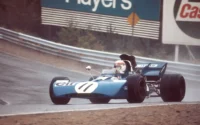



























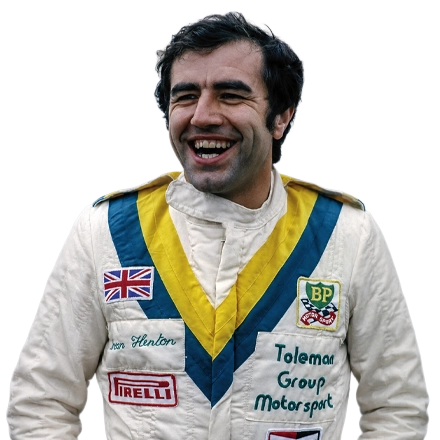
Brian Henton (born 19 September 1946) is a former British racing driver whose career took him from a relatively late start in club-level competition all the way to Formula One. Along the way, he won both the British Formula Three Championship in 1974 and the European Formula Two Championship in 1980. Henton competed in 37 Formula One Grands Prix, making his World Championship debut on 19 July 1975. Despite some memorable performances, he never managed to score a championship point.
Driver Bio
| Born | 19 September 1946 Chaddesden, Derbyshire, United Kingdom |
|---|---|
| Nationality | British |
| Active years | 1975, 1977, 1981–1982 |
| Teams | Lotus, non-works March, Boro, Toleman, Arrows, Tyrrell |
| Entries | 37 (19 starts) |
| Championships | 0 |
| Wins | 0 |
| Podiums | 0 |
| Career points | 0 |
| Pole positions | 0 |
| Fastest laps | 1 |
| First entry | 1975 British Grand Prix |
| Last entry | 1982 Caesars Palace Grand Prix |
Career
Nicknamed “Superhen” by the British motor-racing press, Henton was hardly born into the sort of surroundings normally associated with a future Grand Prix driver. Raised in a modest council-house background, he was already 23 before he began racing — comparatively ancient in a sport where many careers are now mapped out during childhood.
Once he got started, though, Henton was not short of either speed or ambition. After winning the relatively modest British Formula Vee championship in 1971, he demonstrated an early understanding of the value of publicity by promptly announcing that he intended to become World Champion. He never quite managed to make good on that prediction, but it was hardly empty bravado: Henton went on to build an impressive reputation in Formula Three and Formula Two, becoming one of the strongest British single-seater racers of his generation outside Formula One.
His breakthrough season came in 1974, when Henton swept the board in British Formula Three, winning both of the country’s major F3 championships. That success helped propel him towards Formula One, and in 1975 he was handed his Grand Prix opportunity with Lotus.
On paper, joining Lotus sounded like the sort of break a young driver dreamed about. In reality, Henton had arrived at precisely the wrong moment. The once-mighty Lotus 72 had reached the end of its competitive life, while its intended successor, the Lotus 76, had failed to deliver. The team was struggling to rediscover the form that had made it a dominant force, leaving Henton with little opportunity to turn his prestigious drive into meaningful results.
From 1975 to 1978, Henton divided his attention between Formula One and Formula Two. His F1 adventures even included running a privately entered March through his own British Formula One Racing Team, an ambitious undertaking that illustrated both his determination and his willingness to make opportunities rather than simply wait for them. Nevertheless, he struggled to establish a permanent foothold in either championship during this period.
His career received a major second wind in Formula Two. Joining Toleman, Henton put together an outstanding 1980 campaign and captured the European Formula Two Championship. It was a significant title in an era when F2 was packed with serious talent and served as one of the principal proving grounds for prospective Grand Prix drivers.
Toleman duly graduated to Formula One for 1981 and took its champion with it. Unfortunately for Henton, the team’s first Grand Prix car was nowhere near as successful as its Formula Two machinery. The original Toleman-Hart was overweight, underdeveloped and desperately difficult to qualify in an intensely competitive field. Henton spent much of the season fighting simply to make the starting grid and succeeded only once.
For 1982, he remained in Formula One, making appearances with Arrows before moving to Tyrrell. Championship success continued to prove elusive, and Henton finished his World Championship career without a point. Yet tucked away in that otherwise frustrating season was one extraordinary statistic that ensured his name a permanent little corner of Formula One history.
At the 1982 British Grand Prix, Henton recorded the fastest lap of the race. Remarkably, he remains the only driver in F1 history to have set an official fastest lap yet never scored a World Championship point. It is a wonderfully Henton-esque distinction: genuine Grand Prix speed, demonstrated beyond argument by the stopwatch, without the championship results normally expected to accompany it.
There was one final appearance to come. Henton’s last Formula One outing took place at the Race of Champions at Brands Hatch in April 1983. It was an appropriately unusual finale, because the event itself became historic: it proved to be the last non-championship Formula One race of the modern era. Henton therefore bowed out of F1 as part of the closing chapter of a tradition that had once been a regular feature of Grand Prix racing.
His racing career had been unconventional from beginning to end. He started late, came from modest circumstances, confidently declared his World Championship intentions after winning Formula Vee, conquered British Formula Three, became European Formula Two champion and repeatedly fought his way into Formula One without ever enjoying machinery capable of turning his efforts into points. His 38 Grand Prix appearances tell only part of the story.
After stepping away from professional motor racing, Henton returned to the business world. He resumed running a car dealership before moving into property development, and in later years broadened his interests into other sectors, notably engineering.
He has not completely disappeared from the motoring world, either. Henton has occasionally returned to the cockpit at historic motorsport events, giving later generations the chance to see “Superhen” back behind the wheel. Away from racing and business, he has also hosted equestrian events at his home, Ingarsby Hall in Leicestershire.
Henton may never have achieved the World Championship he boldly predicted at the beginning of his career, but his record contains plenty worth remembering: a double British Formula Three champion, European Formula Two champion, Lotus Formula One driver and the holder of one of Grand Prix racing’s most curious records. For a man who did not even start racing until the age of 23, “Superhen” travelled a very long way indeed.
Complete Formula One World Championship results
| Year | Entrant | Chassis | Engine | 1 | 2 | 3 | 4 | 5 | 6 | 7 | 8 | 9 | 10 | 11 | 12 | 13 | 14 | 15 | 16 | 17 | WDC | Points |
|---|---|---|---|---|---|---|---|---|---|---|---|---|---|---|---|---|---|---|---|---|---|---|
| 1975 | John Player Team Lotus | Lotus 72F | Ford Cosworth DFV 3.0 V8 | ARG | BRA | RSA | ESP | MON | BEL | SWE | NED | FRA | GBR 16 | GER | AUT DNS | ITA | USA NC | NC | 0 | |||
| 1977 | Rothmans International Racing | March 761B | Ford Cosworth DFV 3.0 V8 | ARG | BRA | RSA | USW 10 | NC | 0 | |||||||||||||
| British Formula One Racing Team | March 761 | ESP DNQ | MON | BEL | SWE | FRA | GBR DNQ | GER | AUT DNQ | |||||||||||||
| HB Bewaking Alarmsystemen | Boro 001 | NED DSQ | ITA DNQ | USA | CAN | JPN | ||||||||||||||||
| 1978 | Durex Team Surtees | Surtees TS20 | Ford Cosworth DFV 3.0 V8 | ARG | BRA | RSA | USW | MON | BEL | ESP | SWE | FRA | GBR | GER | AUT PO‡ | NED | ITA | USA | CAN | – | – | |
| 1981 | Candy Toleman Motorsport | Toleman TG181 | Hart 415T 1.5 L4 t | USW | BRA | ARG | SMR DNQ | BEL DNQ | MON DNPQ | ESP DNQ | FRA DNQ | GBR DNQ | GER DNQ | AUT DNQ | NED DNQ | ITA 10 | CAN DNQ | CPL DNQ | NC | 0 | ||
| 1982 | Ragno Arrows | Arrows A4 | Ford Cosworth DFV 3.0 V8 | RSA DNQ | BRA DNQ | USW Ret | NC | 0 | ||||||||||||||
| Team Tyrrell | Tyrrell 011 | SMR Ret | BEL Ret | MON 8 | DET 9 | CAN NC | NED Ret | GBR 8 | FRA 10 | GER 7 | AUT Ret | SUI 11 | ITA Ret | CPL 8 | ||||||||
Complete Formula One Non-Championship results
| Year | Entrant | Chassis | Engine | 1 |
|---|---|---|---|---|
| 1977 | British Formula One Racing Team | March 761 | Ford Cosworth DFV 3.0 V8 | ROC 4 |
| 1983 | Theodore Racing Team | Theodore N183 | Ford Cosworth DFV 3.0 V8 | ROC 4 |
Teammates & Qualifying Head-to-Head
| Teammate | Years | Races | Qualifying H2H |
|---|---|---|---|
| Jim Crawford | 1975 | 1 | – |
| Ronnie Peterson | 1975 | 3 | – |
| Derek Warwick | 1981 | 12 | – |
| Mauro Baldi | 1982 | 3 | – |
| Michele Alboreto | 1982 | 13 | – |