





























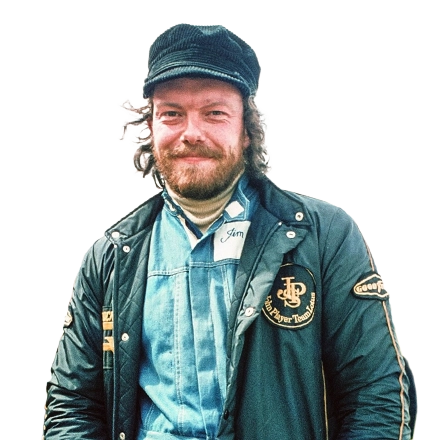
James Alan Crawford (13 February 1948 – 6 August 2002) was a Scottish racing driver whose career spanned Formula Atlantic, Formula One, Can-Am, CART and the Indianapolis 500. Although his Formula One career was brief, Crawford enjoyed considerable success in British single-seater racing, winning the 1982 British Formula One Championship, before forging a career in American open-wheel racing. He is also remembered as the 500th driver to start a Formula One World Championship Grand Prix.
Driver Bio
| Nationality | British |
| Birthplace | Dunfermline, Scotland, UK |
| Born | 13 February 1948 |
| Died | 6 August 2002 |
| First Grand Prix | 1975 British Grand Prix |
| Last Grand Prix | 1975 Italian Grand Prix |
| Current/Last Team | Lotus |
Early career
Born in Scotland, Crawford’s first experience of motorsport came in rallying, where he competed in a Mini. An unsuccessful spell in Formula Ford followed before his fortunes changed when friend Stephen Choularton offered him a drive with SDC Racing in Formula Atlantic.
After impressing in several Formula Libre races at Croft, Crawford became a regular front-runner in Formula Atlantic alongside Choularton’s team. His performances attracted the attention of Lotus Cars, who invited him to undertake a Formula One test, highlighting the promise he had shown in the junior categories.
Formula One career
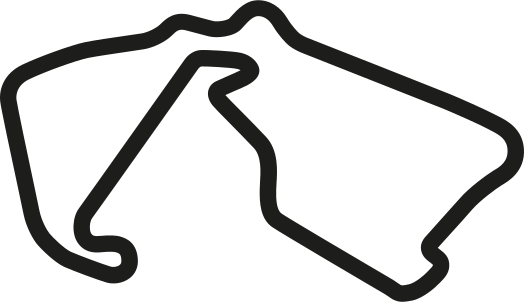
Crawford made his Formula One World Championship debut at the 1975 British Grand Prix, becoming the 500th driver to start a World Championship race. He contested two Grands Prix during the season but was unable to score World Championship points.
Although his time in Formula One was short, Crawford remained highly competitive in domestic single-seater racing and continued to build his reputation in Britain.
His greatest success came in 1982 when he won the British Formula One Championship, demonstrating the speed and consistency that had made him one of Britain’s leading Formula Atlantic drivers during the previous decade.
American racing career
During the early 1980s, Crawford relocated to the United States, where he established himself as a highly competitive Indy car and Can-Am driver.
He twice finished runner-up in the Can-Am Championship before making an impressive CART debut at Long Beach in 1984, finishing fourth. His performances quickly earned him regular entries in the Indianapolis 500, where he became particularly associated with the powerful but unpredictable Buick V6-powered cars.
Indianapolis 500
In 1987, he suffered a heavy practice accident that caused serious leg injuries and threatened to end his racing career. After months of rehabilitation, he returned remarkably for the 1988 Indianapolis 500, joining King Racing shortly before practice began.
Still relying on a walking cane around the paddock, Crawford quietly qualified for the race before producing one of the standout drives of his career on race day. While Penske dominated much of the event, Crawford emerged as their principal challenger and became the only driver outside the Penske team to lead the race, spending eight laps at the front.
Driving aggressively through traffic, he maintained an impressive pace and was running second with only six laps remaining. However, after sliding in Turn Three and flat-spotting his tyres, he was forced to pit for fresh rubber. Delays during the stop cost him valuable time and a lap, leaving him to finish sixth.
Although disappointing after running so close to the front, the result represented the best-ever Indianapolis 500 finish at that time for the Buick V6 engine and earned Crawford widespread praise for one of the drives of the race.
Later Indianapolis campaigns
Expectations were high when Crawford returned in 1989. He qualified fourth—the fastest non-Chevrolet-powered entry—but mechanical problems ended his challenge during the race.
Another spectacular accident followed during practice for the 1990 Indianapolis 500 when his car became airborne after striking the wall. Fortunately, he escaped serious injury and recovered to finish 15th in the race.
His final major opportunity came in 1992 after rejoining King Racing. Driving another Buick-powered car, Crawford and teammate Roberto Guerrero dominated practice, with Crawford setting an unofficial lap of 233.433 mph, an all-time practice record at the circuit.
Engine failures, however, ruined his chances of challenging for pole position. Rain delayed qualifying long enough for one replacement engine to be fitted, only for a second engine to fail during qualifying itself. Although he ultimately posted the sixth-fastest speed, qualifying regulations placed him 21st on the starting grid as a second-day qualifier.
On race day he again showed competitive pace before crashing on lap 75 in an accident that also eliminated four-time Indianapolis 500 winner Rick Mears.
Crawford made his final Indianapolis 500 start in 1993 before unsuccessful attempts to qualify in 1994 and 1995 brought his driving career to a close.
Personal life
Following his retirement from racing, Crawford settled in St. Petersburg, Florida, where he operated a fishing charter business using a boat he had purchased after leaving competition.
James Crawford died from liver failure on 6 August 2002 at the age of 54. He was survived by his second wife, Annie, and by his two children from his first marriage, Geoffrey and Emily.
Grand Prix Stats
| Race Entries | 2 |
| Race Starts | 2 |
| Did Not Start | 0 |
| Best Race Start | 25th |
| Best Race Finish | 13th |
| Retirements | 1 |
| First-Lap Retirements | 0 |
| Not Classified | 0 |
| Disqualified | 0 |
| Did Not Qualify | 0 |
Qualifying
| Qualifying Sessions | 2 |
| Reached Q3 | 0 |
| Q2 Eliminations | 0 |
| Q1 Eliminations | 0 |
| Did Not Qualify | 0 |