


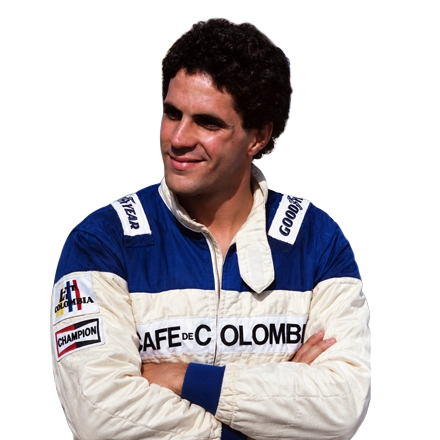
Roberto José Guerrero Isaza (born 16 November 1958) is a Colombian-American former racing driver who competed in Formula One, CART and the Indy Racing League. In 1982, he became the first Colombian to start a Formula One Grand Prix.
Driver Bio
| Nationality | Colombian |
| Birthplace | Medellin, Colombia |
| Born | 16 November 1958 |
| First Grand Prix | 1982 Brazilian Grand Prix |
| Last Grand Prix | 1983 European Grand Prix |
| Current/Last Team | Theodore Racing |
Guerrero entered 29 Grands Prix across two seasons but scored no championship points. Concluding that competitive Formula One machinery was unlikely to come his way, he moved to the United States for 1984 and was immediately named both CART and Indianapolis 500 Rookie of the Year.
His American career promised even more than its two CART victories ultimately delivered. Guerrero twice finished second at Indianapolis, recorded five top-five results there and held the circuit’s qualifying-speed record from 1992 until 1996. His most famous heartbreak came in 1992, when he crashed on the parade lap after qualifying on pole. He was also selected for the 1988 International Race of Champions.
Guerrero became a naturalized United States citizen in 1989. He and his wife have three children and settled in San Juan Capistrano, California. After leaving circuit racing, he turned to off-road competition, beginning with the Baja 2000 and later entering Baja 1000 events and leading tours of the peninsula with Wide Open Baja.
Early career
Karting
Guerrero started kart racing in 1972. During the next five years, he won two Colombian national championships and placed third in the 1975 Pan American Karting Championship.
He enrolled at the Jim Russell Racing School in 1977 and immediately demonstrated his ability. Across six school races, Guerrero won five and finished second in the other.
Formula Ford and Formula Three
Moving to Britain in 1978, Guerrero collected eight victories in Formula Ford 1600.
He then joined Angila Cars in the British Formula Three Championship, driving an Argo JM3-Toyota to ninth in the standings with 15 points. A parallel European Formula Three campaign in the same car produced two points and 25th overall.
Guerrero returned to British Formula Three with Argo Racing Cars in 1980. He won five times—twice at Thruxton and once each at Cadwell Park, Brands Hatch and Oulton Park—and tied Kenneth Acheson for second in the championship on 95 points.
Formula Two
Maurer Motorsport signed Guerrero for the 1981 European Formula Two season. Driving the BMW-powered MM81, he won the Jochen Rindt Memorial Trophy at Thruxton and recorded fourth places at Enna-Pergusa and Misano. Sixteen points placed him seventh in the championship.
Formula One
Ensign
Guerrero joined Ensign for 1982, backed by Café de Colombia and Moda Caribu. His intended debut at the South African Grand Prix was derailed when former Formula Two employer Willy Maurer obtained an injunction against Ensign team principal Morris Nunn. Guerrero was withdrawn, with Nunn’s official statement claiming he was not in an appropriate physical or mental condition to drive.
He returned with Ensign’s newer N181 in Brazil but failed to qualify. Guerrero finally made the grid at the United States Grand Prix West, starting 19th and being classified 15th after crashing on lap 27. In doing so, he became Colombia’s first Formula One starter.
Ensign skipped San Marino amid the FISA–FOCA dispute, and Guerrero subsequently missed the grid in Belgium. Monaco presented an unusual problem when Avon withdrew from Formula One and left Ensign without a current tyre supply. The team sourced older rubber, but Guerrero could not qualify.
Michelin began supplying Ensign from Detroit, where Guerrero started an encouraging 11th before crashing after six laps. He subsequently failed to qualify only in the Netherlands and France. His best Formula One result arrived at the German Grand Prix, where he finished eighth.
At the Caesars Palace finale, Guerrero qualified 15th, but an engine failure during the warm-up prevented him from starting. With no points, he went unclassified in the championship.
Theodore
Ensign merged with Theodore Racing for 1983, giving Guerrero the number 33 Theodore N183-Ford. He became a more consistent qualifier and missed only the Monaco Grand Prix.
Finishing positions remained modest, however. His best results were two 12th places, achieved in the Netherlands and at the European Grand Prix. Rookie teammate Johnny Cecotto scored Theodore’s only point with sixth place, while Guerrero ended a second season outside the championship classification.
With no realistic prospect of joining a competitive Formula One team, he turned his attention to America.
Indy-car career
Immediate impact
Guerrero made his CART debut in 1984 with Bignotti-Cotter Racing, driving a March 84C-Cosworth prepared under renowned chief mechanic George Bignotti.
His arrival could hardly have gone better. Guerrero finished second in his first Indianapolis 500 and shared the race’s Rookie of the Year award with Michael Andretti. Further fifth places at Cleveland and the Michigan 500 helped him finish 11th in the standings, only one point outside the top ten. CART also named him its overall Rookie of the Year.
Bignotti retired before the 1985 season, and the operation continued as Team Cotter. Guerrero placed third at Indianapolis and fourth at Laguna Seca, but twice retired while leading: gearbox trouble stopped him at Michigan, while a crash ended his challenge at Sanair. He finished 17th in the championship.
The 1986 season brought another strong Indianapolis result, this time fourth. Guerrero also finished second at Mid-Ohio and Miami. At Miami, he started from pole and led every lap except the one that counted most; his car ran out of fuel at the finish, handing victory to Al Unser Jr. Guerrero nevertheless climbed to ninth in the standings.
Breakthrough and Indianapolis heartbreak
Vince Granatelli purchased the team for 1987, with Guerrero remaining in its True Value and STP-backed March.
His first CART victory came at Phoenix in spectacular fashion. Guerrero originally qualified third, but his car was ruled illegal and sent to the back of the 22-car grid. He responded by charging through the entire field to win.
Guerrero arrived at Indianapolis as one of the favourites. Unlike many March customers, Granatelli’s team had avoided serious problems with the new 87C. Starting fifth, Guerrero spent much of the race running behind Mario Andretti after defending winner Bobby Rahal retired.
On lap 130, a wheel detached from Tony Bettenhausen’s car, struck Guerrero’s nose and flew into the grandstand, fatally injuring spectator Lyle Kurtenbach. The impact also damaged third gear in Guerrero’s car.
Andretti developed electrical trouble late in the race, allowing Guerrero to take the lead on lap 177. Five laps later, Guerrero made his final pit stop—but the damaged transmission contributed to the engine stalling as he left his pit box. The car briefly moved before stopping again outside the lane, allowing Al Unser Sr. to take the lead and put Guerrero a lap down.
Guerrero eventually restarted and regained his lap. A late caution offered one final chance, but six cars separated him from Unser at the restart. He could not close the gap and finished second, beaten by one of the year-old March chassis several teams had pressed back into service.
He followed Indianapolis with poles at Milwaukee, Portland, Cleveland and Mid-Ohio. At the last of those venues, Guerrero collected his second CART victory.
The 1987 accident
Only days after winning at Mid-Ohio, Guerrero suffered a devastating testing accident at Indianapolis Motor Speedway. A tyre from his car struck him during the crash, leaving him in a coma for 17 days.
IndyCar medical director Dr Steve Olvey treated the pressure building inside Guerrero’s skull using medicines that were then new to emergency neurological care. Guerrero survived and recovered in less than three months. The case subsequently helped inspire Olvey to make traumatic brain injuries a central focus of his work.
Despite missing the final three races, Guerrero finished a career-best fourth in the 1987 championship with 106 points.
Return to competition
Guerrero returned with Granatelli in 1988 and opened the season by finishing second at Phoenix. The remainder of the year proved much harder. At Indianapolis, Scott Brayton collected him in a first-lap accident, while experiments with both Lola and year-old March chassis produced little improvement.
His only later top-ten finishes came at Pocono and Nazareth. Guerrero placed 12th in the championship after missing two races.
He joined Alex Morales Motorsports for 1989 as the lead driver in Alfa Romeo’s ambitious but immature Indy-car engine programme. The powerplant was not ready for the beginning of the season, forcing the team to miss four rounds—including Indianapolis. A contractual commitment prevented Guerrero from accepting an offer to drive an additional Truesports entry.
The Alfa finally debuted in Detroit, where Guerrero finished eighth. He scored once more with 12th at Mid-Ohio and ended the year 23rd in the standings.
Patrick Racing assumed control of the Alfa Romeo project for 1990. Guerrero qualified 28th at Indianapolis and finished 23rd after suspension damage. A mid-season switch from March to Lola brought his best result, fifth at Michigan, and he placed 16th in points.
Difficult seasons and the 1992 pole
Danny Sullivan replaced Guerrero for 1991, leaving him to assemble a patchwork campaign. He returned to Patrick Racing in a second Alfa-powered Lola at Indianapolis but crashed with Kevin Cogan after 24 laps.
Selected appearances followed for King Racing in a Buick-powered Lola, while a Toronto drive came in a Fendi and Hawaiian Tropic-backed Cosworth car. Guerrero failed to score for the first time in his CART career and finished 37th in the standings.
King Racing retained him for two races in 1992. Guerrero placed 13th at Long Beach before producing one of Indianapolis qualifying’s great performances.
Driving a Buick-powered Lola, he established four-lap and single-lap records of 232.482 mph and 232.618 mph respectively. The run earned Guerrero pole position and made him the first part-time entrant to start Indianapolis from the front since Pancho Carter in 1985.
The race ended before it had properly begun.
Grand Prix Stats
| Race Entries | 29 |
| Race Starts | 21 |
| Did Not Start | 2 |
| Best Race Start | 11th |
| Best Race Finish | 8th |
| Retirements | 13 |
| First-Lap Retirements | 1 |
| Not Classified | 3 |
| Disqualified | 0 |
| Did Not Qualify | 5 |
Qualifying
| Qualifying Sessions | 29 |
| Reached Q3 | 0 |
| Q2 Eliminations | 0 |
| Q1 Eliminations | 0 |
| Did Not Qualify | 5 |
