

























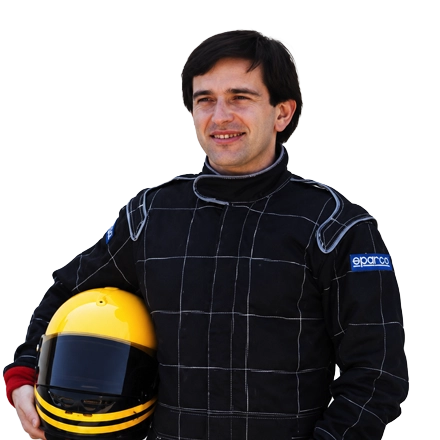
Enrico Agostino Bertaggia (born 19 September 1964) is a former Italian racing driver whose long career spanned junior single-seaters, Formula One, sports cars, touring cars, and professional driver coaching. He was entered for eight Formula One Grands Prix across the 1989 and 1992 seasons, although circumstances and uncompetitive machinery prevented him from making a Grand Prix start.
Driver Bio
| Born | Enrico Agostino Bertaggia 19 September 1964 Noale, Veneto, Italy |
|---|---|
| Nationality | Italian |
| Active years | 1989, 1992 |
| Teams | Coloni, Andrea Moda |
| Entries | 8 (0 starts) |
| Championships | 0 |
| Wins | 0 |
| Podiums | 0 |
| Career points | 0 |
| Pole positions | 0 |
| Fastest laps | 0 |
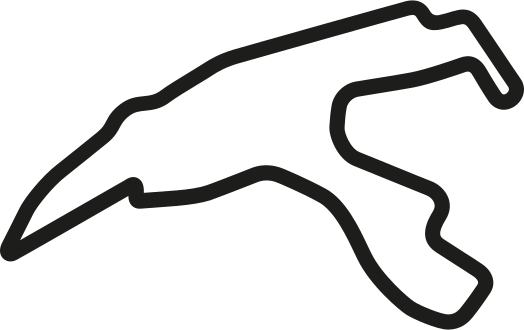
| First entry | 1989 Belgian Grand Prix |
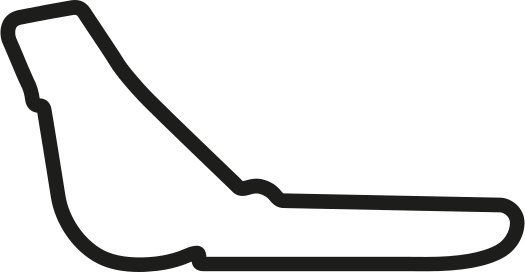
| Last entry | 1989 Australian Grand Prix |
Bertaggia’s reputation was forged primarily in Formula Three, where he became Italian Formula Three Champion in 1987 before enjoying an exceptional 1988 season. That year he won the prestigious Formula Three race at Monaco and then conquered the Macau Grand Prix, two of the biggest prizes available to an aspiring Grand Prix driver.
Racing career
Born on 19 September 1964 in Noale, Veneto, Italy, Bertaggia began his professional motor-racing career in 1982. What followed was a remarkably varied journey lasting almost a quarter of a century and encompassing everything from Formula Three and Formula 3000 to Formula One, GT racing, Super Touring and Porsche competition.
His first major breakthrough arrived in 1987, when Bertaggia captured the Italian Formula Three Championship. It established him as one of Italy’s most promising young drivers, but what he achieved the following season made considerably more noise on the international stage.
In 1988, Bertaggia pulled off the rare feat of winning two of Formula Three’s most prestigious standalone races. First came victory in the F3 event at Monte Carlo, held on the famous Monaco street circuit. He then travelled to Macau and won the Macau Grand Prix, defeating a field containing several drivers who would go on to become major Formula One names.
The result looks particularly impressive in hindsight. Bertaggia won the race ahead of Damon Hill, who finished second, with Jean Alesi taking third. Hill would eventually become Formula One World Champion, while Alesi became one of the most recognisable Grand Prix drivers of the 1990s. Bertaggia had therefore beaten some extremely serious opposition on one of junior motor racing’s most unforgiving circuits.
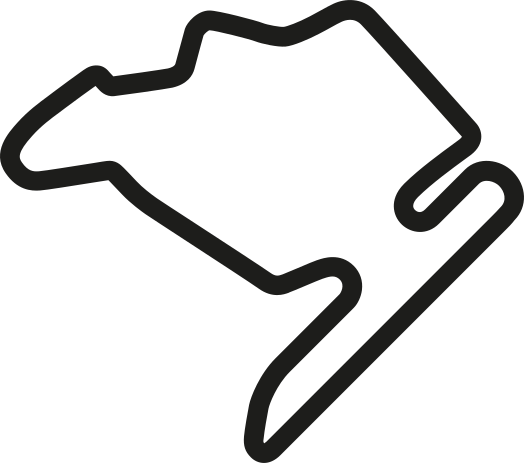
His move into International Formula 3000 during 1988 proved rather less straightforward. Bertaggia was entered for four rounds of that year’s championship but failed to qualify for the first three. He finally made the field at Jerez, where he finished 19th — his best result from that brief International F3000 campaign.
Nevertheless, his Formula Three achievements had been enough to put Formula One within reach. In 1989, Bertaggia joined Coloni, replacing Pierre-Henri Raphanel for the closing stages of the season.
It was an opportunity in name more than in practice. Formula One grids were enormous at the time, with pre-qualifying and qualifying eliminating several cars before Sunday’s race had even begun. Coloni was operating towards the wrong end of that fiercely competitive field, and Bertaggia found himself with one of the toughest assignments in Grand Prix racing.
He was entered for six Grands Prix towards the end of the 1989 season, but was the slowest entrant on each occasion and failed to progress far enough through the qualifying process to start a race. His first Formula One adventure was therefore over almost before it had been given a realistic chance to begin.
Bertaggia subsequently headed east. During 1990 and 1991, he competed in Formula 3000 in Japan with the Footwork team, continuing his single-seater career away from the European spotlight.
Then came one of Formula One’s stranger chapters.
Bertaggia was given another opportunity in 1992, this time with the newly arrived Andrea Moda team. He was entered for two Grands Prix, but the chaotic operation never provided him with a genuine chance to race. The team was excluded from the first event and withdrew from the second, after which Bertaggia departed.
There was even an attempted comeback. Bertaggia subsequently secured a new sponsorship package and sought to return to Andrea Moda, but team owner Andrea Sassetti had already exhausted the number of driver changes permitted under the regulations. The door was closed, bringing Bertaggia’s extraordinary stop-start Formula One story to an end.
His Grand Prix record consequently makes for an unusual statistic. Bertaggia was entered for eight Formula One Grands Prix across 1989 and 1992, yet never actually started one. His lack of race appearances was hardly representative of the ability he had demonstrated in Formula Three, but his F1 opportunities arrived with teams facing enormous competitive and organisational difficulties.
Fortunately, Formula One was only one chapter of a much broader career.
Bertaggia moved into sports-car competition and in 1995 achieved another significant international result when he finished runner-up in the GT2 class at the 24 Hours of Le Mans, driving a Callaway Corvette. It was a very different discipline from the single-seaters in which he had made his name, but it demonstrated the adaptability that would characterise the later stages of his career.
He continued racing across a variety of categories, including Super Touring Car championships, Porsche Carrera Cup competition and sports-car racing, extending a professional driving career that had begun back in 1982 and ultimately lasted for almost 25 years.
Coaching
Bertaggia’s expertise behind the wheel also opened up a substantial second career as an instructor and driver coach.
He became Chief Instructor at the Italian Federal School, working with young and talented racing drivers at an institution responsible for granting national professional racing licences since 1992. It was an appropriate role for someone whose own career had covered such an unusually broad range of machinery and disciplines.
His involvement in professional driver training actually stretched back further. In 1987, Bertaggia worked with driving schools associated with manufacturers including BMW and Renault, before becoming Course Director for the official Ferrari Driving School.
His Ferrari work included a particularly exclusive responsibility: Bertaggia became the only instructor worldwide teaching the private Ferrari Enzo courses, putting his racing experience to use with one of the most formidable road-going Ferraris of its era.
His coaching résumé continued to expand. Bertaggia served as Chief Instructor at the Alfa Romeo safety driving school and also held the same position with the Maserati Master GT School, building a career that connected professional motorsport with high-performance road-car instruction.
In February 2005, Bertaggia joined Ferrari GB as Chief Instructor for its exclusive official Fiorano Ferrari club. His responsibilities soon grew beyond instruction when he became Motorsports Director at Ferrari GB.
In that position, Bertaggia created a six-car team for the Ferrari European Challenge, while continuing to oversee the Fiorano Ferrari track-day programme. By this point, the former Formula Three champion had effectively moved from simply driving racing cars to teaching others how to handle them and organising the teams that competed with them.
Business ventures
A further change of direction came in 2011, when Bertaggia moved to the United States and became a part-owner in the creation of Dream Racing, a luxury driving experience based at Las Vegas Motor Speedway.
Bertaggia became the company’s CEO, bringing together the different strands of his career — professional racing, driver instruction, high-performance cars and motorsport management — in one operation.
Dream Racing initially offered customers the opportunity to drive a fleet of 12 Ferrari F430 GT racing cars. The concept subsequently expanded dramatically, with the fleet growing to more than 80 vehicles, encompassing both purpose-built GT racing machinery and high-performance supercars. The business developed into a sizeable operation, hosting more than 60,000 customers per year.
In 2016, the company expanded its activities again with the launch of Dream Racing Motorsport, taking Bertaggia’s involvement back towards competitive racing as well as the experience and instruction side of the business.
It makes for an unusually wide-ranging motorsport career. Bertaggia may be remembered by Formula One statisticians for eight Grand Prix entries without a start, but that tiny snapshot hardly tells his story. He was an Italian Formula Three Champion, won at Monaco and Macau, defeated future Formula One stars on his way up the ladder, competed in Japanese Formula 3000, stood on the class podium at Le Mans, raced touring cars, Porsches and sports cars, and subsequently became a senior instructor, motorsport director and racing-business executive.
Formula One proved to be the frustrating part of Enrico Bertaggia’s career. Almost everything around it demonstrated just how much more there was to him as a racing driver.
Complete Formula One results
| Year | Entrant | Chassis | Engine | 1 | 2 | 3 | 4 | 5 | 6 | 7 | 8 | 9 | 10 | 11 | 12 | 13 | 14 | 15 | 16 | WDC | Pts |
|---|---|---|---|---|---|---|---|---|---|---|---|---|---|---|---|---|---|---|---|---|---|
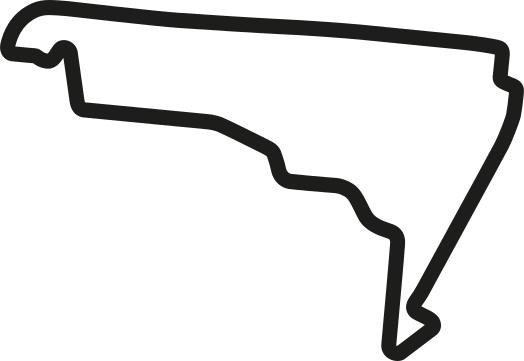
| 1989 | Coloni SpA | Coloni C3 | Ford Cosworth DFR 3.5 V8 | BRA | SMR | MON | MEX | USA | CAN | FRA | GBR | GER | HUN | BEL DNPQ | ITA DNPQ | POR DNPQ | ESP DNPQ | JPN DNPQ | AUS DNPQ | NC | 0 |
| 1992 | Andrea Moda Formula | Andrea Moda C4B | Judd GV 3.5 V10 | RSA EX | NC | 0 | |||||||||||||||
| Andrea Moda S921 | MEX DNP | BRA | ESP | SMR | MON | CAN | FRA | GBR | GER | HUN | BEL | ITA | POR | JPN | AUS | ||||||
Teammates & Qualifying Head-to-Head
| Teammate | Years | Races | Qualifying H2H |
|---|---|---|---|
| Roberto Moreno | 1989 | 6 | – |
| Alex Caffi | 1992 | 2 | – |