





























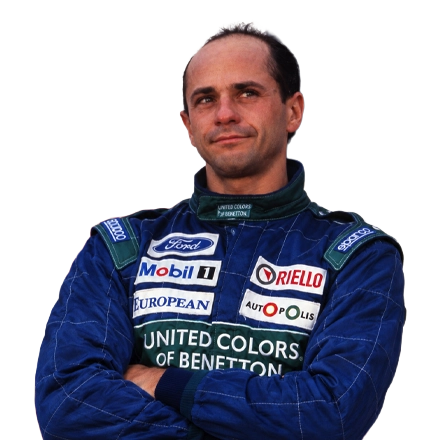
Roberto Pupo Moreno (born 11 February 1959) is a Brazilian former racing driver who entered 75 Formula One Grands Prix, scoring 15 championship points and one podium. He also won the 1988 International Formula 3000 Championship and enjoyed a long career in American open-wheel racing.
Driver Bio
| Nationality | Brazilian |
| Birthplace | Rio de Janeiro, Brazil |
| Born | 11 February 1959 |
| First Grand Prix | 1982 Dutch Grand Prix |
| Last Grand Prix | 1995 Australian Grand Prix |
| Years Active | 1982, 1987, 1989–1992, 1995 |
| Current/Last Team | Forti |
Nicknamed the “Super Sub” for his habit of stepping into cars at short notice, Moreno became a regular replacement for injured or unavailable drivers. His patience was finally rewarded with a full-time Champ Car opportunity in 2000, when he won his first race in 12 years and finished third in the championship.
Moreno later became a driver coach and consultant. He continues to appear at historic events and has never formally declared himself completely retired. Away from racing, he builds light aircraft.
Early career
Moreno won Brazil’s 125cc karting championship in 1976 before setting his sights on Europe. He arrived in England in 1979 for his first Formula Ford campaign, initially racing alongside works Royale driver Marc Smith.
Resources were scarce. Moreno transported and maintained his own Royale, operating from an old shed lent to him by Ralt founder Ron Tauranac. Several promising results convinced Van Diemen’s Ralph Firman Sr to sign him as a works driver for 1980.
Moreno repaid the opportunity by winning eight races and the Townsend Thoresen British Formula Ford title. He added three European victories to finish second in the EFDA Euroseries, placed fourth in the RAC British championship and sixth in the P&O Ferries series, then ended the year by winning the Formula Ford Festival.
In 2021, Moreno reunited with the same car for the Festival’s 50th-anniversary meeting.
Formula Three and Formula Atlantic
His success attracted Lotus founder Colin Chapman, who provided Moreno with a Formula One testing contract for 1981. The income allowed him to continue racing in Formula Three, although his budget remained limited.
With Barron Racing, Moreno won twice. He enjoyed still greater success in North America during 1982, beating Al Unser Jr in the Formula Atlantic support race at Long Beach and winning the prestigious Grand Prix de Trois-Rivières.
Moreno also completed half a British Formula Three season with Ivens Lumar Racing, taking three victories before Lotus summoned him for the Dutch Grand Prix.
Australian Grand Prix success
Managed by Australian Greg “Pee Wee” Siddle, Moreno became a favourite at the pre-World Championship Australian Grand Prix.
He won at Calder Park in 1981, 1983 and 1984, defeating fields containing champions and established Formula One drivers including Nelson Piquet, Alan Jones, Niki Lauda, Keke Rosberg, Jacques Laffite and Andrea de Cesaris.
In the only edition he did not win during that period, Moreno finished third in 1982 behind Alain Prost and Laffite. Each of his appearances came in a Ford-powered Ralt RT4 built to Formula Pacific or Formula Mondial regulations.
Formula One
Difficult Lotus debut
Moreno’s first Formula One opportunity arrived in unfortunate circumstances. Nigel Mansell had broken his wrist at the 1982 Canadian Grand Prix, leaving Lotus in need of a substitute for Zandvoort.
Theodore had previously attempted to borrow Moreno after Jan Lammers injured his thumb, but Chapman refused to release his test driver. Once Mansell was hurt, however, Lotus needed Moreno itself.
The assignment became a nightmare. Moreno had little meaningful experience in the Lotus 91 because Mansell and Elio de Angelis handled most of its development, while his own running had largely been restricted to older cars.
Unable to master the unfamiliar 91 during the race weekend, Moreno qualified more than two seconds outside the field. Lotus released him from his testing duties at the end of the season, and the public failure damaged his reputation for several years.
AGS redemption
Moreno spent five years fighting his way back. AGS finally offered him another chance for the closing rounds of 1987 as Pascal Fabre’s replacement.
At the Japanese Grand Prix, Moreno again appeared to have missed the field after setting the slowest time. Nigel Mansell’s practice injury prompted Williams to withdraw its entry, however, promoting the Brazilian onto the grid for his first Formula One start.
The following race in Adelaide supplied the redemption he needed. Moreno guided the awkward AGS JH22 between the street circuit’s walls and finished seventh as numerous rivals crashed or retired.
Ayrton Senna’s Lotus was subsequently excluded for oversized brake ducts, elevating Moreno to sixth. The result gave both driver and team their first World Championship point.
The years between
Moreno returned to North America after his Lotus setback. A planned full Formula Atlantic season collapsed when the Long Beach support event switched to Super Vee and his sponsor withdrew.
Teddy Yip and Theodore Racing helped keep the effort alive. Moreno won at Willow Springs and, after changing teams, added three more victories. He narrowly lost the championship to Michael Andretti, who repeatedly finished second whenever Moreno won.
In 1984, Moreno initially planned another Formula Three season with West Surrey Racing. Ron Tauranac instead invited him to join Ralt’s works Formula Two team.
Driving the dominant Ralt-Honda, Moreno won at Hockenheim and Donington Park and finished runner-up to teammate Mike Thackwell in the final European Formula Two Championship.
He nearly joined Brabham in Formula One that year. Defending champion Nelson Piquet recommended his friend to team owner Bernie Ecclestone, but sponsor Parmalat insisted upon an Italian teammate. Ecclestone consequently hired brothers Teo and Corrado Fabi to share the second car.
Moreno tested Toleman’s Formula One machinery at the end of 1984 and appeared set to race for the team in 1985. The programme collapsed when Toleman could not secure a tyre supply.
He instead moved into CART with Galles Racing, initially for road-course events and then for a full 1986 campaign. Persistent car problems prevented worthwhile results.
Returning to Formula 3000 with Ralt, Moreno won at Enna-Pergusa and used consistent finishes to take third in the championship before AGS called him back to Formula One.
Formula 3000 champion
Moreno’s point for AGS still failed to secure a permanent Grand Prix seat, so he joined Bromley Motorsport for the 1988 Formula 3000 season.
The team had little money but strong technical talent in Gary Anderson, who had previously worked with Moreno at Galles. Supported by Reynard, Bromley entered a largely sponsorless 88D-Cosworth.
Moreno won three consecutive early races at Pau, Silverstone and Monza, then added victory at the Birmingham Superprix. The results carried him to the International Formula 3000 Championship—the most emphatic response possible to those who had dismissed him after Zandvoort.
He also made a guest appearance in the inaugural Honda CR-X Challenge at Snetterton.
Formula One return
Coloni and EuroBrun
Even the Formula 3000 title did not attract a front-running Formula One team. Moreno became a Ferrari test driver for 1989, with the company helping him obtain a race seat at Coloni.
The car was hopelessly uncompetitive. Moreno qualified only four times from 16 attempts.
Prospects looked worse still in 1990 when he joined the fading EuroBrun operation. He escaped pre-qualifying for only two of the opening 14 rounds, and the team withdrew before the final two races.
Then came the telephone call that transformed his career.
Benetton podium
Benetton needed an urgent replacement after Alessandro Nannini suffered severe hand injuries in a helicopter accident following the Spanish Grand Prix.
Moreno qualified eighth at Suzuka and remained close to teammate Piquet throughout the Japanese Grand Prix. With several leading cars eliminated—including Ayrton Senna and Alain Prost after their first-corner collision—Piquet won and Moreno finished second.
The emotional one-two was Moreno’s only Formula One podium. At Adelaide, he again qualified eighth and finished seventh while Piquet took another victory.
Those performances earned Moreno a full-time Benetton contract for 1991.
Schumacher controversy
The Pirelli-shod Benetton B191 proved less competitive than expected. Moreno’s best results were fourth places in Monaco and Belgium.
At Spa, he also recorded the fastest lap. Yet the weekend was dominated by Michael Schumacher’s remarkable Formula One debut for Jordan.
Benetton management, led by Flavio Briatore and Tom Walkinshaw, viewed Schumacher as the driver around whom the team could build its future. They negotiated his release from Jordan and paid Moreno to surrender his seat.
Rumours later suggested Moreno had deliberately avoided embarrassing friend and teammate Piquet during the season, although the claim was never established.
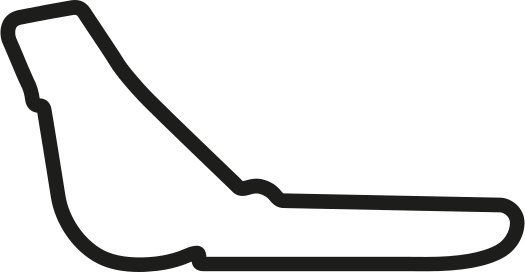
Jordan offered Moreno the newly vacant drive for the Italian Grand Prix. He qualified an impressive ninth, ahead of Andrea de Cesaris, but spun out on lap two. Moreno also raced for Jordan in Portugal before replacing Gianni Morbidelli at Minardi for the Adelaide finale.
Andrea Moda
Moreno joined Andrea Moda for 1992, a team constructed from the remains of Coloni and already engulfed in disorder.
After beginning the year with Alex Caffi and Enrico Bertaggia, the operation restarted with Moreno and Perry McCarthy. The pair faced an extraordinary struggle merely to get functioning cars onto the circuit.
Against every expectation, Moreno qualified the chronically underfunded and barely tested car for the Monaco Grand Prix. It was his only start of the season and perhaps one of his finest qualifying achievements.
The team collapsed after owner Andrea Sassetti was arrested at the Belgian Grand Prix.
Forti
Moreno spent the next two seasons racing touring cars in France and Italy. He also attempted to qualify for the 1994 Indianapolis 500.
Formula One offered one final return with Forti in 1995. His Brazilian nationality helped secure the seat, but the car was among the slowest in the championship.
Moreno’s best classified result was 14th in Belgium. He crossed the line 11th in Argentina but was nine laps behind and therefore not classified.
His Formula One career ended with a crash against the pit-lane wall at the Australian Grand Prix.
CART and the “Super Sub”
Moreno returned to Champ Car in 1996 with Payton-Coyne Racing and finished third at Michigan.
He left early in 1997, frustrated by the team’s lack of commitment, and drove for three different operations during the season. Repeated substitute appearances earned him the nickname “Super Sub”.
His best result was fifth at Detroit for Newman-Haas, where he replaced the injured Christian Fittipaldi. Moreno occasionally outqualified team leader Michael Andretti but still could not secure a competitive full-time seat for 1998, instead accepting a Penske testing role.
He made only three starts in 1998. Two different opportunities followed in 1999 with Newman-Haas and PacWest, producing a pair of fourth places.
Moreno also made his Indy Racing League debut at Phoenix in 1999, finishing sixth. He returned to the Indianapolis 500 after a 13-year absence and placed 20th for Truscelli Team Racing.
Late-career breakthrough
After serving as a substitute for Patrick Racing in 1999, Moreno finally received a full-time Champ Car seat for 2000.
Driving a Reynard-Ford, he led the championship for much of the season before a late downturn allowed Gil de Ferran to overtake him. Moreno still finished third overall, the best major championship result of his American career.
At Cleveland, he claimed his first Champ Car victory. Overwhelmed by a first win since his 1988 Formula 3000 campaign, Moreno wept openly during the celebrations.
He won again at Vancouver in 2001, although inconsistent results dropped him to 13th in the standings.
Moreno joined Herdez Competition for 2003 and finished second in Miami. He announced his retirement at the end of the year—but, true to form, remained available whenever somebody needed a substitute.
Later appearances and testing
After a single Brazilian Stock Car outing at Jacarepaguá, Moreno replaced the injured Ed Carpenter for Vision Racing at St Petersburg in April 2006.
Later that year, Champ Car selected him to perform the first testing of its new Panoz chassis. Paul Tracy praised the choice, describing Moreno as quick, dependable and unlikely to damage a car that urgently needed development mileage.
Moreno completed thousands of kilometres in the Panoz DP01 before receiving a race opportunity at Houston in 2007, substituting for the injured Alex Figge at Pacific Coast Motorsports.
He also replaced Stéphan Grégoire for Chastain Motorsports at the 2007 Indianapolis 500. Moreno crashed early and was classified last.
His racing appearances continued into 2008, extending a professional career that had repeatedly seemed finished but never quite ended.
Helmet
Moreno traditionally wore a yellow helmet decorated with blue, red and white wings around the visor, sides and chin. His surname appeared across its lower section.
Later versions added blue cylindrical shapes to the wing design. His helmets were created by celebrated Brazilian designer Sid Mosca.
Grand Prix Stats
| Race Entries | 75 |
| Race Starts | 42 |
| Did Not Start | 1 |
| Best Race Start | 5th |
| Best Race Finish | 2nd |
| Retirements | 24 |
| First-Lap Retirements | 2 |
| Not Classified | 1 |
| Disqualified | 0 |
| Did Not Qualify | 10 |
Podiums
| Podiums | 1 |
| First Podium | 1990 Japanese Grand Prix |
| Last Podium | 1990 Japanese Grand Prix |
| 1st Place | 0 |
| 2nd Place | 1 |
| 3rd Place | 0 |
| Most Consecutive Podiums | 0 |
| Most Podiums in a Single Season | 1 (1990) |
| Seasons with Podiums | 1 |
Qualifying
| Qualifying Sessions | 0 |
| Reached Q3 | 0 |
| Q2 Eliminations | 0 |
| Q1 Eliminations | 0 |
| Did Not Qualify | 10 |
Fastest Laps
| Fastest Laps | 1 |
| First Fastest Lap | 1991 Belgian Grand Prix |
| Last Fastest Lap | 1991 Belgian Grand Prix |
| Win + Fastest Lap | 0 |
| Most Consecutive Fastest Laps | 0 |
| Most Fastest Laps in a Season | 1 |
| Seasons with Fastest Laps | 1 |
Points
| Points Scored | 15 |
| Points Finishes | 5 |
| Most Points in a Single Season | 8 (1991) |
| Seasons with Points | 3 |
Stats by Season
| Year | Constructor | Entries | Starts | Wins | Podiums | Poles | Fastest Laps | Front Rows | DNF | Best Start | Best Result | Pts Finishes | Points | Championship |
|---|---|---|---|---|---|---|---|---|---|---|---|---|---|---|
| 1982 | Lotus | 1 | 0 | 0 | 0 | 0 | 0 | 0 | 0 | DNQ | – | 0 | 0 | NC |
| 1987 | AGS | 2 | 2 | 0 | 0 | 0 | 0 | 0 | 1 | 25 | 6 | 1 | 1 | 19th |
| 1989 | Coloni | 16 | 4 | 0 | 0 | 0 | 0 | 0 | 4 | 15 | – | 0 | 0 | NC |
| 1990 | EuroBrun / Benetton | 16 | 4 | 0 | 1 | 0 | 0 | 0 | 1 | 8 | 2 | 1 | 6 | 10th |
| 1991 | Benetton / Jordan / Minardi | 14 | 14 | 0 | 0 | 0 | 1 | 0 | 6 | 5 | 4 | 3 | 8 | 10th |
| 1992 | Andrea Moda | 9 | 1 | 0 | 0 | 0 | 0 | 0 | 1 | 26 | – | 0 | 0 | NC |
| 1995 | Forti | 17 | 17 | 0 | 0 | 0 | 0 | 0 | 11 | 20 | 14 | 0 | 0 | NC |
Teammates & Qualifying Head-to-Head
| Teammate | Years | Races | Qualifying H2H |
|---|---|---|---|
| Elio de Angelis | 1982 | 1 | 0-1 |
| Pierre-Henri Raphanel | 1989 | 10 | 9-1 |
| Enrico Bertaggia | 1989 | 6 | 6-0 |
| Claudio Langes | 1990 | 13 | 13-0 |
| Nelson Piquet | 1990, 1991 | 13 | 3-10 |
| Andrea de Cesaris | 1991 | 2 | 1-1 |
| Pierluigi Martini | 1991 | 1 | 0-1 |
| Perry McCarthy | 1992 | 8 | 8-0 |
| Pedro Diniz | 1995 | 17 | 9-8 |