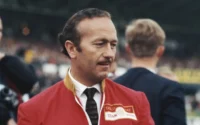




































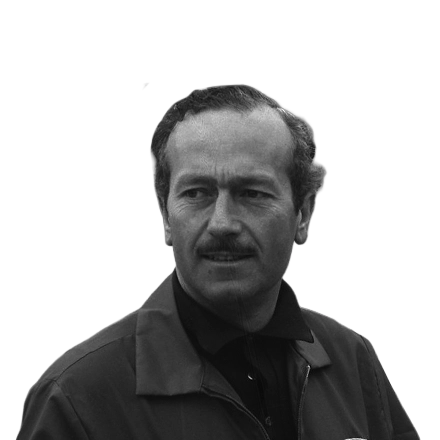
Anthony Colin Bruce Chapman CBE RDI was one of Britain’s most influential automotive minds—an engineer, inventor, constructor, and the visionary founder of Lotus Cars. Few figures have reshaped motor racing and sports car design as profoundly.
Driver Bio
| Nationality | British |
| Birthplace | Richmond, England, UK |
| Born | 19 May 1928 |
| Died | 16 December 1982 |
| First Grand Prix | 1956 French Grand Prix |
| Last Grand Prix | 1956 French Grand Prix |
| Years Active | 1956 |
| Current/Last Team | Vanwall |
Chapman launched Lotus in 1952, initially as a side project powered by enthusiasm, ingenuity, and a small circle of like-minded collaborators. Drawing heavily on cutting-edge aeronautical engineering principles, he reimagined what performance meant in a car. Rather than chasing brute horsepower, Chapman championed lightness, balance, and precision handling—captured perfectly in his famous line: “Adding power makes you faster on the straights. Subtracting weight makes you faster everywhere.”
Under his leadership, Team Lotus became a dominant force, securing seven Formula One Constructors’ Championships, six Drivers’ titles, and victory at the Indianapolis 500 between 1962 and 1978. Meanwhile, the road car division produced tens of thousands of innovative, relatively affordable sports cars, helping Lotus endure as one of the few British performance marques to survive the industry turbulence of the 1970s.
Chapman died suddenly of a heart attack in 1982 at just 54—but by then, his legacy was already deeply embedded in the DNA of modern motorsport.
Early life
Born in Richmond, Surrey, Chapman grew up in North London, where his father ran a pub beside Hornsey railway station. He attended the Stationers’ Company’s School, where his knack for engineering began to emerge—though few could have predicted just how far it would take him.
Education and early engineering instincts
Chapman studied structural engineering at University College London and joined the University Air Squadron, learning to fly—an experience that would later influence his design thinking. Though he left without completing his degree in 1948, he returned to finish it a year later.
After a brief stint with the Royal Air Force—declining a permanent commission—he moved into industry with British Aluminium, experimenting with how lightweight materials could transform structural design. That fascination with weight-saving would become his lifelong obsession.
The birth of Lotus
Chapman’s first car, the Lotus Mk1, was a modified Austin 7 built in 1948 and raced locally. He named it “Lotus”—a name he never fully explained, though many believe it was inspired by his future wife Hazel’s nickname.
Success came quickly. Prize money funded the Mk2, and Chapman began revealing his trademark ingenuity: bending rules without breaking them. One early engine modification—reworking a cylinder head to improve airflow—gave him a decisive edge until regulators stepped in to ban it.
By the mid-1950s, his designs were in demand. The Lotus 6 sold over 100 kits, and then came the breakthrough: the Lotus 7 in 1957. Its minimalist philosophy made it a legend—so much so that Caterham Cars still produces a version today, alongside dozens of derivatives worldwide.
Racing career and Formula One revolution
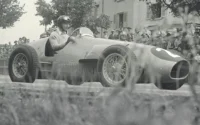
Chapman briefly tried his hand at driving, even racing a Formula One car in 1956, but a crash ended that chapter and pushed him fully toward engineering.
That shift changed everything.
Alongside innovators like John Cooper, Chapman helped revolutionise Formula One by championing compact, mid-engined cars. Though less powerful than rivals from Ferrari and Maserati, their superior handling proved decisive.
With driver Jim Clark, Team Lotus became nearly unstoppable. The Lotus 25 delivered their first World Championship in 1963, and in 1965 Clark drove the Lotus 38 to a groundbreaking Indianapolis 500 victory—the first for a mid-engined car.
Chapman also played a pivotal role in persuading Ford Motor Company to back Cosworth’s DFV engine—one of the most successful racing engines ever built.
Innovation after innovation
Chapman’s genius wasn’t just about winning—it was about rewriting the rulebook:
- He introduced the Chapman strut, adapting suspension design for lighter, more efficient handling.
- He pioneered the monocoque chassis in racing with the Lotus 25—creating cars that were lighter, stronger, and safer.
- He helped bring aerodynamics into Formula One, experimenting with wings to generate downforce.
- He transformed car layout by relocating radiators to improve airflow and weight distribution.
Perhaps most influential of all was his work on ground effect aerodynamics. With collaborators like Peter Wright and Tony Rudd, Chapman developed cars that used airflow beneath the chassis to “stick” to the track. The Lotus 79 dominated the 1978 season using this principle—a concept still central to racing car design today.
He even experimented with a radical twin-chassis car, the Lotus 88, designed to separate driver comfort from aerodynamic performance. Though ultimately banned, it showed just how far ahead of his time he was.
Changing the business of racing
Chapman didn’t just innovate on the track—he transformed the sport’s economics. He was among the first to turn race cars into advertising platforms, bringing in major sponsors like Gold Leaf and John Player Special. That shift helped turn Formula One into the global, multi-billion-pound enterprise it is today.
The DeLorean chapter
In the late 1970s, Chapman became involved with John DeLorean and the creation of the DeLorean sports car. The project, heavily funded by the UK government, eventually collapsed amid financial irregularities and scandal.
Although Chapman denied wrongdoing, investigations after his death revealed complex financial dealings. The episode cast a shadow over his final years, though it never erased his engineering achievements.
Personal life and character
Chapman was married to Hazel, his long-time partner and collaborator, and they had three children. He was known as charismatic, driven, and relentlessly inventive—equally comfortable sketching radical designs or negotiating business deals.
Final days and legacy
On 16 December 1982, Chapman died suddenly of a heart attack at his home in Norwich. Remarkably, that same day, Lotus was testing its first Formula One car with active suspension—yet another innovation he had set in motion.
Chapman’s influence still echoes through modern motorsport and performance car design. From lightweight engineering to aerodynamic mastery, his ideas didn’t just win races—they reshaped the very way cars are conceived.
Put simply: Colin Chapman didn’t follow the rules of racing—he rewrote them.
Grand Prix Stats
| Race Entries | – |
| Race Starts | – |
| Did Not Start | 1 |
| Best Race Start | – |
| Best Race Finish | – |
| Retirements | – |
| First-Lap Retirements | 0 |
| Not Classified | – |
| Disqualified | 0 |
| Did Not Qualify | 0 |
Qualifying
| Qualifying Sessions | – |
| Reached Q3 | – |
| Q2 Eliminations | – |
| Q1 Eliminations | – |
| Did Not Qualify | 0 |
Complete Formula One World Championship results
| Year | Entrant | Chassis | Engine | 1 | 2 | 3 | 4 | 5 | 6 | 7 | 8 | WDC | Points |
|---|---|---|---|---|---|---|---|---|---|---|---|---|---|
| 1956 | Vandervell Products Ltd. | Vanwall | Vanwall 2.5l Straight-4 | ARG | MON | 500 | BEL | FRA DNS | GBR | GER | ITA | NC | 0 |
Teammates & Qualifying Head-to-Head
| Teammate | Years | Races | Qualifying H2H |
|---|---|---|---|
| Mike Hawthorn | 1956 | 1 | 1-0 |
| Harry Schell | 1956 | 1 | 1-0 |