























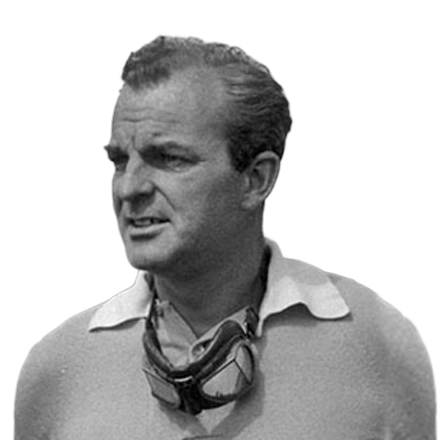
Harry Lawrence O’Reilly Schell was an American racing driver who competed in Formula One from 1950 to 1960. Charming, fast, cosmopolitan and endlessly adventurous, Schell became one of the sport’s most colourful personalities—and an important pioneer for American drivers in Europe.
Driver Bio
| Nationality | American |
| Birthplace | Paris, France |
| Born | 29 June 1921 |
| Died | 13 May 1960 |
| First Grand Prix | 1950 Monaco Grand Prix |
| Last Grand Prix | 1960 Argentine Grand Prix |
| Years Active | 1950–1960 |
| Current/Last Team | Privateer: Cooper |
Born in the 16th arrondissement of Paris, Schell was raised in a world steeped in speed. He was the son of expatriate American racer Laury Schell and wealthy heiress Lucy O’Reilly Schell, one of the most influential women in pre-war motorsport.
Lucy backed Delahaye under the famous Écurie Bleue banner, funding both sports cars and Grand Prix projects. Her team famously shocked the mighty Mercedes operation when René Dreyfus won the 1938 Pau Grand Prix.
Before Harry’s racing career began, tragedy struck. Shortly before the Second World War, his father was killed in a road accident and his mother badly injured. When France was occupied, Harry and Lucy returned to the United States.
Restless and brave, Schell had already volunteered with the Finnish Air Force during the Winter War. Later, when America entered WWII, he served in the United States Tank Corps.
Racing career
First American on the Formula One grid
After the war, Schell attempted to qualify for the 1946 Indianapolis 500, but did not make the field. Europe soon called him back, and he built his career racing across the continent in Formula 3, Formula 2 and top-level sports cars.
When the new Formula One World Championship began in 1950, Schell entered the 1950 Monaco Grand Prix in a Cooper-JAP. By taking the start, he became the first American driver ever to start a Formula One Grand Prix.
His race ended in a multi-car crash at Monaco’s harbour chicane—but history had already been made.
Grand Prix career
Though Schell never won a World Championship race, he carved out a respected ten-year Formula One career during one of the sport’s toughest eras. He raced for a remarkable list of teams, including BRM, Vanwall, Maserati and Ferrari.
He even lined up as a teammate to five-time World Champion Juan Manuel Fangio.
Schell became known as a dependable and intelligent racer—someone who could bring the car home, score points, and occasionally spring a surprise. He reached the Formula One podium twice, with his best result coming as runner-up in the 1958 Dutch Grand Prix.
Moments of brilliance
Schell’s reputation was built on flashes of genuine class.
At the 1954 Spanish Grand Prix, driving a private Maserati, he stormed into the lead from the start and pulled clear before a spin and transmission failure ended a stunning drive.
At the 1956 French Grand Prix, he took over an unwell Mike Hawthorn’s Ferrari after his own Vanwall retired. Schell charged back through the field and nearly stole the race, revealing the pace of the emerging Vanwall project to the world.
Sports car success
Schell was equally capable in endurance racing. He finished second at the 1957 12 Hours of Sebring alongside Stirling Moss, and returned for third place in 1959.
He also won the 1956 Caen Grand Prix, further proving he was much more than a supporting act.
The final chapter
By 1960, approaching 40, Schell’s top-line prospects seemed to be fading. He initially ran a private Cooper under the revived Écurie Bleue banner, linking back to his family heritage.
Then came a fresh opportunity: a full programme with British Racing Partnership alongside Tony Brooks and rising talent Chris Bristow. It looked like the beginning of an unexpected late-career revival.
Death
That comeback never came.
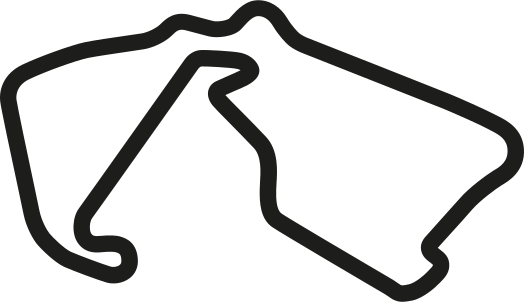
During practice for the non-championship 1960 BRDC International Trophy at Silverstone Circuit, Schell crashed heavily at Abbey Curve. His Cooper slid into mud, lost a wheel, somersaulted through a barrier and struck a brick wall.
He died on 13 May 1960, aged 38.
Safety advocate and legacy
Before his death, Schell had strongly promoted the use of roll-bars on European racing cars—already standard in American racing but still uncommon in Formula One. By the start of the 1961 season, roll-over protection had become standard equipment.
That means Harry Schell helped save lives even after his own life was cut short.
He is remembered as Formula One’s first American starter, a talented international racer, and one of the sport’s great adventurers: elegant, daring, funny, and faster than history often remembers.
Grand Prix Stats
| Race Entries | 56 |
| Race Starts | 56 |
| Did Not Start | 0 |
| Best Race Start | 2nd |
| Best Race Finish | 2nd |
| Retirements | 32 |
| First-Lap Retirements | 2 |
| Not Classified | 0 |
| Disqualified | 0 |
| Did Not Qualify | 0 |
Podiums
| Podiums | 2 |
| First Podium | 1957 Italian Grand Prix |
| Last Podium | 1958 Dutch Grand Prix |
| 1st Place | 0 |
| 2nd Place | 1 |
| 3rd Place | 1 |
| Most Consecutive Podiums | 0 |
| Most Podiums in a Single Season | 1 (1957, 1958) |
| Seasons with Podiums | 2 |
Qualifying
| Qualifying Sessions | 56 |
| Reached Q3 | – |
| Q2 Eliminations | – |
| Q1 Eliminations | – |
| Did Not Qualify | 0 |
Points
| Points Scored | 32 |
| Points Finishes | 12 |
| Most Points in a Single Season | 14 (1958) |
| Seasons with Points | 4 |
Front Row Starts
| Front Row Starts | 5 |
| Poles | 0 |
| 2nd on Grid | – |
| Most Front Row Starts in a Season | 2 (1958, 1959) |
| Seasons with Front Row Starts | 3 |
FIA World Drivers’ Championship results
| Year | Entrant | Chassis | Engine | 1 | 2 | 3 | 4 | 5 | 6 | 7 | 8 | 9 | 10 | 11 | WDC | Points |
|---|---|---|---|---|---|---|---|---|---|---|---|---|---|---|---|---|
| 1950 | Horschell Racing Corporation | Cooper T12 | JAP 1.1 V2 | GBR | MON Ret | 500 | NC | 0 | ||||||||
| Ecurie Bleue | Talbot-Lago T26C | Talbot 23CV 4.5 L6 | SUI 8 | BEL | FRA | ITA | ||||||||||
| 1951 | Enrico Platé | Maserati 4CLT/48 | Maserati 4CLT 1.5 L4s | SUI 12 | 500 | BEL | FRA Ret | GBR | GER | ITA | ESP | NC | 0 | |||
| 1952 | Enrico Platé | Maserati 4CLT/48 | Platé 2.0 L4 | SUI Ret | 500 | BEL | FRA Ret* | GBR 17 | GER | NED | ITA | NC | 0 | |||
| 1953 | Equipe Gordini | Gordini T16 | Gordini 20 2.0 L6 | ARG 7* | 500 | NED Ret | BEL 7 | FRA Ret | GBR Ret | GER Ret | SUI | ITA 9 | NC | 0 | ||
| 1954 | Harry Schell | Maserati A6GCM | Maserati A6 2.0 L6 | ARG 6 | 500 | BEL | FRA Ret | GBR 12 | GER 7 | NC | 0 | |||||
| Officine Alfieri Maserati | Maserati 250F | Maserati 250F1 2.5 L6 | SUI Ret | ITA | ||||||||||||
| Harry Schell | Maserati 250F | Maserati 250F1 2.5 L6 | ESP Ret | |||||||||||||
| 1955 | Officine Alfieri Maserati | Maserati 250F | Maserati 250F1 2.5 L6 | ARG 6+7* | NC | 0 | ||||||||||
| Scuderia Ferrari | Ferrari 555 | Ferrari 555 2.5 L4 | MON Ret | 500 | BEL DNS | NED | ||||||||||
| Vandervell Products | Vanwall VW 55 | Vanwall 254 2.5 L4 | GBR 9* | ITA Ret | ||||||||||||
| 1956 | Vandervell Products | Vanwall VW 2 | Vanwall 254 2.5 L4 | ARG | MON Ret | 500 | BEL 4 | FRA 10* | GBR Ret | ITA Ret | 17th | 3 | ||||
| Scuderia Centro Sud | Maserati 250F | Maserati 250F1 2.5 L6 | GER Ret | |||||||||||||
| 1957 | Scuderia Centro Sud | Maserati 250F | Maserati 250F1 2.5 L6 | ARG 4 | 7th | 10 | ||||||||||
| Officine Alfieri Maserati | Maserati 250F | Maserati 250F1 2.5 L6 | MON Ret* | 500 | FRA 5 | GBR Ret | GER 7 | PES 3 | ITA 5* | |||||||
| 1958 | Jo Bonnier | Maserati 250F | Maserati 250F1 2.5 L6 | ARG 6 | 6th | 14 | ||||||||||
| Owen Racing Organisation | BRM P25 | BRM P25 2.5 L4 | MON 5 | NED 2 | 500 | BEL 5 | FRA Ret | GBR 5 | GER Ret | POR 6 | ITA Ret | MOR 5 | ||||
| 1959 | Owen Racing Organisation | BRM P25 | BRM P25 2.5 L4 | MON Ret | 500 | NED Ret | FRA 7 | GBR 4 | GER 7 | POR 5 | ITA 7 | 13th | 5 | |||
| Ecurie Bleue | Cooper T51 | Climax FPF 2.5 L4 | USA Ret | |||||||||||||
| 1960 | Ecurie Bleue | Cooper T51 | Climax FPF 2.2 L4 | ARG Ret | MON | 500 | NED | BEL | FRA | GBR | POR | ITA | USA | NC | 0 |