
























Born in Nice on 16 February 1921, Jean Behra was one of the fiercest and most charismatic racers of Formula One’s early years — a fearless competitor whose raw determination, uncompromising driving style, and larger-than-life personality made him both admired and feared throughout the paddock. Across an extraordinary career spanning motorcycles, sports cars, endurance racing, and Formula One, Behra became one of France’s greatest post-war racing heroes.
Driver Bio
| Nationality | French |
| Birthplace | Nice, France |
| Born | 16 February 1921 |
| Died | 1 August 1959 |
| First Grand Prix | 1952 Swiss Grand Prix |
| Last Grand Prix | 1959 French Grand Prix |
| Years Active | 1952 – 1959 |
| Current/Last Team | Behra-Porsche |
Small, broad-shouldered, and heavily scarred from countless accidents, Behra looked every inch the hard man of motorsport’s most dangerous era. He carried the physical evidence of his bravery everywhere he went. By the mid-1950s, he had survived so many crashes that fellow drivers joked he was almost indestructible. In 1955, he even lost part of an ear in a racing accident. Yet none of it dulled his appetite for speed. Behra drove with ferocious intensity — sometimes brilliant, occasionally wild, but never half-hearted. His aggressive, hard-charging approach earned enormous respect, although his fiery temper also created tension with team managers and rivals alike.
Motorcycles
Before establishing himself in Grand Prix racing, Behra began his competitive career on motorcycles with Moto Guzzi. His transition to four wheels came naturally, and by 1950, he had already achieved a podium finish in the Monte Carlo Rally, sharing a Simca 8 coupé with Julio Quinlin. From there, his rise through international motorsport was rapid.
Formula One
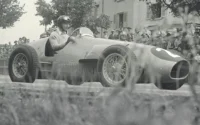
Behra entered Formula One in 1952 and quickly became one of the standout talents of the era. Driving for Gordini, Maserati, BRM, Ferrari, and later his own Behra-Porsche project, he contested 54 World Championship Grands Prix between 1952 and 1959. Although he never secured a Formula One World Championship victory, his consistency and speed earned him nine podium finishes and one fastest lap. His finest championship campaign came in 1956 with Maserati, when he finished fourth in the World Drivers’ Championship after claiming five podiums from just seven starts.
One of Behra’s earliest headline performances came in the 1952 non-championship Reims Grand Prix, where he stunned the established stars by taking victory for Gordini. It was a sign of things to come. Behra rapidly became known as a specialist in non-championship races and endurance events, piling up victories across Europe during the 1950s.
At Gordini, Behra showcased both speed and resilience. During the gruelling 1952 Carrera Panamericana in Mexico, he won the opening stage before crashing the following day heavily. Two years later, he delivered a dramatic victory at the Grand Prix of Pau after overcoming repeated mechanical problems and charging through the field in the closing laps.
His move to Maserati elevated him into the top tier of international racing. In 1955, he defended his Pau Grand Prix crown, while also winning major sports car races, including the Supercortemaggiore Grand Prix at Monza alongside Luigi Musso. Behra’s versatility was extraordinary — equally competitive in Grand Prix machinery, endurance racers, and sports cars. He claimed victories in Rome, Modena, Sweden, and across countless prestigious European events.
Even serious injuries rarely slowed him down. After leg surgery in 1956 forced him to miss the Monza 1000km race, Behra returned almost immediately to take pole position at Rouen and continued collecting victories throughout the season. In 1957, he once again dominated at Pau before suffering injuries while testing for the Mille Miglia. Weeks later, he was back racing at Le Mans.
By 1958, Behra had become one of Europe’s most formidable sports car drivers. Racing Porsche Spyders, he strung together eight consecutive victories in European events while simultaneously competing in Formula One for BRM. He won at Rouen and Berlin, finished fourth in the Portuguese Grand Prix at Porto, and became famous for his relentless commitment to racing. At Riverside in California, after finishing fourth in a Porsche RSK, Behra reportedly left the circuit in an ambulance simply to make his flight back to Europe in time for his next race.
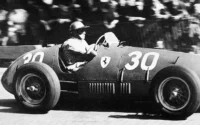
In 1959, Behra joined Ferrari to partner Tony Brooks in Formula One. The move should have represented the peak of his career, but the relationship with Enzo Ferrari’s team quickly became strained. Behra’s uncompromising personality clashed with Ferrari management, especially as he simultaneously developed his own Formula Two project based on the Porsche 718 RSK. The Behra-Porsche team entered the Monaco Grand Prix with Maria Teresa de Filippis, and although the car failed to qualify, the project showed considerable promise. Matters escalated after Hans Herrmann drove the Behra-Porsche to second place in the Reims Formula Two race, finishing ahead of Ferrari’s own entries and infuriating Enzo Ferrari.
Tensions exploded later that same weekend after Behra retired from the French Grand Prix with engine failure. During a heated argument in a restaurant, Behra punched Ferrari team manager Romolo Tavoni and another customer. Ferrari dismissed him from the team immediately.
Death
Less than a month later, tragedy struck at the fearsome AVUS circuit in Berlin. On 1 August 1959, during the sports car race supporting the German Grand Prix, Behra lost control of his Porsche RSK in torrential rain while travelling at immense speed on the steeply banked section of the circuit. The car spun violently, launched over the top of the banking, and crashed heavily. Behra was thrown from the wreckage and fatally struck a flagpole lining the top of the embankment. He suffered catastrophic injuries and died instantly at the age of 38.
His death sent shockwaves through the motorsport world. Behra received funeral services in Berlin, Paris, and Nice, where thousands lined the streets to pay their respects. Fellow French driver Maurice Trintignant described him as one of the bravest racers of his generation and called upon young French drivers to continue defending their nation’s colours in international competition.
| Race Entries | 53 |
| Race Starts | 52 |
| Did Not Start | 1 |
| Best Race Start | 2nd |
| Best Race Finish | 2nd |
| Retirements | 31 |
| First-Lap Retirements | 0 |
| Not Classified | 0 |
| Disqualified | 1 |
| Did Not Qualify | 0 |
Podiums
| Podiums | 9 |
| First Podium | 1952 Swiss Grand Prix |
| Last Podium | 1958 Dutch Grand Prix |
| 1st Place | 0 |
| 2nd Place | 2 |
| 3rd Place | 7 |
| Most Consecutive Podiums | 3 |
| Most Podiums in a Single Season | 5 (1956) |
| Seasons with Podiums | 5 |
Qualifying
| Qualifying Sessions | 53 |
| Reached Q3 | N/A |
| Q2 Eliminations | N/A |
| Q1 Eliminations | N/A |
| Did Not Qualify | 0 |
Fastest Laps
| Fastest Laps | 1 |
| First Fastest Lap | 1954 British Grand Prix |
| Last Fastest Lap | 1954 British Grand Prix |
| Win + Fastest Lap | 0 |
| Most Consecutive Fastest Laps | 0 |
| Most Fastest Laps in a Season | 1 |
| Seasons with Fastest Laps | 1 |
Points
| Points Scored | 51.14 |
| Points Finishes | 16 |
| Most Points in a Single Season | 22 (1956) |
| Seasons with Points | 7 |
Front Row Starts
| Front Row Starts | 10 |
| Poles | 0 |
| 2nd on Grid | – |
| Most Front Row Starts in a Season | 4 |
| Seasons with Front Row Starts | 5 |
Stats by Season
| Year | Constructor | Entries | Starts | Wins | Podiums | Poles | Fastest Laps | Front Rows | DNF | Best Start | Best Result | Pts Finishes | Points | Championship |
|---|---|---|---|---|---|---|---|---|---|---|---|---|---|---|
| 1952 | Gordini | 3 | 3 | 0 | 1 | 0 | 0 | 1 | 1 | 7 | 3 | 2 | 6 | 10th |
| 1953 | Gordini | 6 | 6 | 0 | 0 | 0 | 0 | 0 | 4 | 8 | 7 | 0 | 0 | NC |
| 1954 | Gordini | 8 | 8 | 0 | 0 | 0 | 1 | 0 | 6 | 5 | 10 | 1 | 0.14 | 26th |
| 1955 | Maserati | 6 | 6 | 0 | 1 | 0 | 0 | 2 | 5 | 3 | 3 | 3 | 6 | 9th |
| 1956 | Maserati | 7 | 7 | 0 | 5 | 0 | 0 | 1 | 2 | 4 | 2 | 5 | 22 | 4th |
| 1957 | Maserati | 6 | 6 | 0 | 1 | 0 | 0 | 4 | 3 | 2 | 2 | 1 | 6 | 11th |
| 1958 | Maserati, BRM | 10 | 10 | 0 | 1 | 0 | 0 | 2 | 7 | 2 | 3 | 3 | 9 | 10th |
| 1959 | Ferrari, Behra-Porsche | 4 | 3 | 0 | 0 | 0 | 0 | 1 | 2 | 2 | 5 | 1 | 2 | 17th |
Stats by Constructor
| Constructor | Years | Entries | Starts | Wins | Podiums | Poles | Fastest Laps | Front Rows | DNF | Best Start | Best Result | Pts Finishes | Points |
|---|---|---|---|---|---|---|---|---|---|---|---|---|---|
| Gordini | 1952–1954 | 17 | 17 | 0 | 1 | 0 | 1 | 1 | 11 | 5 | 3 | 3 | 6.14 |
| Maserati | 1955–1957 | 19 | 19 | 0 | 7 | 0 | 0 | 7 | 10 | 2 | 2 | 9 | 34 |
| Maserati | 1958 | 1 | 1 | 0 | 0 | 0 | 0 | 0 | 1 | 15 | 15 | 0 | 0 |
| BRM | 1958 | 9 | 9 | 0 | 1 | 0 | 0 | 1 | 7 | 2 | 3 | 2 | 7 |
| Ferrari | 1959 | 3 | 3 | 0 | 0 | 0 | 0 | 1 | 2 | 2 | 5 | 1 | 2 |
| Behra-Porsche | 1959 | 1 | 0 | 0 | 0 | 0 | 0 | 0 | 0 | – | – | 0 | 0 |