


























Behra-Porsche was one of Formula One’s most fascinating short-lived projects — a fiercely independent racing team born from the ambition, personality, and determination of French racing star Jean Behra. Although the constructor entered only four World Championship Grands Prix in 1959 and 1960, the story behind the car captured the rebellious spirit of an era when drivers still dared to build and race machines under their own names.
| Nationality | French |
| Base | France |
| Years Active | 1959–1960 |
| First Race | 1960 Argentine Grand Prix |
| Last Race | 1960 Italian Grand Prix |
| Race Entries | 4 |
| Race Starts | 2 |
| Podiums | 0 |
| Pole Positions | 0 |
| Fastest Laps | 0 |
| Points | 0 |
| Constructors’ Championships | 0 |
| Drivers’ Championships | 0 |
| Best Start | 14th |
| Best Finish | 10th |
| Did Not Start | 1 |
| Did Not Qualify | 1 |
| Retirements | 0 |
By the late 1950s, Jean Behra had already established himself as one of Europe’s toughest and most respected racers. A Grand Prix winner in non-championship events and a multiple podium finisher in Formula One, Behra had raced for Gordini, Maserati, BRM, and Ferrari, earning a reputation for fearless driving and an equally fiery temperament. While contracted to Ferrari for the 1959 season, Behra began pursuing a project entirely his own — a lightweight Formula Two car combining Porsche engineering with bespoke chassis design.
The car’s origins lay in the highly successful Porsche 718 RSK sports car. Behra commissioned Porsche to supply the mechanical components, while former Maserati engineer Valerio Colotti designed and adapted the chassis specifically to accommodate the German machinery. The result was an elegant and highly distinctive single-seater painted in the famous Bleu de France racing colours of Behra’s native France. The machine became known simply as the Behra-Porsche.
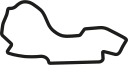
The team’s first appearance came at the 1959 Monaco Grand Prix, where Behra entered the car for his close friend Maria Teresa de Filippis, the first woman ever to compete in Formula One. Unfortunately, de Filippis failed to qualify the car for the race, meaning the Behra-Porsche’s World Championship debut ended before it had begun.
Events soon took a dramatic turn. Following the 1959 French Grand Prix, Behra’s already-strained relationship with Ferrari finally collapsed after an explosive confrontation with team management. During a heated argument in a restaurant, Behra punched Ferrari team manager Romolo Tavoni and was dismissed from the Scuderia with immediate effect. Ironically, the split freed Behra to race his own Behra-Porsche in Formula One.
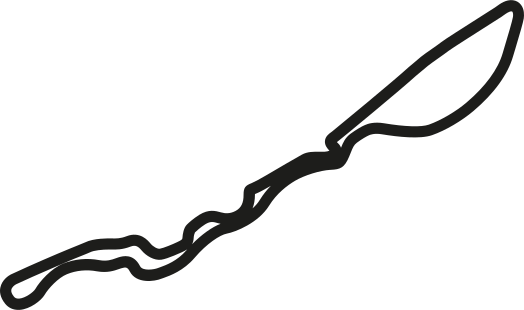
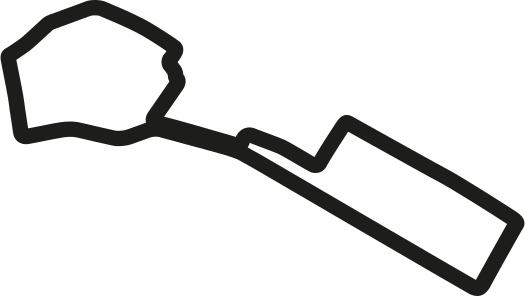
That opportunity came at the 1959 German Grand Prix, held on the terrifying AVUS circuit in Berlin — the only World Championship Grand Prix ever staged there. Behra entered both the Behra-Porsche Formula car and a Porsche RSK sports car for the supporting race. Tragically, it was during that support event that disaster struck.
In torrential rain, Behra lost control of his Porsche RSK on the infamous steeply banked section of the AVUS circuit. The car spun violently, launched over the top of the banking, and Behra was thrown from the wreckage before striking a flagpole with catastrophic force. He suffered fatal skull fractures and multiple broken ribs, with doctors concluding he died instantly on impact. The crash ended not only the life of one of motorsport’s most charismatic racers, but also the original vision behind the Behra-Porsche project.
Following Behra’s death, the car was acquired by Lloyd “Lucky” Casner’s ambitious Camoradi International team, which continued campaigning the machine during the 1960 Formula One season. The Behra-Porsche finally made its first World Championship start at the 1960 Argentine Grand Prix, where American driver Masten Gregory brought the car home in 12th place, four laps behind the winner.
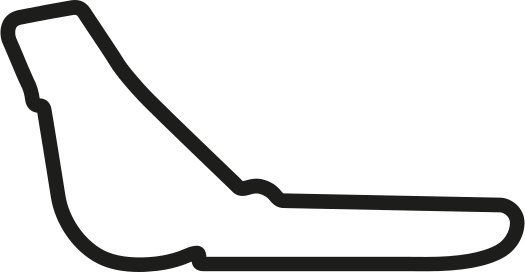
The car’s final Formula One appearance came later that year at the 1960 Italian Grand Prix at Monza. That race became notable for the boycott of several leading British teams over safety concerns regarding Monza’s banking. American driver Fred Gamble drove the Behra-Porsche to 10th place — the final classified finisher, nine laps adrift of the leader. Although modest in outright results, the finish was the end of one of Formula One’s most unusual and romantic independent constructor stories.
In total, Behra-Porsche entered four Formula One World Championship Grands Prix, starting and finishing two races during the 1960 season. The team scored no championship points, but its significance extended far beyond statistics. Behra-Porsche represented the final expression of Jean Behra’s fierce independence and love for racing — a privateer dream combining French passion, German engineering, and the fearless spirit of Formula One’s most adventurous era.
Behra-Porsche Stats by Season
| Year | Engine | Drivers | Entries | Starts | Wins | Podiums | Poles | Fastest Laps | Front Rows | DNF | Best Start | Best Result | Points | Championship |
|---|---|---|---|---|---|---|---|---|---|---|---|---|---|---|
| 1959 | Porsche | Maria Teresa de Filippis, Jean Behra | 2 | – | – | – | – | – | – | – | – | – | – | NC |
| 1960 | Porsche | Masten Gregory, Fred Gamble | 2 | 2 | – | – | – | – | – | – | 14 | 10 | – | NC |


