




















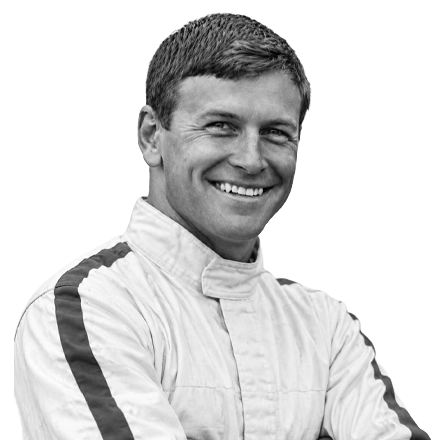
Frederick Kesner Gamble (March 17, 1932 – March 30, 2024) was an American racing driver, journalist and motorsport executive. His only Formula One World Championship appearance came at the 1960 Italian Grand Prix, where he finished tenth in a Formula Two Behra-Porsche without scoring points.
Driver Bio
| Nationality | American |
| Birthplace | Pittsburgh, Pennsylvania, USA |
| Born | 17 March 1932 |
| Died | 30 March 2024 |
| First Grand Prix | 1960 Italian Grand Prix |
| Last Grand Prix | 1960 Italian Grand Prix |
| Years Active | 1960 |
| Current/Last Team | Behra-Porsche |
Gamble’s influence ultimately stretched well beyond that single Grand Prix. He helped create Camoradi USA, worked with Carroll Shelby during the birth of the Cobra and established Goodyear’s international racing operation, which accumulated world titles, Le Mans victories and landmark Formula One successes.
He died in Honolulu, Hawaii, on March 30, 2024, aged 92.
Early life
Fred Kesner Gamble was born in Pittsburgh, Pennsylvania, on March 17, 1932. His family relocated to Fort Lauderdale, Florida, after the Second World War, placing him close to the emerging American sports-car scene.
A job selling refreshments at a local circuit gave Gamble more than pocket money: it allowed him to meet drivers and become part of the racing community. He graduated from Fort Lauderdale High School in 1950 and later served as a U.S. Air Force radio operator during the Korean War.
After leaving the military, Gamble studied first at California Polytechnic State University and then at the University of Florida. Racing clubs at both institutions kept his motorsport ambitions alive.
Building the Gambini
During his final semester, Gamble discovered a dismantled Crosley Hot Shot and persuaded its owner to exchange it for his Zündapp motorcycle. He discarded the original body and, while working part-time as a Volkswagen salesman, created a featherweight aluminium replacement around the standard 750 cc engine.
The finished H Modified special was christened the Gambini Mk1. Gamble completed the joke by entering international competition under the name “Fredrico Gambini.”
His first national race came at Gainesville, Georgia, in May 1958. After a lengthy battle with a DB that had competed at Le Mans, Gamble finished second in the H Modified category.
The performance earned him a position with Pensacola-based Jarrard Motors, an importer representing Renault, Triumph, AC Cars and Borgward across approximately 200 dealerships in 11 southeastern states. Gamble became assistant advertising manager and joined Bill Kimberly as a Triumph team driver.
Jarrard operated three Triumph TR3s, while Gamble was assigned to the smaller saloon category in a TR10—the 1,000 cc Standard Ten—where his opponents included Volkswagens, Renault Dauphines and Morris Minors.
When Jarrard abandoned plans to run the factory-supported Triumph team at Sebring in 1959 and withdrew from SCCA competition, Gamble resigned. He returned to southern Florida and raced an MGA owned by a University of Miami student.
Journalism and the birth of Camoradi
Gamble had already begun writing about motorsport during the mid-1950s. His work appeared in Chris Economaki’s National Speed Sport News, the SCCA magazine Sports Car, Denise McCluggage’s Competition Press and Road & Track.
That combination of racing, publicity and commercial experience became crucial after a chance meeting with Lloyd “Lucky” Casner at a summer SCCA event in Miami. During the prize presentation, Casner announced his ambition to take a team to Europe and jokingly invited the gathered amateurs to help finance it.
Gamble took the proposal seriously. Recognising Casner as a talented promoter, he offered to travel as a helper and publicist while paying his own expenses through motoring journalism. Casner instead suggested that they become partners.
Drawing on his education in advertising, public relations, journalism and marketing, Gamble developed the idea of an American “Olympic team” for motor racing. Inspired by Scotland’s Ecurie Ecosse, the operation would combine leading American drivers, competitive machinery and corporate backing in an assault on European racing.
Casner and his friends had previously used the informal name Camoradi—short for Casner Motor Racing Division. The new professional organisation was incorporated as Camoradi USA and promoted as America’s first industry-sponsored international racing team.
The timing was fortunate. Goodyear was entering sports-car racing and supplied substantial funding along with tyres. Chevrolet president Ed Cole and engineer Zora Arkus-Duntov arranged discreet financial assistance and provided two competition-equipped Corvettes through Don Allen Chevrolet in Miami. The support remained unofficial because American manufacturers were operating under a voluntary ban on factory racing involvement.
Those early commitments helped attract Shell/BP, Exide, Champion, DA Lubricants, Koni, Dow and Guest Airways, whose route from Mexico to Paris passed through Miami.
Casner travelled to Europe in September 1959 and approached Maserati. Although financially troubled, the Italian manufacturer had developed the fast new Tipo 61 “Birdcage” but lacked the money to operate a works team. Camoradi offered a solution.
Casner also struck an agreement with Porsche competition chief Huschke von Hanstein and purchased two cars from the estate of Jean Behra: a lightweight Carrera and the special Behra-Porsche Formula Two car. The latter had served as a development prototype for Porsche’s 1960 F2 machines and its later 1.5-litre Formula One programme.
Stirling Moss used his longstanding relationship with Maserati to join the project, compromising its intended all-American identity but adding one of the world’s greatest drivers.
Camoradi’s wide-ranging roster included Moss, Jim Rathmann, Roger Ward, Carroll Shelby, Masten Gregory, Dan Gurney, Chuck Daigh, Jo Bonnier, Jack McAfee, Jim Jeffords, Bill Wuesthoff, Joe Sheppard, Dick Dungan, Denise McCluggage, Umberto Maglioli, Nino Vaccarella, Gino Munaron, Giorgio Scarlatti, Casner and Gamble. Juan Manuel Fangio also drove a demonstration lap for the team at Córdoba, Argentina, in 1960.
Camoradi’s 1960 campaign
Camoradi’s factory-prepared Maseratis led every round of the 1960 World Sportscar Championship at some stage, although mechanical fragility repeatedly denied them results. Their major victory came at the Nürburgring 1000 Kilometres, where Moss and Gurney won in a Tipo 61.
The programme had already shown promise at Nassau in 1959. Shelby led before retiring with mechanical trouble, Bonnier won the two-litre category in a Porsche RSK and Johnny Cuevas claimed the GT class in a Porsche Carrera.
At the 1960 Buenos Aires 1000 Kilometres, Gurney and Gregory again showed speed before accidents and mechanical problems intervened. Gregory also drove the Behra-Porsche in the Argentine Grand Prix.
Camoradi entered eight cars for the Havana Grand Prix. Moss delivered overall victory in a Maserati, Gregory won the two-litre division with the Porsche RSK, Jeffords took the main GT category in a Corvette and Cuevas captured the under-two-litre GT class in the Carrera.
The Sebring 12 Hours produced an even larger eight-car assault: three Maseratis, two Porsche Carreras, two Corvettes and an OSCA 750. Moss and Gurney led for eight hours before their Maserati failed. Sheppard and Dungan won the under-two-litre GT class with a Carrera and placed second among all GT finishers, while the McCluggage/Windridge OSCA retired.
Gamble shared the Corvette entry with Jeffords and Wuesthoff but drove for the entire 12 hours himself, becoming one of only two drivers then known to have completed the race solo. The effort earned him the press nickname “Iron Man Gamble.”
At the Nürburgring, Gamble qualified Camoradi’s bulky Corvette—nicknamed the “Yank Tank”—third among the large GT cars, ahead of several Ferrari 250 GTs. He never got to race it. Co-driver Lee Lilley started but retired with a wheel-bearing failure before handing over. Moss and Gurney won overall in the team’s Maserati, while Gregory and Munaron finished fourth.
Le Mans brought speed without reliability for the three Birdcages. Gregory and Daigh led in the streamlined Maserati, establishing a three-litre lap record and reaching 170 mph before engine failure ended their challenge. Both long-tail team cars retired with electrical problems.
Gamble and Lilley treated their Corvette more conservatively and were announced as tenth overall at the finish, receiving participant medals during the awards ceremony. They later discovered that the car had been excluded for failing to cover sufficient distance under the Index of Performance regulations. Immediately ahead on the road had been the 1959-winning Aston Martin DBR1 in ninth and the Cunningham Corvette of John Fitch and Bob Grossman in eighth.
Gamble was also approved to drive the Behra-Porsche at the 1960 German Grand Prix, where Porsche used the car during practice. Von Hanstein withdrew it at the last moment, however, because a factory engine had been installed.
Formula One at Monza
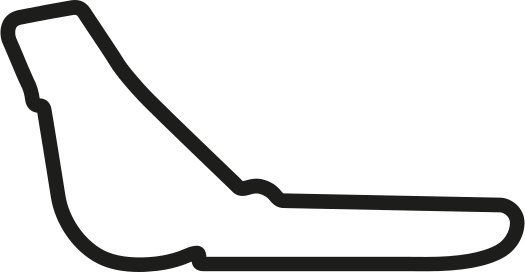
Gamble finally reached the World Championship at Monza on September 4, 1960. Ferrari had encouraged the organisers to include the circuit’s notoriously rough banked oval, a decision that prompted the leading British teams to boycott the race. Lotus founder Colin Chapman was particularly concerned that his fragile rear-engined cars might not survive the pounding.
The reduced field opened the door to Formula Two entrants. Gamble entered Camoradi’s Behra-Porsche, serving as both driver and organiser while also collecting the valuable starting money.
Designer Valerio Colotti and constructor Neri worked in his pit and believed the car could complete the 500-kilometre race without refuelling. Gamble therefore kept the engine approximately 500 rpm below its limit.
The strategy initially worked. He ran eighth overall and led the private Formula Two competitors before the fuel calculations proved optimistic. Stranded on the circuit, Gamble ran back to the pits, collected a can of petrol and returned to the car. He eventually crossed the line in tenth place. Phil Hill won for Ferrari.
It was Gamble’s only Formula One Grand Prix.
Sweden, Goodwood and departure from Camoradi
Gamble and New Zealand mechanic Bob Wallace subsequently took a Corvette and Maserati to Sweden. Wallace later remained in Modena and became Lamborghini’s chief test driver.
At the Swedish sports-car Grand Prix, Bonnier placed the Birdcage second behind Moss in the first Lotus 19, while Casner won the GT division. Bonnier then drove both Camoradi cars on a closed superhighway, setting a Swedish speed record in the Maserati and a national GT mark in the Corvette.
Gamble held a paid entry for the Goodwood Tourist Trophy and believed the durability of his Goodyear tyres would be valuable on a circuit famous for punishing rubber. The car never arrived. After a lunch stop in southern Sweden, Wallace apparently fell asleep at the wheel, overturning and destroying the Corvette.
By October 1960, Gamble had become disillusioned with Casner’s spending and what he viewed as a misuse of sponsors’ trust. He resigned from Camoradi.
The Harrison opportunity
Gamble returned to Nassau that December as a journalist, although he remained open to another drive. Racing patron Frank Harrison of Chattanooga approached him with an ambitious proposal.
Harrison owned Camoradi’s former streamlined Birdcage Maserati, recently used by Shelby and Jeffords to win the American professional sports-car championship. He offered Gamble the chance to race that car and a Maserati 450S in national SCCA events during 1961. The plan was to preserve the machinery, learn the circuits and build towards a new Cooper or Lotus in 1962. A national championship would then unlock a Formula One campaign for 1963.
At Sebring in 1961, Gamble served as reserve driver for Denise McCluggage and the inexperienced Alan Eager in a Ferrari 250 GT. Eager received permission to race, and the pair went on to win their GT category.
Gamble began his own season at Marlboro, Maryland, finishing second to circuit lap-record holder Bob Holbert. Strong results left him leading the standings during the opening half of the campaign, but internal disagreements—centred on a difficult workshop manager—began pulling Harrison’s operation apart.
Unable to resolve the conflict, Gamble left both the team and active racing. Despite contesting only part of the season, he was classified third in the final SCCA standings behind Roger Penske and Walt Hansgen.
Triumph, Shelby and Goodyear
Gamble moved to New York and became assistant advertising manager for Standard-Triumph North America during the launch of the TR4. Working with his manager, Mike Cook, he helped establish Triumph’s competition programme, a manufacturer-backed model later adopted by other companies. Gamble and Cook also supported Bob Tullius early in his career, helping create the foundations from which the highly successful Group 44 team emerged.
In the summer of 1962, Carroll Shelby brought his first Cobra to New York for a presentation to the International Motor Press Association. Gamble, a member of the organisation, sat with Shelby during lunch. When Shelby explained that he needed to establish a company to manufacture the car, Gamble became his first sales manager and relocated to Venice, California.
Two months later, during the Cobra’s racing debut at Riverside, Shelby and Gamble met Goodyear racing manager Tony Webner. Over dinner, Webner outlined plans to expand Goodyear’s competition activities and mentioned that he needed another assistant.
Shelby, already Goodyear’s racing-tyre distributor for the western states, made his own requirement clear: he needed the company’s backing—along with Ford’s—to take the Cobra to Europe and challenge Ferrari for the World GT Championship.
Goodyear hired Gamble. Through the 1963 season, Gamble, Webner and Shelby worked to convince company management that international racing deserved a dedicated tyre division. Approval followed, and Gamble was appointed its founding director.
In February 1964, he and chief engineer Walt DeVinney established the new operation at Goodyear’s Wolverhampton plant in England.
The results came quickly. During the next five years, Gamble’s team contributed to seven World Championships and three consecutive Le Mans victories: Ferrari’s win in 1965 followed by Ford’s triumphs in 1966 and 1967. Goodyear earned its first Formula One victory with Richie Ginther and Honda at the 1965 Mexican Grand Prix, then supplied Dan Gurney’s all-American Eagle-Weslake for its historic victory at the 1967 Belgian Grand Prix.
Gamble handed control of Goodyear Racing to Leo Mehl in 1968 and moved into general management.
His extensive collection of photographs, films and memorabilia was later placed at the International Motor Racing Research Center in Watkins Glen, New York. The archive is divided into three areas: Goodyear’s early racing years, the history of Camoradi USA and Gamble’s personal career.
Grand Prix Stats
| Race Entries | 1 |
| Race Starts | 1 |
| Did Not Start | 0 |
| Best Race Start | 14th |
| Best Race Finish | 10th |
| Retirements | 0 |
| First-Lap Retirements | 0 |
| Not Classified | 0 |
| Disqualified | 0 |
| Did Not Qualify | 0 |
Qualifying
| Qualifying Sessions | 1 |
| Reached Q3 | 0 |
| Q2 Eliminations | 0 |
| Q1 Eliminations | 0 |
| Did Not Qualify | 0 |
Stats by Season
| Year | Constructor | Entries | Starts | Wins | Podiums | Poles | Fastest Laps | Front Rows | DNF | Best Start | Best Result | Pts Finishes | Points | Championship |
|---|---|---|---|---|---|---|---|---|---|---|---|---|---|---|
| 1960 | Behra-Porsche | 1 | 1 | 0 | 0 | 0 | 0 | 0 | 0 | 14 | 10 | 0 | 0 | NC |
Stats by Constructor
| Constructor | Years | Entries | Starts | Wins | Podiums | Poles | Fastest Laps | Front Rows | DNF | Best Start | Best Result | Pts Finishes | Points |
|---|---|---|---|---|---|---|---|---|---|---|---|---|---|
| Behra-Porsche | 1960 | 1 | 1 | 0 | 0 | 0 | 0 | 0 | 0 | 14 | 10 | 0 | 0 |