


























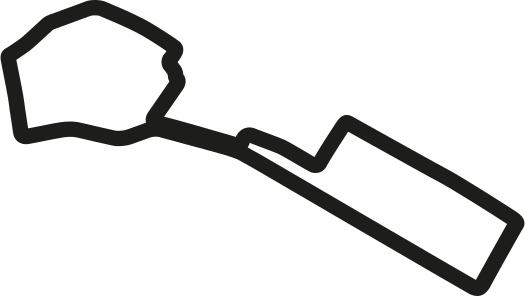
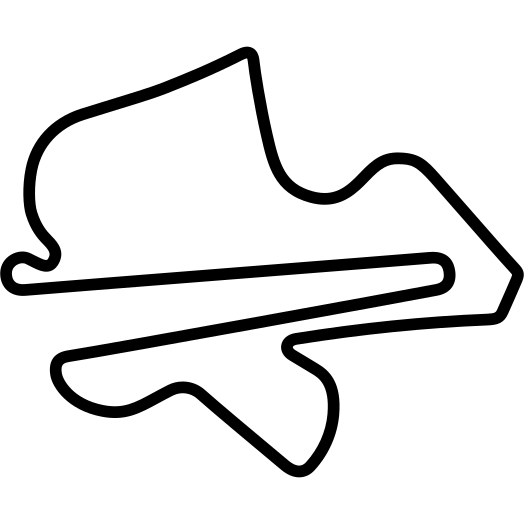
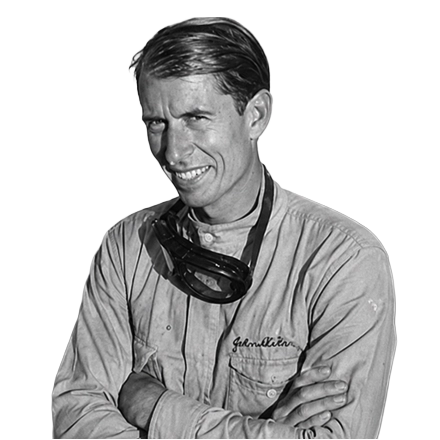
John Cooper Fitch (4 August 1917 – 31 October 2012) was an American racing driver, aviation veteran, engineer and inventor. A pioneer of post-war international motorsport, he became the first American driver to achieve sustained success in European sports car racing after the Second World War. During an 18-year racing career, Fitch won major events including the 1953 12 Hours of Sebring, the Gran Premio de Eva Duarte Perón – Sport, the production car class at the 1955 Mille Miglia and the 1955 RAC Tourist Trophy, while also claiming the inaugural SCCA National Sports Car Championship.
Driver Bio
| Nationality | American |
| Birthplace | Indianapolis, Indiana, USA |
| Born | 4 August 1917 |
| Died | 31 October 2012 |
| First Grand Prix | 1953 Italian Grand Prix |
| Last Grand Prix | 1955 Italian Grand Prix |
| Years Active | 1953, 1955 |
| Current/Last Team | Privateer: Stirling Moss Ltd. Maserati |
Although he made only two Formula One World Championship starts, Fitch was equally renowned for his work with Briggs Cunningham and Mercedes-Benz at the highest level of sports car racing. Following his retirement from competition, he became one of the world’s foremost authorities on motorsport and highway safety. His pioneering impact-attenuation systems, barrier designs and driver protection concepts have saved countless lives and permanently changed racing circuits and public roads around the world.
Early life
John Fitch was born in Indianapolis, Indiana, in 1917 and was a descendant of the steamboat inventor John Fitch. His fascination with automobiles began early through his stepfather, an executive with the Stutz Motor Company.
During the late 1930s, he attended the Kentucky Military Institute before studying civil engineering at Lehigh University. In 1939, he travelled throughout Europe, witnessing the final race held at Brooklands before the outbreak of the Second World War. Returning to the United States, he sailed a 32-foot schooner from Sarasota to New Orleans before world events dramatically altered the course of his life.
World War II service
Although motorsport would eventually make him famous, aviation was Fitch’s first passion.
While travelling in England in 1939, he volunteered for military service and formally joined the United States Army Air Corps in 1941. Flying first in North Africa aboard the Douglas A-20 Havoc before transferring to England, he later flew North American P-51 Mustangs with the elite Fourth Fighter Group on bomber escort missions.
Fitch became one of the American pilots credited with shooting down the revolutionary German Messerschmitt Me 262 jet fighter. Just two months before the war ended, however, he was himself shot down after making a third strafing attack on an Axis train. Captured by German forces, he spent the remainder of the conflict as a prisoner of war.
Racing career
Returning home after the war, Fitch channelled the adrenaline of military flying into motorsport. He opened an MG dealership and began racing an MG TC at American road courses including Bridgehampton, Watkins Glen and Thompson.
His speed quickly attracted the attention of racing patron Briggs Cunningham, who invited him to join his ambitious programme. In 1950, Fitch developed his own modified Fiat 1100, known as the “Fitch Model B”, before ending the year driving a Jaguar XK120 at Sebring.
The following season proved to be his breakthrough. Driving a Cadillac-powered Allard J2, he won the Gran Premio de Eva Duarte Perón – Sport in Argentina, receiving both the winner’s trophy and congratulations from Eva Perón herself. The victory also secured Cunningham’s financial backing, allowing Fitch to establish himself as one of America’s leading sports car drivers. During the same year he became the inaugural SCCA National Sports Car Champion and added victories in Formula Three competition.
In 1952, Fitch continued racing for Cunningham while competing internationally in endurance events, rallies and sports car races. At Le Mans he impressed Mercedes-Benz technical director Rudolf Uhlenhaut with his speed, eventually earning an invitation to test the new Mercedes-Benz 300 SL. Determined to make an impression, Fitch pushed the car to its limits at the Nürburgring and successfully convinced Mercedes to contest the Carrera Panamericana in Mexico.
Although mechanical problems and a subsequent disqualification prevented a strong result there, his performances earned enormous respect from Mercedes management.
Sebring triumph and Formula One
Fitch enjoyed the finest season of his career in 1953.
Together with Phil Walters, he drove a Cunningham C4R to victory in the 12 Hours of Sebring, defeating the favoured Aston Martin works team and becoming the first American drivers to win the race in an American-built car. The achievement established Fitch among the world’s elite sports car racers and earned him Speed Age magazine’s Sports Car Driver of the Year award.
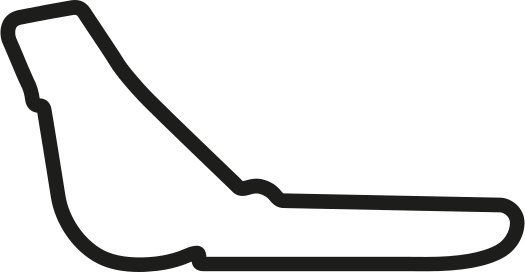
That same season he made the first of two Formula One World Championship appearances, driving an HWM-Alta at the Italian Grand Prix at Monza. Although he failed to finish, he had reached the highest level of single-seater racing while simultaneously competing in endurance events, Formula Three and even attempting to qualify for the Indianapolis 500.
Mercedes-Benz and Le Mans
In 1955, Fitch joined the legendary Mercedes-Benz works sports car team alongside Juan Manuel Fangio, Stirling Moss and Karl Kling.
He produced one of his finest individual performances in the Mille Miglia by winning the Gran Turismo over 1300cc production class in a standard Mercedes-Benz 300 SL while finishing fifth overall behind only the factory 300 SLR race cars. During the event, he also helped Stirling Moss by designing the innovative rolling route-map device used by Denis Jenkinson to navigate the 1,000-mile course.
Later that season, Fitch and Moss combined to win the RAC Tourist Trophy.
His year was also overshadowed by tragedy. At the 1955 24 Hours of Le Mans, Fitch had been scheduled to share a Mercedes-Benz 300 SLR with Pierre Levegh. While Fitch was resting in the pits, Levegh’s fatal accident triggered the worst disaster in motorsport history, claiming the lives of 83 spectators.
Witnessing the aftermath profoundly affected Fitch and inspired the lifelong commitment to safety engineering that would define the rest of his career.
Later racing career
Following his European successes, Chevrolet appointed Fitch to manage its new Corvette racing programme. Under his leadership, the Corvette quickly established itself as a competitive sports car, setting speed records at Daytona and winning multiple class honours.
Throughout the late 1950s and early 1960s he remained active behind the wheel, racing Jaguars, Maseratis, Porsches, Corvettes, Cooper Monacos and numerous other machines. He also became circuit director at the newly opened Lime Rock Park, helping establish one of America’s most important permanent road racing venues.
His final professional races came alongside longtime friend Briggs Cunningham, with whom he competed at Sebring and Le Mans well into the 1960s. Although mechanical failures ended their final appearance together at Sebring in 1966, both later reflected that they had raced simply because they loved driving rather than chasing victories.
Even after retiring, Fitch regularly competed in historic events at Lime Rock, Goodwood and Monterey. Remarkably, he returned to official competition in his late eighties, attempting land speed records at Bonneville in the same Mercedes-Benz 300 SLR he had raced half a century earlier.
World Championship career summary
Fitch competed in two Formula One World Championship Grands Prix, making his debut at the 1953 Italian Grand Prix with HWM-Alta before returning to Monza in 1955 aboard a Maserati 250F. He finished ninth in his second and final World Championship start and scored no championship points. Although his Formula One career was brief, his greatest successes came in sports car racing, where he established himself as one of America’s finest international competitors.
Engineering and automotive design
Away from the cockpit, Fitch possessed a remarkable talent for engineering.
He designed several racing specials, including the innovative Fitch Model B and the lightweight Fitch-Whitmore, before later developing road-going performance cars such as the acclaimed Fitch Sprint, based on the Chevrolet Corvair. Rather than chasing outright power, the Sprint focused on suspension, steering and chassis improvements, transforming the Corvair into a refined sports car capable of competing with far more expensive European machinery.
His most ambitious project was the Fitch Phoenix, a lightweight Corvair-based sports car that blended American engineering with Italian-inspired styling. Although changing safety regulations and the end of Corvair production prevented series manufacture, the prototype became one of the most celebrated American concept sports cars of the era.
Revolutionising motorsport safety
Fitch’s greatest legacy came not through race victories but through his revolutionary work in safety engineering.
Motivated by the horrors of the 1955 Le Mans disaster, he founded Impact Attenuation Inc. and devoted decades to making both motorsport and public roads safer.
His best-known invention was the Fitch Barrier, an impact-attenuation system using rows of energy-absorbing barrels placed in front of fixed roadside hazards. Introduced in the late 1960s, the system became standard across North American highways and is estimated to have saved many thousands of lives.
He also developed the Fitch Compression Barrier for racing circuits, the Displaceable Guardrail system, advanced driver safety capsules designed to reduce neck and spinal injuries, improved suspension concepts, cooling systems and numerous other automotive innovations.
Working alongside doctors, engineers and leading racing figures, Fitch became one of the world’s foremost authorities on vehicle safety, advising governments, research organisations and racing authorities for decades.
Honours and recognition
Fitch’s achievements were recognised across both motorsport and engineering.
His military service earned him numerous decorations, including the Purple Heart, Air Medals and Prisoner of War Medal. His engineering work was honoured with the Kenneth Stonex Roadside Safety Award in 1998 for a lifetime of contributions to highway safety.
He was also inducted into the Corvette Hall of Fame, Sebring Hall of Fame, Sports Car Club of America Hall of Fame, Motorsports Hall of Fame of America and the New England Auto Racers Hall of Fame, recognising both his racing accomplishments and his enduring influence on automotive safety.
Personal life and legacy
An enthusiastic sailor as well as a racing driver, Fitch spent much of his later life in Connecticut near Lime Rock Park with his wife Elizabeth, with whom he had three sons.
He remained active as an engineer, consultant and speaker well into his nineties, continuing to attend historic racing events and promote improvements in vehicle safety.
John Fitch died on 31 October 2012 from Merkel cell carcinoma at his Connecticut home, aged 95.
Although he enjoyed an outstanding racing career that included victories at Sebring, the Mille Miglia and the RAC Tourist Trophy, John Fitch’s greatest achievement lies in the countless lives saved through his pioneering safety innovations. His influence extends far beyond motorsport, making him one of the most important figures in the history of automotive engineering.
Grand Prix Stats
| Race Entries | 2 |
| Race Starts | 2 |
| Did Not Start | 0 |
| Best Race Start | 20th |
| Best Race Finish | 9th |
| Retirements | 1 |
| First-Lap Retirements | 0 |
| Not Classified | 0 |
| Disqualified | 0 |
| Did Not Qualify | 0 |
Qualifying
| Qualifying Sessions | – |
| Reached Q3 | – |
| Q2 Eliminations | – |
| Q1 Eliminations | – |
| Did Not Qualify | 0 |
Stats by Season
| Year | Constructor | Entries | Starts | Wins | Podiums | Poles | Fastest Laps | Front Rows | DNF | Best Start | Best Result | Pts Finishes | Points | Championship |
|---|---|---|---|---|---|---|---|---|---|---|---|---|---|---|
| 1953 | HWM | 1 | 1 | 0 | 0 | 0 | 0 | 0 | 1 | 26 | – | 0 | 0 | NC |
| 1955 | Privateer: Stirling Moss Ltd. Maserati | 1 | 1 | 0 | 0 | 0 | 0 | 0 | 0 | 20 | 9 | 0 | 0 | NC |
Stats by Constructor
| Constructor | Years | Entries | Starts | Wins | Podiums | Poles | Fastest Laps | Front Rows | DNF | Best Start | Best Result | Pts Finishes | Points |
|---|---|---|---|---|---|---|---|---|---|---|---|---|---|
| HWM | 1953 | 1 | 1 | 0 | 0 | 0 | 0 | 0 | 1 | 26 | – | 0 | 0 |
| Privateer: Stirling Moss Ltd. Maserati | 1955 | 1 | 1 | 0 | 0 | 0 | 0 | 0 | 0 | 20 | 9 | 0 | 0 |
Teammates & Qualifying Head-to-Head
| Teammate | Years | Races | Qualifying H2H |
|---|---|---|---|
| Lance Macklin | 1953 | 1 | – |
| Yves Giraud-Cabantous | 1953 | 1 | – |