



























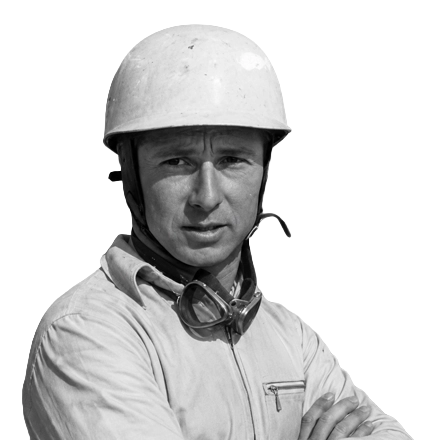
Lance Noel Macklin (2 September 1919 – 29 August 2002) was a British racing driver who entered 15 Formula One World Championship Grands Prix between 1952 and 1955. A talented sports car and Grand Prix competitor, he is remembered both for his victory in the 1952 BRDC International Trophy and for his involvement in the tragic 1955 Le Mans disaster, one of the darkest days in motorsport history.
Driver Bio
| Nationality | British |
| Birthplace | Kensington, London |
| Born | 2 September 1919 |
| Died | 29 August 2002 |
| First Grand Prix | 1952 Swiss Grand Prix |
| Last Grand Prix | 1955 British Grand Prix |
| Years Active | 1952–1955 |
| Current/Last Team | Privateer: Stirling Moss Maserati |
Early Life
Born in Kensington, London, on 2 September 1919, Macklin came from a family with deep roots in the British motor industry. His father, Noel Macklin, founded the Invicta and Railton car companies and later established Fairmile Marine, a leading builder of motor gun boats and torpedo boats during the Second World War.
Educated at Eton College, Macklin volunteered for service in the Royal Navy following the outbreak of war in 1939. Reflecting his family’s engineering background, he served aboard motor gun boats before returning to civilian life after the conflict.
Early Racing Career
Following demobilisation, Macklin pursued his ambition of becoming a professional racing driver. His first attempt to enter a race on the Isle of Man was rejected because he lacked competitive experience, but he remained determined to establish himself.
Before competing in the 1948 Grand Prix des Frontières, Macklin famously prepared by driving his Invicta at high speed on public roads and teaching himself advanced car control techniques, including practising four-wheel drifts around London’s Belgrave Square.
His performance impressed observers and led to an opportunity with Aston Martin. Initially serving as a reserve driver for the 24 Hours of Le Mans, he also competed in the Spa 24 Hours, finishing fifth.
Sports Car Success
Macklin became a regular Aston Martin driver and achieved fifth place at the 1950 24 Hours of Le Mans alongside George Abecassis, founder of HWM.
Abecassis subsequently invited him to race for HWM, where Macklin enjoyed the greatest success of his career by winning the prestigious 1952 BRDC International Trophy, one of Britain’s leading non-championship Formula One events.
At Le Mans, Macklin continued to perform strongly. Returning with Aston Martin in 1951, he finished third overall and secured his second victory in the under-three-litre class, although class wins did not receive the same recognition they do today.
After leaving Aston Martin in 1952 following a disagreement over his contract, he joined Bristol for the 1953 season. Results proved difficult to come by, but Macklin remained a popular figure within the paddock thanks to his relaxed personality and easy-going approach to racing.
Former teammate George Abecassis often joked that persuading Macklin to practise could be harder than preparing the cars themselves, as he was sometimes more interested in socialising than spending time on the circuit.
Formula One Career
HWM provided Macklin with his Formula One World Championship debut in 1952.
Between 1952 and 1955, he entered 15 World Championship Grands Prix. Although the small team struggled to match the pace of the leading factory entrants, Macklin established himself as a capable and respected competitor during Formula One’s formative years.
While racing for HWM, he also formed a close friendship with fellow British driver Stirling Moss, who would go on to become one of the sport’s all-time greats.
Although he never scored World Championship points, Macklin’s victory in the 1952 BRDC International Trophy remains one of the standout achievements of his racing career.
The 1955 Le Mans Disaster
Macklin’s name became permanently linked with the tragic events of the 1955 24 Hours of Le Mans.
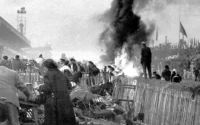
During the race, Mike Hawthorn braked sharply to enter the pits, forcing Macklin to take evasive action in his Austin-Healey. As Macklin moved across the circuit, Pierre Levegh‘s Mercedes-Benz struck the rear of his car, launching into the air before disintegrating in front of the grandstands.
Levegh was killed instantly, while debris from the Mercedes caused the deaths of 83 spectators and injured many more in what remains the deadliest accident in motorsport history.
Macklin escaped without serious injury, but the tragedy had a profound effect on him. He believed Hawthorn’s late manoeuvre had initiated the sequence of events and later felt that public opinion had unfairly shifted responsibility towards him.
The accident led to major changes in circuit safety and race organisation, becoming a defining moment in the history of international motorsport.
Retirement and Business Career
Macklin continued racing after Le Mans, but later that year he was involved in another serious accident during the Tourist Trophy at Dundrod. While avoiding a separate crash that claimed the lives of Jim Mayers and William T. Smith, Macklin crashed his Austin-Healey 100S.
Following these traumatic experiences, and encouraged by his girlfriend at the time, he decided to retire from competitive motor racing.
After leaving the sport, Macklin moved into the automotive industry. He joined French manufacturer Facel Vega, managing its export division until the company’s collapse in 1963. He later continued his career with prestigious London dealership H.R. Owen.
Personal Life and Legacy
Macklin married twice, first to Shelagh and later to Gillian. He had two children from his first marriage and one from his second.
Later in life, he moved to Spain before returning to England following ill health. Lance Macklin died in Tenterden, Kent, on 29 August 2002, just four days before his 83rd birthday.
Although history often remembers him for his involuntary role in the 1955 Le Mans disaster, Macklin was also a talented racing driver whose achievements included success with Aston Martin, victory in one of Britain’s premier Formula One races, and a respected career in both Grand Prix and endurance competition. Today, he remains an important figure in the story of post-war British motorsport.
Grand Prix Stats
| Race Entries | 15 |
| Race Starts | 13 |
| Did Not Start | 0 |
| Best Race Start | 9 |
| Best Race Finish | 8 |
| Retirements | 8 |
| First-Lap Retirements | 0 |
| Not Classified | 0 |
| Disqualified | 0 |
| Did Not Qualify | 2 |
Qualifying
| Qualifying Sessions | 15 |
| Reached Q3 | 0 |
| Q2 Eliminations | 0 |
| Q1 Eliminations | 0 |
| Did Not Qualify | 2 |
Stats by Season
| Year | Constructor | Entries | Starts | Wins | Podiums | Poles | Fastest Laps | Front Rows | DNF | Best Start | Best Result | Pts Finishes | Points | Championship |
|---|---|---|---|---|---|---|---|---|---|---|---|---|---|---|
| 1952 | HWM | 6 | 5 | 0 | 0 | 0 | 0 | 0 | 1 | 9 | 8 | 0 | 0 | NC |
| 1953 | HWM | 6 | 6 | 0 | 0 | 0 | 0 | 0 | 6 | 12 | – | 0 | 0 | NC |
| 1954 | HWM | 1 | 1 | 0 | 0 | 0 | 0 | 0 | 1 | 15 | – | 0 | 0 | NC |
| 1955 | Privateer: Stirling Moss Maserati | 2 | 1 | 0 | 0 | 0 | 0 | 0 | 0 | 16 | 8 | 0 | 0 | NC |
Stats by Constructor
| Constructor | Years | Entries | Starts | Wins | Podiums | Poles | Fastest Laps | Front Rows | DNF | Best Start | Best Result | Pts Finishes | Points |
|---|---|---|---|---|---|---|---|---|---|---|---|---|---|
| HWM | 1952–1954 | 13 | 12 | 0 | 0 | 0 | 0 | 0 | 8 | 9 | 8 | 0 | 0 |
| Privateer: Stirling Moss Maserati | 1955 | 2 | 1 | 0 | 0 | 0 | 0 | 0 | 0 | 16 | 8 | 0 | 0 |
Teammates & Qualifying Head-to-Head
| Teammate | Years | Races | Qualifying H2H |
|---|---|---|---|
| Peter Collins | 1952, 1953 | 9 | – |
| Stirling Moss | 1952 | 1 | – |
| George Abecassis | 1952 | 1 | – |
| Roger Laurent | 1952 | 1 | – |
| Paul Frere | 1952, 1953 | 3 | – |
| Yves Giraud-Cabantous | 1952, 1953 | 3 | – |
| Duncan Hamilton | 1952, 1953 | 3 | – |
| Dries van der Lof | 1952 | 1 | – |
| Jack Fairman | 1953 | 1 | – |
| Albert Scherrer | 1953 | 1 | – |
| John Fitch | 1953 | 1 | – |