






















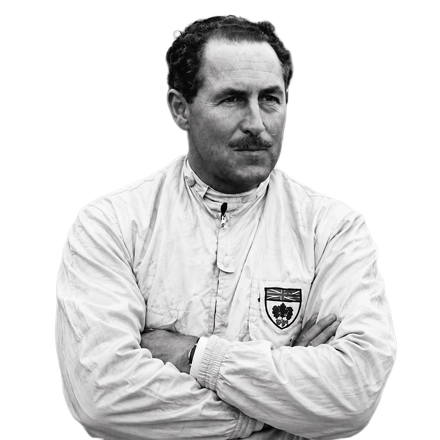
Jack Fairman combined racing with the demands of a family precision-tools business, becoming a respected development driver as well as a versatile competitor. Born in Horley on 15 March 1913, he began competing in 1934 with an Alvis 12/50, tackling trials, hillclimbs and races at Brooklands before wartime service in the Tank Corps interrupted his sporting activities.
Driver Bio
| Nationality | British |
| Birthplace | Smallfield, England, UK |
| Born | 15 March 1913 |
| Died | 7 February 2002 |
| First Grand Prix | 1953 British Grand Prix |
| Last Grand Prix | 1961 Italian Grand Prix |
| Years Active | 1953, 1955–1961 |
| Current/Last Team | Cooper |
His engineering background proved valuable when racing resumed. Fairman could test a car, explain what it was doing and help improve it, abilities that made him particularly useful to Connaught during its Formula Two and Formula One programmes. He was never simply chasing a succession of race seats; the work between meetings was an important part of his contribution.
That combination also explains why his appearances were often sporadic. Fairman maintained responsibilities outside racing, while teams could call on a driver whose practical understanding extended beyond reporting that a car was fast or slow.
Sports cars offered another outlet. He drove Bristol machinery, raced Jaguars for Ecurie Ecosse and competed for Aston Martin. In 1959 he shared winning Aston Martins with Stirling Moss at both the Nürburgring 1000 Kilometres and the Tourist Trophy at Goodwood, two notable successes in a season that brought the marque the World Sportscar Championship.
Fairman’s own World Championship debut had come in the British Grand Prix on 18 July 1953, driving an HWM that failed to finish. Across 13 championship appearances he scored five points, all earned during 1956 with a Connaught B. Those results placed him tenth in that year’s drivers’ standings, the most rewarding season of his Grand Prix career.
When Bernie Ecclestone bought the Connaught cars in 1958, Fairman continued to find opportunities in a variety of machinery. One of the most unusual came at the 1961 British Grand Prix, where he drove the Ferguson P99 entered by Rob Walker. Its four-wheel-drive system made it a technical landmark, while its engine remained ahead of the driver as the rest of F1 moved decisively towards rear-engined cars.
The P99 became the last front-engined car to start a World Championship Grand Prix and the first four-wheel-drive car to do so. Moss took over after brake trouble in his Lotus, but the Ferguson was disqualified after receiving a push-start. The result was disappointing; the car’s place in F1 history was secure.
Fairman’s final Formula One outing came outside the championship, in the 1963 Imola Grand Prix, where he drove an Ecurie Maarsbergen Porsche. His combination of occasional racing and demanding engineering work had carried him across a period of enormous technical change, from pre-war competition to the early 1960s revolution in Grand Prix design.
He died in Rugby on 7 February 2002, aged 88. Horley later gave him a particularly local memorial: the Jack Fairman pub opened on 12 February 2007 in Victoria Road, occupying a former garage building that had also housed a Kwik Fit branch. Photographs inside recalled a driver whose name belonged both to his home town and to several distinctive chapters of British motor racing.
Grand Prix Stats
| Race Entries | 13 |
| Race Starts | 12 |
| Did Not Start | 1 |
| Best Race Start | 11th |
| Best Race Finish | 4th |
| Retirements | 7 |
| First-Lap Retirements | 0 |
| Not Classified | 1 |
| Disqualified | 1 |
| Did Not Qualify | 0 |
Qualifying
| Qualifying Sessions | 13 |
| Reached Q3 | 0 |
| Q2 Eliminations | 0 |
| Q1 Eliminations | 0 |
| Did Not Qualify | 0 |
Points
| Points Scored | 5 |
| Points Finishes | 2 |
| Most Points in a Single Season | 5 (1956) |
| Seasons with Points | 1 (1956) |
Stats by Season
| Year | Constructor | Entries | Starts | Wins | Podiums | Poles | Fastest Laps | Front Rows | DNF | Best Start | Best Result | Pts Finishes | Points | Championship |
|---|---|---|---|---|---|---|---|---|---|---|---|---|---|---|
| 1953 | HWM, Connaught | 2 | 2 | 0 | 0 | 0 | 0 | 0 | 1 | 22 | – | 0 | 0 | NC |
| 1955 | Connaught | 1 | 0 | 0 | 0 | 0 | 0 | 0 | 0 | – | – | 0 | 0 | NC |
| 1956 | Connaught | 2 | 2 | 0 | 0 | 0 | 0 | 0 | 0 | 15 | 4 | 2 | 5 | 10th |
| 1957 | BRM | 1 | 1 | 0 | 0 | 0 | 0 | 0 | 1 | 16 | – | 0 | 0 | NC |
| 1958 | Privateer: BC Ecclestone Connaught, Cooper | 2 | 2 | 0 | 0 | 0 | 0 | 0 | 1 | 11 | 8 | 0 | 0 | NC |
| 1959 | Privateer: High Efficiency Motors Cooper | 2 | 2 | 0 | 0 | 0 | 0 | 0 | 2 | 15 | – | 0 | 0 | NC |
| 1960 | Privateer: CT Atkins Cooper | 1 | 1 | 0 | 0 | 0 | 0 | 0 | 1 | 15 | – | 0 | 0 | NC |
| 1961 | Privateer: Rob Walker Racing Ferguson, Privateer: Fred Truck Cars Cooper | 2 | 2 | 0 | 0 | 0 | 0 | 0 | 1 | 20 | – | 0 | 0 | NC |
Teammates & Qualifying Head-to-Head
| Teammate | Years | Races | Qualifying H2H |
|---|---|---|---|
| Duncan Hamilton | 1953 | 1 | – |
| Peter Collins | 1953 | 1 | – |
| Lance Macklin | 1953 | 1 | – |
| Ken McAlpine | 1953, 1955 | 2 | – |
| Roy Salvadori | 1953, 1958 | 2 | – |
| Desmond Titterington | 1956 | 1 | – |
| Archie Scott-Brown | 1956 | 2 | – |
| Les Leston | 1956, 1957 | 2 | – |
| Ron Flockhart | 1956 | – | – |
| Ivor Bueb | 1958 | – | – |
| Stirling Moss | 1961 | – | – |