





















The British Racing Partnership was one of the most intriguing privateer teams to emerge from post-war Britain. Founded in 1957 by Alfred Moss (father of Stirling) and Ken Gregory (Stirling’s long-time manager), BRP was conceived as a way to run competitive cars for Moss when he wasn’t tied to factory contracts and, just as importantly, to give other young drivers a shot at the big time.
BRP’s early years were a mix of promise and drama. In 1959, they campaigned both a Cooper-Borgward in Formula Two and, occasionally, a BRM Formula One car. That BRM, unfortunately, met a spectacular end in a high-speed crash at Berlin’s fearsome Avus circuit. But there were highlights too: Stirling Moss famously hustled a BRP-run BRM P25 to second place in the 1959 British Grand Prix, the team’s best F1 result.
More than just racers, BRP were an innovator. They were the very first Formula One outfit in F1 history to strike a full-team sponsorship deal, effectively selling their identity to a backer. Yeoman Credit, a hire-purchase company, came aboard in late 1959, rebranding the squad as Yeoman Credit Racing the following season. The deal was substantial for its day: £40,000 upfront to acquire equipment and £20,000 per year to keep the show on the road. With Cooper machinery in both F1 and F2, the team showed flashes of speed in 1960. But tragedy struck twice when two of their drivers lost their lives, souring Yeoman Credit’s enthusiasm for the partnership. By season’s end, the sponsorship had shifted to Reg Parnell Racing.
Undeterred, BRP secured another identity makeover in 1961. Backed by United Dominions Trust (UDT) and its engineering arm Laystall, then Britain’s leading supplier of crankshafts, the team became UDT Laystall Racing. The rebrand would stick for two seasons.
From team to constructor
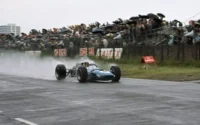
By 1963, BRP shed the sponsor-driven moniker and returned to its roots, but now with bigger ambitions. Having run Lotus 24s and Cooper T51s, the team desperately wanted Colin Chapman’s cutting-edge Lotus 25 monocoque, but Chapman wasn’t selling. So BRP did the next best thing: they built their own. Chief designer Tony Robinson penned a car heavily inspired by the Lotus 25, but with a beefier monocoque skin and powered by a BRM V8 rather than the universal Coventry Climax. The result: the BRP-BRM, driven by Innes Ireland and Trevor Taylor.
Between 1963 and 1964, BRP competed as a full constructor in 13 World Championship Grand Prix, collecting 11 points along the way. But politics caught up with them. When the Formula 1 Constructors’ Association refused BRP membership, and with it access to vital start money, the team’s F1 adventure came to a standstill.
Last chapter
BRP didn’t fade quietly. In 1965, they were hired by George Bryant (stepfather of American racer Masten Gregory) to build two cars for that year’s Indianapolis 500. It was an ambitious final act, though the effort yielded little success.
Still, BRP remains a fascinating footnote in racing history: a team that gave Stirling Moss a stage, pioneered the commercial model of sponsorship in Formula One, and dared to build its own Grand Prix machines in the face of giants.
British Racing Partnership Formula One World Championship Records
| First entry | 1958 Moroccan Grand Prix |
|---|---|
| Races entered | 43 |
| Constructors’ Championships | 0 |
| Drivers’ Championships | 0 |
| Race victories | 0 |
| Pole positions | 0 |
| Fastest laps | 2 |
| Final entry | 1964 Mexican Grand Prix |
British Racing Partnership Constructors’ Championship Results
Entrant Names
| Years | Name |
|---|---|
| 1958–1959, 1963–1964 | British Racing Partnership |
| 1960 | Yeoman Credit Racing Team |
| 1961–1962 | UDT Laystall Racing Team |
As Entrant
| Year | Chassis | Engine | Tyre | Drivers | Rounds |
|---|---|---|---|---|---|
| 1958 | Cooper T45 | Climax FPF 1.5 L4 | D | Tom Bridger* | 11 |
| 1959 | Cooper T51 | Climax FPF 1.5 L4 | D | Ivor Bueb | 1 |
| Borgward 1500 RS 1.5 L4 | 5 | ||||
| Chris Bristow | 5 | ||||
| BRM P25 | BRM P25 2.5 L4 | Stirling Moss | 4–5 | ||
| Hans Herrmann | 6 | ||||
| 1960 | Cooper T51 | Climax FPF 2.5 L4 | D | Chris Bristow | 2, 4–5 |
| Tony Brooks | 2, 4–5, 7–8, 10 | ||||
| Henry Taylor | 4, 6–8, 10 | ||||
| Olivier Gendebien | 5–8, 10 | ||||
| Bruce Halford | 6 | ||||
| Phil Hill | 10 | ||||
| 1961 | Lotus 18 Lotus 18/21 | Climax FPF 1.5 L4 | D | Cliff Allison | 1, 3 |
| Henry Taylor | 1, 3–5, 7 | ||||
| Lucien Bianchi | 4–5 | ||||
| Juan Manuel Bordeu | 4 | ||||
| Masten Gregory | 7–8 | ||||
| 1962 | Lotus 24 | Climax FWMV 1.5 V8 | D | Innes Ireland | 1–5, 7–9 |
| Masten Gregory | 5 | ||||
| BRM P56 1.5 V8 | 2–4, 7–8 | ||||
| Lotus 18/21 | Climax FPF 1.5 L4 | 1 | |||
| 1963 | Lotus 24 | BRM P56 1.5 V8 | D | Masten Gregory | 1–9 |
| Innes Ireland | 1, 6 | ||||
| 1964 | Lotus 24 | BRM P56 1.5 V8 | D | Innes Ireland | 1 |
| Trevor Taylor | 5 |
As Works
| Year | Chassis | Engine | Tyre | Drivers | Rounds | WCC Pts. | WCC Pos. | Report |
|---|---|---|---|---|---|---|---|---|
| 1963 | Mk1 | BRM P56 1.5 V8 | D | Innes Ireland | 2–5, 7 | 6 | 6th | Report |
| 1964 | Mk1 Mk2 | BRM P56 1.5 V8 | D | Innes Ireland | 2–5, 7–10 | 5 | 7th | Report |
| Trevor Taylor | 1, 3–4, 7–10 |