























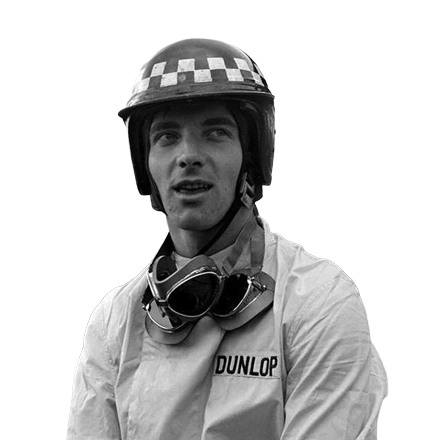
Christopher William Bristow was a fast, fearless, and controversial British Formula One driver whose raw talent and aggressive driving style made him one of the most talked-about young racers of his generation.
Driver Bio
| Nationality | British |
| Birthplace | Lambeth, England, UK |
| Born | 2 December 1937 |
| Died | 19 June 1960 |
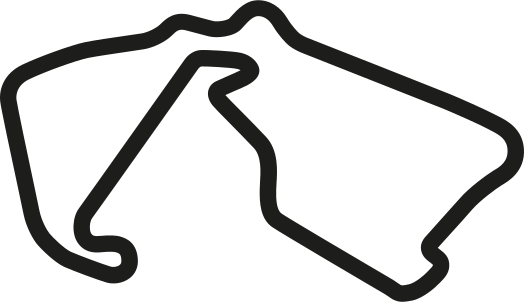
| First Grand Prix | 1959 British Grand Prix |
| Last Grand Prix | 1960 Belgian Grand Prix |
| Years Active | 1959–1960 |
| Current/Last Team | BRP |
Nicknamed the “wild man of British club racing,” Bristow built a reputation for spectacular speed combined with an uncompromising approach behind the wheel. He raced on the edge almost constantly — thrilling spectators, frustrating rivals, and alarming team managers in equal measure. Spins, collisions, and dramatic overtaking attempts became part of his reputation long before he reached Formula One, yet so too did flashes of undeniable brilliance.
Born in England in 1937, Bristow emerged from Britain’s hugely competitive late-1950s club racing scene, a breeding ground for many future Grand Prix stars. At a time when British motorsport was exploding with talent, he quickly stood out thanks to his courage, natural speed, and refusal to be intimidated by more experienced drivers.
His Formula One World Championship career was brief, but it immediately showed signs of enormous potential.
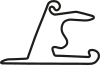
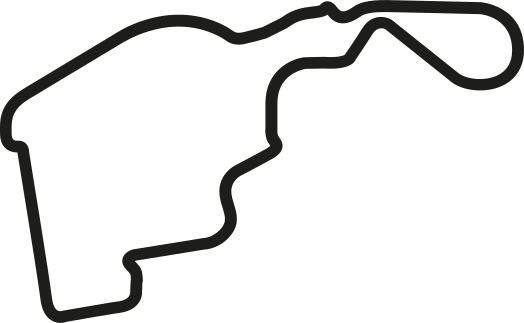
Driving for British Racing Partnership in 1960, Bristow made his Formula One debut at the Monaco Grand Prix. Incredibly, in his very first Grand Prix qualifying session, he stunned the paddock by setting a joint-third fastest time. Although officially placed fourth on the grid, the performance instantly marked him as a driver to watch.
For a newcomer to challenge established stars around the narrow streets of Monaco required exceptional confidence and precision. Unfortunately, his race ended early due to gearbox trouble on lap 17, before he could convert that remarkable qualifying speed into a result.
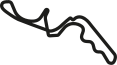
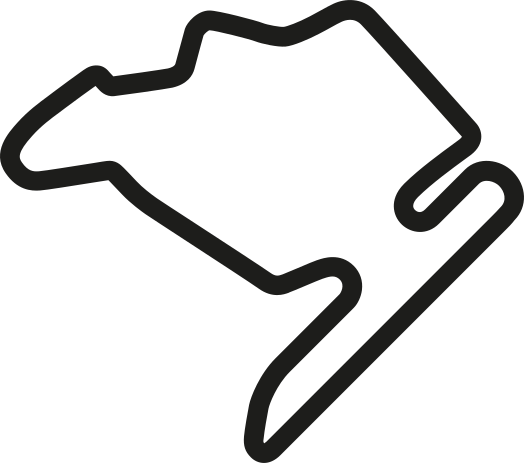
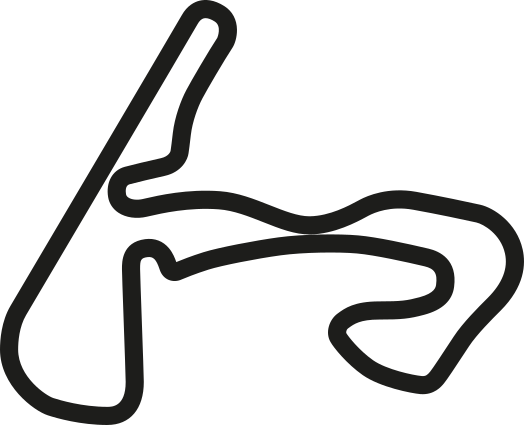
At the following Dutch Grand Prix, Bristow again demonstrated his pace by out-qualifying his more experienced BRP teammates and securing seventh on the grid. Once again, however, reliability denied him the chance to shine, with engine failure forcing another early retirement.
Even with only a handful of Grand Prix appearances, Bristow had already gained a reputation as one of Britain’s most exciting young talents — albeit one whose driving style many believed bordered on reckless.
That combination of speed and danger would tragically define his final race.
Death
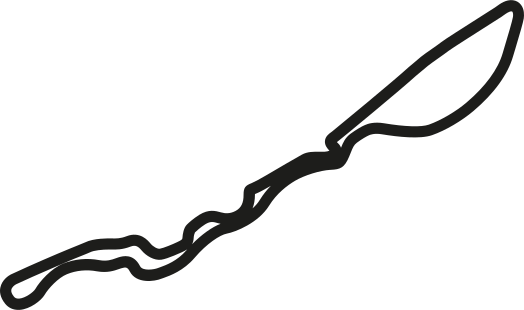
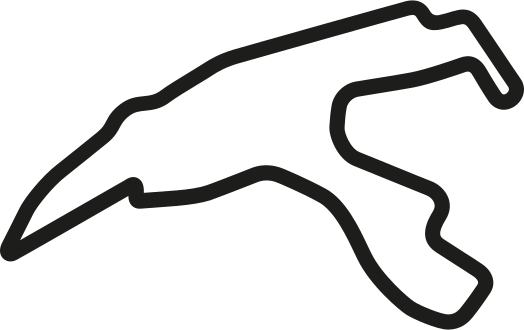
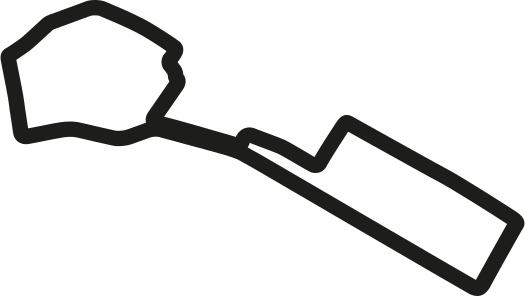
The 1960 Belgian Grand Prix at Spa-Francorchamps became one of the darkest weekends in Formula One history. The old Spa circuit was terrifyingly fast, lined with trees, embankments, ditches, and virtually no meaningful safety barriers. Drivers regularly approached the Burnenville corner at around 120 mph (190 km/h), threading fragile racing cars through sweeping bends with little room for error.
On lap 20, while battling to stay ahead of Ferrari driver Willy Mairesse, Bristow lost control of his Yeoman Credit Racing Cooper T51 at Burnenville. His car struck a four-foot embankment and rolled violently toward a barbed-wire fence bordering the circuit.
In one of the sport’s most horrific accidents, Bristow was thrown from the car into the wire fencing, suffering fatal injuries instantly. He was just 22 years old, making him at the time the youngest driver ever to die during a Formula One World Championship event.
Only minutes later — and only a short distance away at the same corner — fellow British driver Alan Stacey was also killed after a separate accident. The double tragedy shocked the Formula One world and deeply affected many drivers, including future World Champion Jim Clark, who developed a lifelong hatred of the Spa circuit after witnessing the events of that day.
Bristow’s death also intensified debate around his aggressive driving style. One friend later remarked with painful honesty: “We all knew this was going to happen. It does no good to say now, but Chris simply did not have the experience to drive that way in Grand Prix racing.”
Yet despite the criticism, many inside the sport believed Bristow possessed genuine world-class potential. Decades later, British Racing Partnership boss Ken Gregory described him as “the early Schumacher of his day,” suggesting he could have become a future World Champion. Stirling Moss offered a more measured assessment, comparing Bristow instead to Jean Alesi — naturally fast, spectacularly committed, and exciting to watch.
Even now, Bristow’s name remains part of British motorsport culture. The winner of the prestigious annual Autosport BRDC Award for promising young British drivers receives the Chris Bristow Trophy, ensuring that the memory of one of Britain’s most daring young racers continues to inspire future generations.
Grand Prix Stats
| Race Entries | – |
| Race Starts | – |
| Did Not Start | 0 |
| Best Race Start | 4th |
| Best Race Finish | 10th |
| Retirements | 3 |
| First-Lap Retirements | 0 |
| Not Classified | – |
| Disqualified | 0 |
| Did Not Qualify | 0 |
Qualifying
| Qualifying Sessions | – |
| Reached Q3 | – |
| Q2 Eliminations | – |
| Q1 Eliminations | – |
| Did Not Qualify | 0 |
Stats by Season
| Year | Constructor | Entries | Starts | Wins | Podiums | Poles | Fastest Laps | Front Rows | DNF | Best Start | Best Result | Pts Finishes | Points | Championship |
|---|---|---|---|---|---|---|---|---|---|---|---|---|---|---|
| 1959 | Cooper | 1 | 1 | 0 | 0 | 0 | 0 | 0 | 0 | 16th | 10th | 0 | 0 | NC |
| 1960 | BRP | 3 | 3 | 0 | 0 | 0 | 0 | 0 | 3 | 4th | – | 0 | 0 | NC |
Stats by Constructor
| Constructor | Years | Entries | Starts | Wins | Podiums | Poles | Fastest Laps | Front Rows | DNF | Best Start | Best Result | Pts Finishes | Points |
|---|---|---|---|---|---|---|---|---|---|---|---|---|---|
| Cooper | 1959–1960 | 4 | 4 | 0 | 0 | 0 | 0 | 0 | 3 | 4th | 10th | 0 | 0 |
Teammates & Qualifying Head-to-Head
| Teammate | Years | Races | Qualifying H2H |
|---|---|---|---|
| Ivor Bueb | 1959 | 1 | – |
| Stirling Moss | 1959 | 1 | – |
| Tony Brooks | 1960 | 3 | – |
| Olivier Gendebien | 1960 | 1 | – |