

























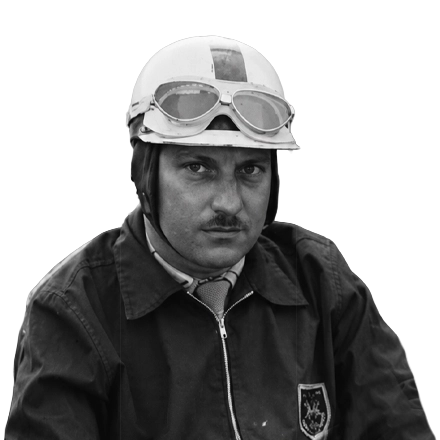
Ivor Léon John Bueb — pronounced “Bweeb” — was one of Britain’s toughest and most respected post-war racing drivers. Born on 6 June 1923 in East Ham, Essex, Bueb became a familiar figure across Formula One and endurance racing during the 1950s, earning a reputation as a dependable team driver who thrived in some of motorsport’s most demanding events.
Driver Bio
| Nationality | British |
| Birthplace | East Ham, England, UK |
| Born | 6 June 1923 |
| Died | 1 August 1959 |
| First Grand Prix | 1957 Monaco Grand Prix |
| Last Grand Prix | 1959 British Grand Prix |
| Current/Last Team | BRP |
His background reflected a rich mix of European heritage. His father, Léon Gervase Bueb, was born in Breisach, Germany to French parents, while his mother, Grace Marie Alice Vagnolini, had English, Italian and Welsh roots. After his parents divorced in 1926, Bueb grew up in Dulwich, South London, where his passion for racing was sparked by regular visits to Crystal Palace circuit to watch stars such as Prince Bira, Freddie Dixon and Raymond Mays in action.
Before motorsport took over his life, Bueb served in the RAF during the Second World War. In the years that followed, he entered business selling surplus ex-military vehicles in Newport, Monmouthshire, while also pursuing another passion: flying. In 1949 he earned his Aviator’s Certificate in Cardiff, piloting a de Havilland Tiger Moth. By the early 1950s, after moving back to Cheltenham and receiving encouragement from Geoffrey Turk, Bueb fully committed himself to motor racing.
He began competing seriously in 1953 in Formula Three, driving a 500cc Cooper, and quickly proved himself a natural talent. His performances earned him a place with the Cooper works team in 1955, the same season he finished runner-up in the British Formula Three Championship.
Although his Formula One career was relatively modest in statistical terms, Bueb became a respected presence in Grand Prix racing’s fiercely competitive privateer era. Between 1957 and 1959 he competed in six Formula One World Championship Grands Prix, driving machinery from Connaught, Maserati and Lotus, as well as cars entered by Gilby Engineering, BRP and Bernie Ecclestone’s Connaught team. He never scored championship points, but he also contested numerous non-championship Formula One races, which at the time formed a major part of the European racing calendar.
Away from Formula One, however, Bueb truly excelled in sports car racing. Following the tragic death of Archie Scott Brown at Spa in 1958, Brian Lister selected Bueb to take over the coveted Lister-Jaguar seat. He stepped into the role superbly, claiming several victories at circuits such as Crystal Palace and Goodwood during the 1958 and 1959 seasons, proving himself one of Britain’s finest sports car drivers.
Bueb’s greatest achievements came at the legendary 24 Hours of Le Mans. In 1955, he partnered with Mike Hawthorn to victory in a works Jaguar D-type, triumphing in one of the most infamous editions of the race — a year overshadowed by the catastrophic accident that claimed the lives of 82 spectators. Despite the tragedy surrounding the event, the victory cemented Bueb’s place among endurance racing’s elite.
He returned to Le Mans glory again in 1957, this time sharing the winning Ecurie Ecosse Jaguar with Ron Flockhart. Securing two victories in the world’s toughest endurance race established Bueb as one of the standout sports car racers of his generation.
Despite his rugged appearance and reputation for bravery behind the wheel, friends and fellow drivers often described him as gentle, modest and deeply thoughtful. Nicknamed “Ivor the Driver” — a playful twist on “Ivan the Terrible” — he was admired throughout the paddock for his honesty and humility. Fellow racer Jimmy Ebdon later remembered him as “a quiet and very sensitive person” who remained modest in success and brutally honest about his own mistakes.
Tragically, Bueb’s career and life were cut short in 1959. While driving a BRP Cooper-Borgward Formula Two car at the daunting Charade Circuit near Clermont-Ferrand in France, he crashed heavily at the fast and dangerous Gravenoire section of the track. Thrown from the car during the accident, he suffered severe injuries and died six days later in hospital on 1 August 1959, aged just 36.
His death, coming little more than a year after the loss of Archie Scott Brown, deeply affected Brian Lister and ultimately contributed to the closure of Lister’s hugely successful sports car racing programme.
Bueb’s funeral took place at Manor Park Cemetery in London on 10 August 1959, attended by family, friends, fellow racers and his widowed wife Florence Ada Bueb. His father, unable to travel, arranged for a high mass to be held simultaneously in Clermont-Ferrand.
Grand Prix Stats
| Race Entries | 5 |
| Race Starts | 4 |
| Did Not Start | 0 |
| Best Race Start | 16th |
| Best Race Finish | 8th |
| Retirements | – |
| First-Lap Retirements | 0 |
| Not Classified | – |
| Disqualified | 0 |
| Did Not Qualify | 1 |
Qualifying
| Qualifying Sessions | – |
| Reached Q3 | – |
| Q2 Eliminations | – |
| Q1 Eliminations | – |
| Did Not Qualify | 1 |
Complete Formula One World Championship results
| Year | Entrant | Chassis | Engine | 1 | 2 | 3 | 4 | 5 | 6 | 7 | 8 | 9 | 10 | 11 | WDC | Points |
|---|---|---|---|---|---|---|---|---|---|---|---|---|---|---|---|---|
| 1957 | Connaught Engineering | Connaught Type B | Alta Straight-4 | ARG | MON Ret | 500 | FRA | NC | 0 | |||||||
| Gilby Engineering Ltd. | Maserati 250F | Maserati Straight-6 | GBR NC | GER | PES | ITA | ||||||||||
| 1958 | BC Ecclestone | Connaught Type B | Alta Straight-4 | ARG | MON | NED | 500 | BEL | FRA | GBR Ret | NC | 0 | ||||
| Ecurie Demi Litre | Lotus 12 | Climax Straight-4 | GER 11 * | POR | ITA | MOR | ||||||||||
| 1959 | British Racing Partnership | Cooper T51 | Climax Straight-4 | MON DNQ | 500 | NED | FRA | NC | 0 | |||||||
| Borgward Straight-4 | GBR 13 | GER | POR | ITA | USA |