





























The Ferguson P99 was one of the most innovative Formula One cars of its era. Developed by Ferguson Research Ltd. and campaigned by the Rob Walker Racing Team during the 1961 season, it combined a front-engine layout with an advanced four-wheel-drive system at a time when the sport was rapidly embracing rear-engined designs.
| Nationality | British |
| Years Active | 1961 |
| First Race | 1961 British Grand Prix |
| Last Race | 1961 British Grand Prix |
| Race Entries | 1 |
| Race Starts | 1 |
| Wins | 0 |
| Podiums | 0 |
| Pole Positions | 0 |
| Fastest Laps | 0 |
| Points | 0 |
| Constructors’ Championships | 0 |
| Drivers’ Championships | 0 |
| Best Start | 20th |
| Did Not Start | 0 |
| Did Not Qualify | 0 |
| Retirements | 0 |
Officially entered as the Ferguson Climax, the car took its familiar P99 designation from the internal Harry Ferguson Research project number. Powered by Coventry Climax engines, the P99 became a landmark in Formula One history by achieving two remarkable milestones: it became the first four-wheel-drive car to win a Formula One race and the last front-engined car ever to win a Formula One event.
Development
The project began in 1960 when Tony Rolt explored the potential of applying Ferguson’s four-wheel-drive technology to Grand Prix racing. Harry Ferguson, whose company had pioneered four-wheel-drive systems in agriculture and automotive engineering, supported the project as a showcase for the technology’s capabilities.
Designed by Claude Hill, the P99 featured a permanent four-wheel-drive system with an even 50:50 torque split between the front and rear axles. To complement this arrangement, the chassis was engineered with balanced weight distribution, although accommodating the transmission required the gearbox to sit behind the driver while a driveshaft ran beneath the cockpit to the front wheels. As a result, the driver was positioned slightly off-centre.
These packaging requirements meant the car retained a front-engine layout, despite the overwhelming success already being enjoyed by rear-engined Cooper and Lotus machines. By 1960, front-engined Formula One cars were becoming obsolete, making the Ferguson’s concept both unconventional and technically ambitious.
Adapting to New Regulations
While development was underway, Formula One underwent one of its biggest technical rule changes. The FIA confirmed that the 2.5-litre engine formula would end after 1960, with the 1961 World Championship adopting 1.5-litre engines and a minimum vehicle weight of 450 kg, effectively aligning Formula One with contemporary Formula Two regulations.
The change significantly affected the Ferguson project. The additional weight of the four-wheel-drive system became a greater disadvantage under the smaller-engine regulations, reducing the performance benefits the design had originally been expected to deliver.
Undeterred, the team completed the car using a 1.5-litre Coventry Climax FPF four-cylinder engine. Mounted at an angle to provide clearance for the front driveshaft, the compact engine allowed the innovative transmission layout to function while maintaining the car’s balanced chassis design.
Formula One
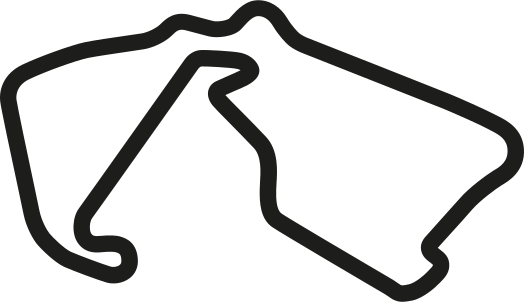
The Ferguson P99 made its competitive debut at Silverstone in the non-championship British Empire Trophy on 8 July 1961. Driven by Jack Fairman, the car’s first outing ended prematurely after an accident on just the second lap.
A week later, Fairman returned with the P99 for the 1961 British Grand Prix at Aintree. During the race, Stirling Moss took over the Ferguson after the failure of his Rob Walker-entered Lotus 18. Although the car reached the finish, it was disqualified after receiving outside assistance during the race.
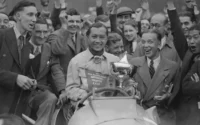
The P99’s defining moment arrived later that year at Oulton Park. In damp and slippery conditions during the 1961 International Gold Cup, Stirling Moss expertly exploited the car’s four-wheel-drive traction to secure victory. The success made history as the first Formula One race win for a four-wheel-drive car and remains the final victory by a front-engined Formula One machine.
Later Competition
Although its World Championship career was brief, the Ferguson P99 continued to compete after Formula One.
For the 1963 off-season events in New Zealand and Australia, the car was fitted with a larger 2.5-litre Coventry Climax engine. Driven by both Innes Ireland and Graham Hill, it appeared in several races, including the Australian Grand Prix at Warwick Farm and the Lakeside International, recording sixth and second-place finishes respectively.
The P99 remained competitive in British hill climbing, where Peter Westbury drove it to the 1964 British Hill Climb Championship. The car also continued to appear in the championship during the 1965 and 1966 seasons before eventually becoming a regular attraction at historic motorsport events.
Legacy
The Ferguson P99 remains one of the most significant technical innovations in Formula One history. Its pioneering four-wheel-drive system influenced later racing projects, including the Ferguson P104 Novi Indycar, which Bobby Unser drove in the Indianapolis 500 in 1964 and 1965. Although the Indy project was ultimately curtailed following a major crash and persistent reliability issues, it demonstrated the continuing interest in Ferguson’s engineering concepts.
The P99’s place in Formula One folklore was further cemented in 1997 when Sir Stirling Moss named it his favourite Formula One car of all those he had driven. Combining technical ingenuity with a unique place in Grand Prix history, the Ferguson P99 remains one of the sport’s most celebrated and distinctive racing cars.
Ferguson Complete Formula One World Championship results
| Year | Entrant | Engine | Driver | 1 | 2 | 3 | 4 | 5 | 6 | 7 | 8 | Pts. | WCC |
|---|---|---|---|---|---|---|---|---|---|---|---|---|---|
| 1961 | Rob Walker Racing | Climax L4 | MON | NED | BEL | FRA | GBR | GER | ITA | USA | 0 | – | |
| Jack Fairman / Stirling Moss | DSQ |