








































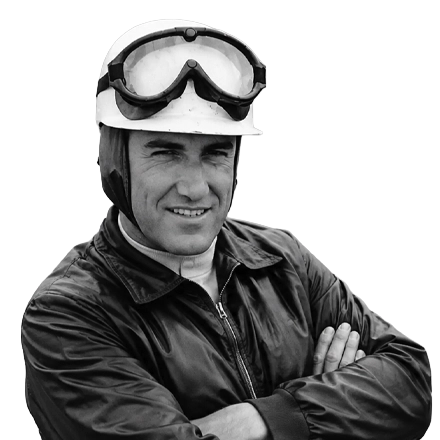
Kenneth McAlpine OBE DL (21 September 1920 – 8 April 2023) was a British racing driver, businessman, and one of the key figures behind Connaught Engineering, the small British constructor that punched considerably above its weight during the formative years of Formula One. McAlpine competed in seven Formula One World Championship Grands Prix, but his contribution to the sport went far beyond his own appearances behind the wheel. As a major financial supporter of Connaught, he helped create a team that became an important part of Britain’s emergence as a serious Grand Prix racing nation during the 1950s.
Driver Bio
| Nationality | British |
| Birthplace | Cobham, England, UK |
| Born | 21 September 1920 |
| Died | 8 April 2023 |
| First Grand Prix | 1952 British Grand Prix |
| Last Grand Prix | 1955 British Grand Prix |
| Years Active | 1952–1953, 1955 |
| Current/Last Team | Connaught |
Biography
McAlpine was born on 21 September 1920 in Cobham, Surrey, into a family with engineering very much in its blood.
He was a grandson of the celebrated Scottish civil engineer Sir Robert McAlpine, 1st Baronet, whose name became synonymous with major construction projects through the family engineering business. Kenneth therefore grew up surrounded by an appreciation for machinery, engineering and ambitious projects — useful ingredients for somebody who would later become involved in building a British Formula One team almost from scratch.
Motor racing became one of his passions, and by the early 1950s McAlpine was not simply watching from the sidelines. He was competing himself while simultaneously becoming increasingly important to the development of Connaught Engineering.
Connaught was based at Send in Surrey and emerged from a comparatively small operation into one of the most interesting British racing constructors of the period. The name itself was derived from Continental Autos, the garage business from which the racing concern developed.
What Connaught possessed in engineering ambition it did not necessarily possess in enormous financial resources. This was where McAlpine became particularly important.
He provided considerable financial backing to the team, helping Connaught develop its racing cars and compete against much larger and better-established European manufacturers. At a time when British Grand Prix racing was still trying to establish itself internationally, that support mattered enormously.
McAlpine wasn’t merely writing cheques, either. He raced the cars. His Formula One World Championship debut came at the 1952 British Grand Prix on 19 July, where he appeared as a Connaught driver alongside fellow Briton Kenneth Downing.
It was the beginning of a World Championship career that would ultimately encompass seven Grands Prix.
McAlpine competed during a fascinating transitional period for British motor racing. At the beginning of the 1950s, the Grand Prix landscape was still dominated largely by continental European manufacturers, particularly the Italian marques. British constructors had enthusiasm and engineering talent in abundance, but turning those qualities into internationally competitive Formula One cars required money, development and persistence.
Connaught became part of that effort.
For McAlpine, therefore, the racing programme was unusual because he occupied several positions at once. He was a driver, a supporter of the company and, through his investment, one of the people making it possible for the team to exist at Grand Prix level in the first place.
His own Formula One results were modest, and he never scored a World Championship point. Yet concentrating solely on those seven appearances misses the more significant part of his motor-racing legacy.
Connaught gradually became a genuine force.
The team’s defining moment arrived in 1955, and although McAlpine wasn’t the man driving the car, he had played an important role in putting the machinery onto the grid.
At the Syracuse Grand Prix in Sicily, young British driver Tony Brooks produced one of the landmark performances in British Formula One history.
Brooks won.
Today, a British driver winning a Formula One race for a British constructor is hardly extraordinary. In 1955, it most certainly was. British teams had not yet become the dominant force they would eventually be, and the established Italian manufacturers remained formidable opponents.
Connaught’s victory at Syracuse was therefore a genuine breakthrough.
Brooks defeated the works opposition to give the small British team a sensational Formula One victory, and the result became one of Connaught’s greatest achievements. For McAlpine, who had invested heavily in the team’s development, it was vindication of the belief that a comparatively small British operation could compete successfully on the international stage.
The victory was also an early sign of what was about to happen to Grand Prix racing. Within only a few years, British constructors would begin transforming Formula One, with teams such as Cooper and Lotus pushing the sport towards a new technical era.
Connaught helped prove that the potential was already there.
McAlpine’s racing activities were not confined to Grand Prix single-seaters. In 1955, he also tackled one of motorsport’s greatest endurance races, the 24 Hours of Le Mans.
McAlpine shared a Connaught ALSR with fellow British driver Eric Thompson. Taking Connaught to Le Mans demonstrated the breadth of the company’s ambitions, but the race did not provide the result they wanted. After approximately six hours, the car suffered an engine failure, forcing McAlpine and Thompson to retire.
It nevertheless added Le Mans to a competition résumé that already included Formula One and further underlined McAlpine’s willingness to participate directly in the racing activities he was helping to finance. There was always, however, a practical business reality behind Connaught’s ambitions.
Running a Grand Prix operation was expensive, and McAlpine’s financial support could not continue indefinitely. The team’s viability was assisted by tax concessions available to him, but when those advantages disappeared the economics became considerably harder to justify.
In 1957, after McAlpine ceased receiving the relevant tax concessions, his support for the operation came to an end. Without that crucial backing, Connaught was broken up and its cars sold.
It was an abrupt ending for a constructor that had managed to achieve something remarkable with comparatively limited resources. Yet Connaught’s disappearance did not erase what the team had accomplished — nor McAlpine’s role in making those achievements possible.
His involvement is particularly significant when viewed against what followed.
Britain would soon become the centre of the Formula One engineering world. Cooper revolutionised Grand Prix racing with the widespread adoption of rear-engined machinery, Lotus became one of the sport’s great innovators, and a succession of British teams came to dominate the World Championship.
Connaught belonged to the generation immediately before that explosion.
McAlpine was therefore part of the group of British enthusiasts, engineers, businessmen and drivers who helped establish the foundations upon which the country’s later Formula One success was built.
His own World Championship career ended without points, but his contribution as a backer produced something far more substantial than his personal results sheet: a Formula One team capable of winning.
Life beyond racing
When his competitive motor-racing days were over, McAlpine returned his attention fully to the world in which his family had already built such a formidable reputation: civil engineering.
He resumed working full-time in his engineering business, exchanging racing workshops and Grand Prix paddocks for a professional career away from motorsport.
But McAlpine was not finished with ambitious ventures.
In later life, he became involved in an industry that, at the time, might have sounded almost as unlikely as a small British constructor beating established Italian manufacturers in Formula One: English wine.
At his estate in Lamberhurst, Kent, McAlpine established a successful wine-growing and bottling business. Long before English wine achieved the international profile it enjoys today, he was involved in cultivating grapes and developing a serious commercial operation.
It was another indication of the entrepreneurial streak that had characterised his involvement with Connaught.
McAlpine also had a strong interest in aviation and was a member of The Air Squadron, adding another form of high-performance machinery to a life already shaped by engineering and motor racing.
By the later years of his life, he had also become one of the final surviving links to the earliest seasons of the Formula One World Championship.
Kenneth McAlpine died on 8 April 2023 at the ripe old age of 102.
His longevity was extraordinary, but so too was the span of history he witnessed. Born only a few years after the First World War, he lived through the rise of the motor car, the Second World War, the creation of the Formula One World Championship and more than seven decades of Grand Prix racing.
His own Formula One statistics remain straightforward: seven World Championship Grand Prix appearances and no championship points.
But, as with so many racers from Formula One’s earliest years, the numbers provide only the narrowest version of the story.
McAlpine was a racing driver who competed at World Championship level and at Le Mans, but he was also a businessman prepared to put substantial resources behind British engineering at a time when success against the established continental manufacturers was anything but guaranteed.
His seven Grands Prix make him part of Formula One history. But his part in making Connaught possible makes him considerably more important than that statistic suggests.
Grand Prix Stats
| Race Entries | 7 |
| Race Starts | 7 |
| Did Not Start | 0 |
| Best Race Start | 13th |
| Best Race Finish | 13th |
| Retirements | 4 |
| First-Lap Retirements | 1 |
| Not Classified | 1 |
| Disqualified | 0 |
| Did Not Qualify | 0 |
Qualifying
| Qualifying Sessions | 7 |
| Reached Q3 | – |
| Q2 Eliminations | – |
| Q1 Eliminations | – |
| Did Not Qualify | 0 |
Stats by Season
| Year | Constructor | Entries | Starts | Wins | Podiums | Poles | Fastest Laps | Front Rows | DNF | Best Start | Best Result | Pts Finishes | Points | Championship |
|---|---|---|---|---|---|---|---|---|---|---|---|---|---|---|
| 1952 | Connaught | 2 | 2 | 0 | 0 | 0 | 0 | 0 | 1 | 17 | 16 | 0 | 0 | NC |
| 1953 | Connaught | 4 | 4 | 0 | 0 | 0 | 0 | 0 | 2 | 13 | 13 | 0 | 0 | NC |
| 1955 | Connaught | 1 | 1 | 0 | 0 | 0 | 0 | 0 | 1 | 17 | – | 0 | 0 | NC |
Stats by Constructor
| Constructor | Years | Entries | Starts | Wins | Podiums | Poles | Fastest Laps | Front Rows | DNF | Best Start | Best Result | Pts Finishes | Points |
|---|---|---|---|---|---|---|---|---|---|---|---|---|---|
| Connaught | 1952–1953, 1955 | 7 | 7 | 0 | 0 | 0 | 0 | 0 | 4 | 13 | 13 | 0 | 0 |
Teammates & Qualifying Head-to-Head
| Teammate | Years | Races | Qualifying H2H |
|---|---|---|---|
| Eric Thompson | 1952 | 1 | – |
| Dennis Poore | 1952 | 2 | – |
| Ken Downing | 1952 | 1 | – |
| Stirling Moss | 1952, 1953 | 2 | – |
| Roy Salvadori | 1953 | 4 | – |
| Birabongse Bhanudej | 1953 | 2 | – |
| Jack Fairman | 1953, 1955 | 2 | – |