



























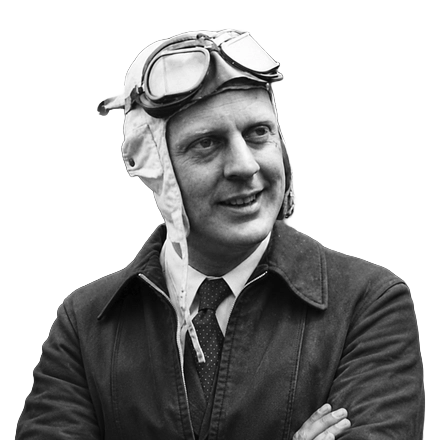
Eric David Thompson (4 November 1919 – 22 August 2015) was a British racing driver whose motorsport career successfully balanced with an equally distinguished professional life as a Lloyd’s of London insurance broker. A talented sports car racer and occasional Formula One competitor, Thompson enjoyed his greatest international success with a third-place finish at the 1951 24 Hours of Le Mans and scored an impressive fifth place in his only Formula One World Championship start at the 1952 British Grand Prix. After retiring from racing, he became one of Britain’s best-known dealers in rare motorsport books, remaining closely connected to the sport for decades.
Driver Bio
| Nationality | British |
| Birthplace | Ditton Hill, England, UK |
| Born | 4 November 1919 |
| Died | 22 August 2015 |
| First Grand Prix | 1952 British Grand Prix |
| Last Grand Prix | 1952 British Grand Prix |
| Years Active | 1952 |
| Current/Last Team | Connaught |
Biography
Early Life
Born on 4 November 1919 in Ditton Hill, Surrey, Eric Thompson developed a fascination with motor racing from an early age. Like many young British enthusiasts of his generation, he idolised the legendary Richard Seaman, whose exploits inspired Thompson’s lifelong passion for the sport.
Rather than pursuing racing immediately, Thompson built a successful career at Lloyd’s of London, where he worked as an insurance broker. The role demanded long hours, commitment and professionalism, qualities that would later define his approach to racing. During the Second World War, he also served on active duty before returning to civilian life and eventually fulfilling his ambition of becoming a racing driver.
Career
Unlike many of his rivals, Thompson did not begin racing until after the war. At the age of 28, he launched his competitive career in 1948 while continuing to work full-time at Lloyd’s. With only two weeks of annual leave and every third weekend available for racing, he somehow managed to build one of Britain’s most respected post-war racing careers.
His first competitive outing came at the 12 Heures de Paris at Montlhéry, where he shared an HRG with Robin Richards. The pair finished fourth in the 1.5-litre class and 17th overall, providing an encouraging start to what would become an increasingly successful sports car career.
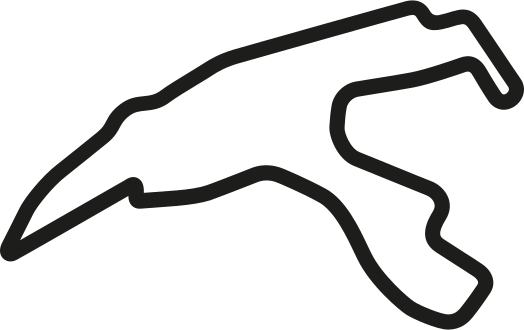
Thompson truly announced himself on the international stage in 1949 when he made his debut at the 24 Hours of Le Mans alongside Jack Fairman in an HRG. The duo claimed victory in the 1.5-litre class while finishing an outstanding eighth overall. Success continued later that season with another class victory in the 24 Hours of Belgium at Spa-Francorchamps, along with handicap race wins at Goodwood, a class victory in the Silverstone International Trophy and more impressive domestic results.
His performances attracted the attention of Aston Martin, and for the 1950 season Thompson joined the famous British manufacturer. As part of the works programme, he supported leading drivers including Reg Parnell, Peter Collins and Roy Salvadori while continuing to race selected HRG entries and explore single-seater competition in Formula Three.
Although his first Le Mans appearance for Aston Martin ended early with engine failure after just nine laps, Thompson continued to build an impressive reputation across both sports car and open-wheel racing. During the season he collected further class victories and podium finishes while expanding his experience in Formula Three aboard a Cooper-Vincent.
The 1951 season proved to be one of the finest of Thompson’s career. He raced extensively in Formula Libre events with machinery including Cooper, Bugatti, ERA/Delage and Delahaye cars, while also remaining a regular force in sports car competition.
His standout achievement came at the 24 Hours of Le Mans, where he partnered Lance Macklin in an Aston Martin DB2. The pair delivered a superb performance, winning the 3-litre class and finishing third overall—still regarded as the greatest result of Thompson’s international racing career.
Formula One
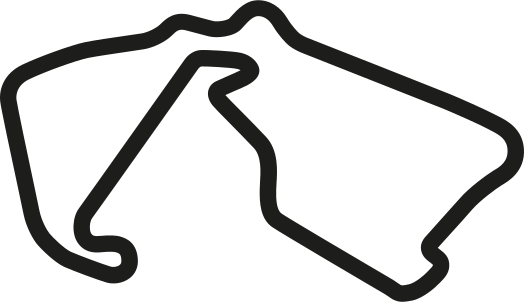
In 1952, Thompson earned the opportunity to compete in the Formula One World Championship when he entered the British Grand Prix for the Connaught works team. Driving the Lea-Francis-powered Connaught, he qualified ninth on the grid against an exceptionally competitive field.
During the race, Thompson drove with remarkable consistency and maturity. After Robert Manzon retired with clutch trouble, Thompson climbed another position and eventually crossed the finish line in fifth place. Although he finished three laps behind dominant Ferrari driver Alberto Ascari, it was an excellent result for both driver and team. Remarkably, Thompson finished ahead of former World Champion Giuseppe Farina and behind only his Connaught teammate Dennis Poore among the British runners.
Despite the strong performance, the British Grand Prix remained Thompson’s only Formula One World Championship appearance.
Sports Car Success After Formula One
While Formula One proved to be a brief chapter, Thompson’s sports car career continued to flourish.
At the 1952 24 Hours of Le Mans he partnered Reg Parnell in an Aston Martin DB3, although transmission problems forced an early retirement. The pair also endured dramatic scenes during the Goodwood Nine Hours when Thompson brought their smoking Aston Martin into the pits. Fearing the car was about to catch fire, Parnell famously pulled Thompson from the cockpit moments before flames engulfed the car.
Thompson bounced back strongly in 1953. Alongside Dennis Poore, he contested Le Mans once again before the pair retired with ignition failure. However, Thompson and Reg Parnell enjoyed a memorable victory in the Goodwood Nine Hours after overcoming punctures, clutch problems and a demanding endurance battle. They also finished runners-up in that year’s RAC Tourist Trophy, underlining Aston Martin’s competitiveness and Thompson’s reliability as one of Britain’s finest endurance racers.
Away from endurance racing, Thompson remained active across Britain’s national circuits. He scored victories in Connaught Formula Two machinery at Snetterton, added podium finishes in Formula Libre competition and continued to collect strong handicap and sports car results in Aston Martin machinery.
Final Racing Years
By 1954, Thompson began reducing his racing commitments as the demands of his career at Lloyd’s increasingly took priority. He continued to represent Aston Martin in selected events and returned to Le Mans driving a Lagonda DP115 alongside Dennis Poore, although the race ended prematurely following an accident after 25 laps.
In 1955, Thompson announced that he would retire from front-line competition, citing increasing pressure from his professional career. He made one final appearance at Le Mans that year, retiring with engine failure after 60 laps, and also competed in the Goodwood Nine Hours with Kenneth McAlpine.
Although his retirement was officially announced in 1955, Thompson made one final competitive appearance in 1956 at the Cambridge University Automobile Club Speed Trials, where he drove a tiny 498cc Jason to second place in class, bringing an end to nearly a decade of successful competition.
Later Life
Following his retirement from racing, Thompson devoted his full attention to his career at Lloyd’s of London before leaving the insurance industry during the 1980s.
He then combined his lifelong passion for motorsport with a new profession, opening a specialist bookshop near Guildford dealing in rare and historic motor racing books. Over the years he became one of Britain’s leading authorities on motorsport literature, helping collectors and historians preserve the sport’s rich heritage.
Although no longer competing, Thompson remained a familiar face at historic racing events and classic car festivals, where he was widely respected as both a racer and historian.
In recognition of his achievements, he became the first driver ever inducted into the Le Mans Drivers Hall of Fame in 2013—a fitting tribute to a man whose career embodied dedication, versatility and an enduring love of motor racing.
Grand Prix Stats
| Race Entries | 1 |
| Race Starts | 1 |
| Did Not Start | 0 |
| Best Race Start | 9th |
| Best Race Finish | 5th |
| Retirements | 0 |
| First-Lap Retirements | 0 |
| Not Classified | 0 |
| Disqualified | 0 |
| Did Not Qualify | 0 |
Qualifying
| Qualifying Sessions | 1 |
| Reached Q3 | 0 |
| Q2 Eliminations | 0 |
| Q1 Eliminations | 0 |
| Did Not Qualify | 0 |
Points
| Points Scored | 2 |
| Points Finishes | 1 |
| Most Points in a Single Season | 2 (1952) |
| Seasons with Points | 1 |
Stats by Season
| Year | Constructor | Entries | Starts | Wins | Podiums | Poles | Fastest Laps | Front Rows | DNF | Best Start | Best Result | Pts Finishes | Points | Championship |
|---|---|---|---|---|---|---|---|---|---|---|---|---|---|---|
| 1952 | Connaught | 1 | 1 | 0 | 0 | 0 | 0 | 0 | 0 | 9 | 5 | 1 | 2 | 16th |
Stats by Constructor
| Constructor | Years | Entries | Starts | Wins | Podiums | Poles | Fastest Laps | Front Rows | DNF | Best Start | Best Result | Pts Finishes | Points |
|---|---|---|---|---|---|---|---|---|---|---|---|---|---|
| Connaught | 1952 | 1 | 1 | 0 | 0 | 0 | 0 | 0 | 0 | 9 | 5 | 1 | 2 |
Teammates & Qualifying Head-to-Head
| Teammate | Years | Races | Qualifying H2H |
|---|---|---|---|
| Dennis Poore | 1952 | 1 | – |
| Ken McAlpine | 1952 | 1 | – |
| Ken Downing | 1952 | 1 | – |