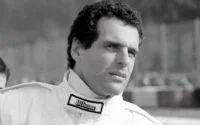




















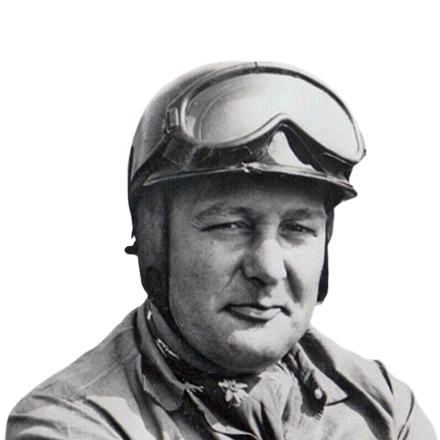
James Duncan Hamilton was a British racing driver, entrepreneur, and one of the great characters of post-war motorsport. Famous for his flamboyant personality, razor-sharp wit, and fearless commitment behind the wheel, Hamilton became one of Britain’s finest sports car racers of the 1950s. Though capable in Grand Prix machinery, his greatest triumphs came in endurance racing—most notably victory at the 24 Hours of Le Mans in 1953.
Driver Bio
| Nationality | British |
| Birthplace | Cork, Ireland |
| Born | 30 April 1920 |
| Died | 13 May 1994 |
| First Grand Prix | 1951 British Grand Prix |
| Last Grand Prix | 1953 British Grand Prix |
| Years Active | 1951–1953 |
| Current/Last Team | HWM |
Born in County Cork on 30 April 1920, Hamilton grew up far from the glamour of racing’s elite circles. During the Second World War, he served in the Fleet Air Arm, flying Lysander aircraft. The experience sharpened the cool nerve and mechanical confidence that would later define his driving style.
After the war, he opened a garage business and began racing in local events. His early machinery included an MG R-type, a Bugatti Type 35B, and later a Maserati 6CM. By the late 1940s, he had graduated to the powerful Talbot-Lago Grand Prix car, launching his serious international career.
Formula One career
Hamilton participated in five Formula One World Championship Grands Prix and a remarkable 18 non-championship Formula One races, a reminder of how vibrant Grand Prix racing was beyond the official title chase in that era.
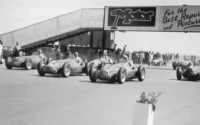
His early post-war Grand Prix debut came at the 1948 Zandvoort Grand Prix, where he finished fourth in a Maserati 6CM. Later that year, he entered the first official post-war British Grand Prix—the RAC International Grand Prix—but retired due to oil pressure problems.
Throughout the late 1940s and early 1950s, Hamilton remained a regular and respected Grand Prix entrant. Among his strongest results were third in the Richmond Trophy, second in the BRDC International Trophy, and fourth in the ADAC Eifelrennen.
He was especially feared in wet weather, where his instinctive car control often neutralised faster machinery. At Silverstone in the 1951 International Trophy, Hamilton famously beat reigning world champion Juan Manuel Fangio on pace, finishing second to Reg Parnell. It was the sort of performance that cemented his reputation among peers.
24 Hours of Le Mans
Hamilton competed in the 24 Hours of Le Mans nine times, becoming one of the race’s most memorable personalities. His long-running partnership with Tony Rolt produced several notable results. They finished fourth in 1950 and sixth in 1951 in a Nash-Healey coupé before their breakthrough with Jaguar.
Their Jaguar C-Type retired in 1952, but they returned magnificently in 1953 to claim outright victory. Hamilton later finished second in 1954 with a Jaguar D-Type after a dramatic chase of the leading Ferrari in torrential conditions. He remained a Le Mans contender through the rest of the decade, making his final appearance in 1958.
1953 Le Mans victory
Hamilton’s greatest triumph came in the 1953 Le Mans race with Rolt in the Jaguar C-Type. The event quickly entered motorsport folklore. Initially disqualified for a practice infringement involving duplicate race numbers, the pair were later reinstated after intervention from Jaguar team manager Lofty England.
Stories from Hamilton’s own autobiography added to the legend: claims that the drivers had already begun celebrating in a local bar, that Jaguar attempted to sober him with coffee during pit stops, and that he preferred brandy instead. Whether embellished or not, the tale perfectly suited his image.
During the race, Hamilton also struck a bird at around 130 mph, breaking his nose, yet he carried on. Against all odds, he and Rolt won the race and became the first team to average more than 100 mph over the full 24 hours at Le Mans. It remains one of the sport’s great romantic victories.
Other sports car success
Hamilton’s record extended well beyond Le Mans. He won two Coupe de Paris events and triumphed in the 1956 12 Heures Internationales de Reims for Jaguar, sharing a D-Type with Ivor Bueb.
Ironically, despite winning at Reims, Jaguar dropped him from their Le Mans line-up that year after he ignored team orders to slow down and overtook team-mate Paul Frère. Such rebelliousness was classic Hamilton—brilliant, fast, and impossible to tame.
Lucky escapes
Hamilton’s life was full of astonishing near-misses. In 1947, while towing his MG to the Brighton Speed Trials, he noticed a Bugatti seemingly pacing him downhill near Guildford. Only when it drew level did he realise it was actually his own race car, which had broken free from the tow and was rolling beside him unattended.
A week after winning Le Mans in 1953, he crashed heavily at the Portuguese Grand Prix at Circuito da Boavista. His Jaguar struck an electricity pylon, cutting power to the city of Porto for hours. Hamilton was thrown from the car into a tree, then dropped back onto the circuit and narrowly avoided being run over by another competitor. He survived after emergency surgery.
Retirement
After injuries sustained at the 1958 Le Mans race and the emotional blow of losing close friend Mike Hawthorn in 1959, Hamilton stepped away from competition. He focused on the garage business he had founded in Byfleet, Surrey, which evolved into Duncan Hamilton & Co., later recognised internationally as specialists in historic and classic cars.
He also co-wrote his autobiography, Touch Wood!, a fittingly colourful account of an extraordinary life.
Death and legacy
Hamilton died of lung cancer on 13 May 1994 in Sherborne, aged 74. His son Adrian later continued the family’s classic-car business, while grandson Archie Hamilton carried the family name back to Le Mans in the 21st century.
Grand Prix Stats
| Race Entries | 5 |
| Race Starts | 5 |
| Did Not Start | 0 |
| Best Race Start | 10th |
| Best Race Finish | 7th |
| Retirements | 3 |
| First-Lap Retirements | 0 |
| Not Classified | 0 |
| Disqualified | 0 |
| Did Not Qualify | 0 |
Qualifying
| Qualifying Sessions | 5 |
| Reached Q3 | 0 |
| Q2 Eliminations | 0 |
| Q1 Eliminations | 0 |
| Did Not Qualify | 0 |
Stats by Season
| Year | Constructor | Entries | Starts | Wins | Podiums | Poles | Fastest Laps | Front Rows | DNF | Best Start | Best Result | Pts Finishes | Points | Championship |
|---|---|---|---|---|---|---|---|---|---|---|---|---|---|---|
| 1951 | Privateer: Talbot-Lago | 2 | 2 | 0 | 0 | 0 | 0 | 0 | 1 | 11 | 12 | 0 | 0 | NC |
| 1952 | HWM | 2 | 2 | 0 | 0 | 0 | 0 | 0 | 1 | 10 | 7 | 0 | 0 | NC |
| 1953 | HWM | 1 | 1 | 0 | 0 | 0 | 0 | 0 | 1 | 17 | – | 0 | 0 | NC |
Stats by Constructor
| Constructor | Years | Entries | Starts | Wins | Podiums | Poles | Fastest Laps | Front Rows | DNF | Best Start | Best Result | Pts Finishes | Points |
|---|---|---|---|---|---|---|---|---|---|---|---|---|---|
| Privateer: Talbot-Lago | 1951 | 2 | 2 | 0 | 0 | 0 | 0 | 0 | 1 | 11 | 12 | 0 | 0 |
| HWM | 1952–1953 | 3 | 3 | 0 | 0 | 0 | 0 | 0 | 2 | 10 | 7 | 0 | 0 |
Teammates & Qualifying Head-to-Head
| Teammate | Years | Races | Qualifying H2H |
|---|---|---|---|
| Lance Macklin | 1952, 1953 | 3 | – |
| Peter Collins | 1952, 1953 | 2 | – |
| Dries van der Lof | 1952 | 1 | – |
| Jack Fairman | 1953 | 1 | – |