



























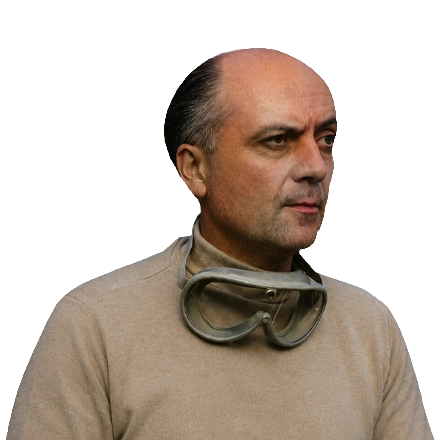
Pierre Levegh, born Pierre Eugène Alfred Bouillin on 22 December 1905 in Paris, was one of motor racing’s most courageous and tragic figures — a driver remembered as much for his extraordinary determination as for the devastating events that claimed his life at the 1955 24 Hours of Le Mans.
Driver Bio
| Nationality | French |
| Birthplace | Paris, France |
| Born | 22 December 1905 |
| Died | 11 June 1955 |
| First Grand Prix | 1950 Belgian Grand Prix |
| Last Grand Prix | 1951 Italian Grand Prix |
| Years Active | 1950–1951 |
| Current/Last Team | Privateer: Talbot-Lago |
Adopting the racing name “Pierre Levegh” in tribute to his uncle Alfred Velghe, an early motorsport pioneer who died in 1904, Levegh built a reputation as a fiercely committed competitor during the golden age of endurance racing. Away from the circuit he was also an accomplished sportsman, competing in both ice hockey and tennis, but it was behind the wheel where his relentless spirit truly stood out.
Levegh competed in Formula One as a privateer with the Talbot-Lago team during the 1950 and 1951 seasons. Across six World Championship starts he endured the unforgiving nature of early Grand Prix racing, retiring from half of those events and scoring no championship points.
It was at Le Mans, however, where Levegh forged his legend. Racing for Talbot, he entered the famous endurance classic four times and steadily established himself among the event’s toughest competitors. In 1951 he guided his Talbot to fourth place, but it was his heroic drive in 1952 that became part of motorsport folklore.
Driving virtually the entire race alone, Levegh built a commanding four-lap lead and appeared destined for victory. Refusing to hand over to his co-driver because he believed only he could carefully manage the increasingly fragile car to the finish, he battled through exhaustion and mechanical issues deep into the final hour. Tragically, with victory almost certain, the engine failed after a bolt in the crankshaft bearing worked loose — an issue that had silently developed many hours earlier. Although many blamed driver fatigue at the time, the mechanical failure ultimately denied Levegh one of endurance racing’s greatest solo triumphs.
He returned to Le Mans in 1953 to finish eighth, while in 1954 another accident cut short his challenge during the seventh hour of the race. Yet Levegh’s reputation as a fearless and respected endurance specialist only continued to grow.
In 1955 he joined Mercedes-Benz, partnering American driver John Fitch in the revolutionary Mercedes-Benz 300 SLR. What followed during that year’s Le Mans race would become the darkest day in motorsport history.
Death
During the third hour of the race, defending leader Mike Hawthorn suddenly pulled his Jaguar D-Type toward the pits on the fast Tribunes Straight, forcing Lance Macklin to swerve his Austin-Healey 100S across the circuit. Levegh, approaching at high speed in the Mercedes just ahead of teammate Juan Manuel Fangio, had no time to avoid the collision.
Levegh’s Mercedes rode up over Macklin’s car, launched into the air and slammed into an embankment before disintegrating violently into the crowd. Thrown from the wreckage, Levegh was killed instantly. The magnesium-heavy bodywork ignited in flames, while debris tore through the packed grandstands. In total, around 81 spectators lost their lives and more than 100 others were injured in what remains the deadliest accident in the history of motor racing.
Fangio later believed Levegh may have saved his life in the moments before impact. According to the five-time world champion, Levegh signalled for him to slow down just seconds before the crash — a warning that allowed Fangio to narrowly avoid becoming part of the catastrophe.
The disaster transformed motorsport forever. Mercedes immediately withdrew from the race as a mark of respect and abandoned factory racing activities for the next three decades. The tragedy also accelerated a global push toward improved circuit safety, crowd protection and modern racing regulations, fundamentally reshaping the future of the sport.
Today, Pierre Levegh is remembered not only for the horror of 1955, but for his immense bravery, endurance and devotion to racing during one of motorsport’s most dangerous eras. He is buried at Père Lachaise Cemetery, where his name remains forever linked to both the romance and the risks of early motor racing.
Grand Prix Stats
| Race Entries | 6 |
| Race Starts | 6 |
| Did Not Start | 0 |
| Best Race Start | 9th |
| Best Race Finish | 7th |
| Retirements | 3 |
| First-Lap Retirements | 0 |
| Not Classified | 0 |
| Disqualified | 0 |
| Did Not Qualify | 0 |
Qualifying
| Qualifying Sessions | 0 |
| Reached Q3 | 0 |
| Q2 Eliminations | 0 |
| Q1 Eliminations | 0 |
| Did Not Qualify | 0 |
Stats by Season
| Year | Constructor | Entries | Starts | Wins | Podiums | Poles | Fastest Laps | Front Rows | DNF | Best Start | Best Result | Pts Finishes | Points | Championship |
|---|---|---|---|---|---|---|---|---|---|---|---|---|---|---|
| 1950 | Privateer: Talbot-Lago | 3 | 3 | 0 | 0 | 0 | 0 | 0 | 2 | 9 | 7 | 0 | 0 | NC |
| 1951 | Privateer: Talbot-Lago | 3 | 3 | 0 | 0 | 0 | 0 | 0 | 1 | 13 | 8 | 0 | 0 | NC |
Stats by Constructor
| Constructor | Years | Entries | Starts | Wins | Podiums | Poles | Fastest Laps | Front Rows | DNF | Best Start | Best Result | Pts Finishes | Points |
|---|---|---|---|---|---|---|---|---|---|---|---|---|---|
| Privateer: Talbot-Lago | 1950–1951 | 6 | 6 | 0 | 0 | 0 | 0 | 0 | 3 | 9 | 7 | 0 | 0 |