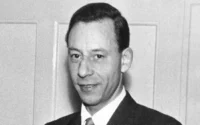























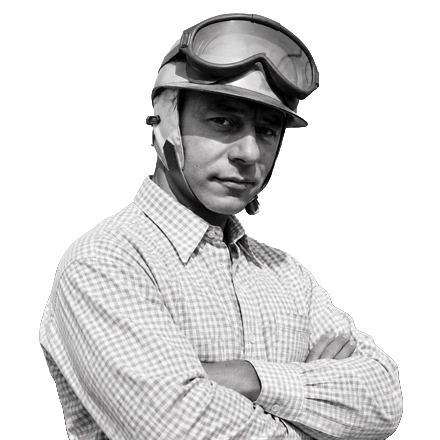
George Edgar Abecassis DFC (21 March 1913 – 18 December 1991) was a British racing driver, decorated Royal Air Force pilot and co-founder of the HWM Formula One team. His career connected the fiercely independent world of pre-war British racing with the emerging Formula One and sports-car scene of the 1950s.
Driver Bio
| Nationality | British |
| Birthplace | Chertsey, England, UK |
| Born | 21 March 1913 |
| Died | 18 December 1991 |
| First Grand Prix | 1951 Swiss Grand Prix |
| Last Grand Prix | 1952 Swiss Grand Prix |
| Years Active | 1951–1952 |
| Current/Last Team | HWM |
Pre-war racing
Born in Oatlands, Surrey, Abecassis was educated at Clifton College. He entered circuit racing in 1935 with a heavily modified Austin Seven known as The Einsitzer.
After sitting out the 1937 season, Abecassis acquired an Alta and quickly became one of the strongest competitors in British national racing.
He demonstrated his speed in multiple disciplines. On 3 July 1938, Abecassis set a Prescott Hill Climb record of 47.85 seconds in his supercharged 1.5-litre Alta. He also held the lap record around Brooklands’ Campbell circuit at an average of 72.61 mph.
His defining pre-war victory came in the rain-soaked 1939 Imperial Trophy at Crystal Palace. Abecassis defeated Prince Bira’s celebrated ERA, Romulus, in his smaller Alta. It was reportedly the only occasion on which that ERA was beaten in the British Isles by a 1.5-litre car.
Wartime service
When the Second World War began, Abecassis joined the Royal Air Force Volunteer Reserve and trained as a pilot.
His duties extended far beyond ordinary flying. Abecassis became a member of the clandestine “Moon Squadrons,” which used specially modified Halifax and Stirling aircraft to carry secret agents into and out of occupied Europe under cover of darkness.
He also served as a flying instructor and deputy flight commander. The official citation accompanying his recognition praised the energy, consistency and care he brought to training pilots for operational service.
Abecassis received the Distinguished Flying Cross and was mentioned in dispatches. He reached the rank of squadron leader and remained in the RAF Volunteer Reserve after the war, finally leaving in 1953.
Return to racing
Abecassis resumed competition soon after peace returned, initially relying on machinery built before the war.
On 15 June 1946, he won at Gransden Lodge in a road-going 3.3-litre Bugatti. A year later, he finished second in the Swedish Grand Prix, an extraordinary event held on a frozen lake at Vallentuna, driving an ERA.
Another runner-up result followed in the 1948 Jersey International Road Race, where Abecassis finished behind Bob Gerard.
Creating HWM
Abecassis entered business with fellow racer John Heath through Hersham and Walton Motors, a dealership and garage in Walton-on-Thames.
The company’s initials supplied the name HWM, which would become familiar across Formula Two, Formula One and sports-car racing.
Building on Abecassis’s established relationship with Alta, HWM contributed to the development of the Alta Grand Prix car for the newly introduced Formula One regulations. When that project failed to become competitive, Abecassis and Heath decided to construct their own cars while retaining Alta engines.
Their early HWM machines were designed for Formula Two. That decision became unexpectedly valuable in 1952, when the World Championship temporarily adopted Formula Two regulations. HWM suddenly possessed cars eligible for Grand Prix racing.
The team became an important proving ground for young talent. Future stars including Stirling Moss and Peter Collins drove for HWM, while Belgian racer Johnny Claes delivered its first victory at the Grand Prix des Frontières on the Chimay street circuit.
Another notable success came at Silverstone in 1952, when Lance Macklin won the International Trophy for the team.
Formula One returned to 2.5-litre regulations in 1954. Abecassis and Heath attempted to create a competitive HWM powered by the enlarged Alta engine, but the design was unsuccessful. The marque entered only two further World Championship Grands Prix after 1953.
Formula One and sports cars
Abecassis drove an HWM in both of his Formula One World Championship appearances. Each came at Switzerland’s Bremgarten circuit, in the 1951 and 1952 Swiss Grands Prix.
His own strongest results arrived in sports-car racing.
At the 1950 24 Hours of Le Mans, Abecassis shared an Aston Martin DB2 with Lance Macklin and won his class. Three years later, he partnered Reg Parnell to second place in the 12 Hours of Sebring.
In 1953, Abecassis constructed a Jaguar straight-six-powered HWM sports car for his personal use. He raced it successfully in British national events through 1956.
He also produced a striking performance in the 1955 Mille Miglia. Driving a red Austin-Healey 100S, Abecassis attacked the final section from Rome at a pace reportedly close to that achieved by Stirling Moss’s victorious Mercedes-Benz 300 SLR. He finished 11th overall.
Retirement and business
John Heath was killed during the 1956 Mille Miglia. His death prompted Abecassis to retire from competition and concentrate on running HWM.
The company continued as a prominent motor business, and Abecassis became Britain’s importer for the French luxury manufacturer Facel Vega.
His automotive connections extended into his family life. Abecassis married Angela, the daughter of Aston Martin chairman Sir David Brown.
Abecassis died at Ibstone, near High Wycombe in Buckinghamshire, on 18 December 1991. He was 78.
Legacy
In September 2010, his son David published a detailed biography titled A Passion for Speed.
The family’s involvement in historic motorsport continued through Abecassis’s grandson, Jonathan. He became an active vintage racer in the Fifties Sports Car Racing Club series, driving an Austin-Healey 100/4.
Abecassis’s legacy reaches beyond his own results. Through HWM, he helped provide opportunities to a generation of drivers who would shape British motor racing, while the company he created survived as a direct link to the independent, improvisational spirit of the sport’s early post-war years.
Grand Prix Stats
| Race Entries | 2 |
| Race Starts | 2 |
| Did Not Start | 0 |
| Best Race Start | 10th |
| Best Race Finish | – |
| Retirements | 2 |
| First-Lap Retirements | 0 |
| Not Classified | 0 |
| Disqualified | 0 |
| Did Not Qualify | 0 |
Qualifying
| Qualifying Sessions | 2 |
| Reached Q3 | 0 |
| Q2 Eliminations | 0 |
| Q1 Eliminations | 0 |
| Did Not Qualify | 0 |
Stats by Season
| Year | Constructor | Entries | Starts | Wins | Podiums | Poles | Fastest Laps | Front Rows | DNF | Best Start | Best Result | Pts Finishes | Points | Championship |
|---|---|---|---|---|---|---|---|---|---|---|---|---|---|---|
| 1951 | HWM | 1 | 1 | 0 | 0 | 0 | 0 | 0 | 1 | 20 | n/a | 0 | 0 | NC |
| 1952 | HWM | 1 | 1 | 0 | 0 | 0 | 0 | 0 | 1 | 10 | n/a | 0 | 0 | NC |
Stats by Constructor
| Constructor | Years | Entries | Starts | Wins | Podiums | Poles | Fastest Laps | Front Rows | DNF | Best Start | Best Result | Pts Finishes | Points |
|---|---|---|---|---|---|---|---|---|---|---|---|---|---|
| HWM | 1951–1952 | 2 | 2 | 0 | 0 | 0 | 0 | 0 | 2 | 10 | n/a | 0 | 0 |
Teammates & Qualifying Head-to-Head
| Teammate | Years | Races | Qualifying H2H |
|---|---|---|---|
| Stirling Moss | 1951, 1952 | 2 | – |
| Lance Macklin | 1952 | 1 | – |
| Peter Collins | 1952 | 1 | – |