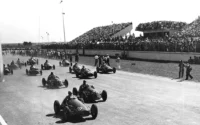
Juan Manuel Fangio delivered a brilliant drive in appallingly wet conditions to win the 1951 Swiss Grand Prix, cementing his reputation as one of the greatest drivers of all time.
Race Guide
Season: 1951 F1 World Championship
Race date: Sunday, 27 May 1951
Race start time: Start time unconfirmed local time (UTC+01:00)
Circuit: Circuit Bremgarten
Laps: 42 laps
Circuit length: 7.28 km
1950 winner: Nino Farina
Previous race: 1950 Italian Grand Prix
Next race: 1951 Indianapolis 500
Autosport wrote, “His fearless passage through the circuit’s innumerable fast bends gained him the sincere admiration of all, elevating him still higher in the ranks of Grand Prix drivers.” Fangio had been haunted by running over a black cat during a reconnaissance drive the night before the race. “I had resisted the temptation to let myself be dragged down by superstition,” he said.
Italian driver Piero Taruffi, who drove for Ferrari, finished second and fellow Italian driver, Nino Farina rounded out the podium in third, in the second Alfa Romeo car.
| Pole position | ||
|---|---|---|
| Driver | Juan Manuel Fangio | Alfa Romeo |
| Time | 2:35.900 | |
| Fastest lap | ||
| Driver | Juan Manuel Fangio | Alfa Romeo |
| Time | 2:51.100 on lap 33 | |
| Podium | ||
| First | Juan Manuel Fangio | Alfa Romeo |
| Second | Piero Taruffi | Ferrari |
| Third | Nino Farina | Alfa Romeo |
Weekend Schedule
| Date | Session | Local Time |
|---|---|---|
| 25 May 1951 | Friday timed practice | Time unconfirmed |
| 26 May 1951 | Saturday final qualifying | Time unconfirmed |
| 27 May 1951 | Race | Time unconfirmed |
Championship background
The 1951 F1 World Championship began with a fresh points table and the first opportunity to measure the teams in race conditions. Circuit Bremgarten hosted the opening contest, where qualifying pace, tyre management and reliability would all shape the result.
Race entries
Alfa Romeo entered Fangio, defending champion Farina, Sanesi and de Graffenried. Ferrari brought Villoresi, Taruffi and Ascari, although Ascari was hampered by burns sustained at an earlier event. Moss and Abecassis represented HWM, while BRM withdrew its planned entry.
Friday timed practice
Alfa Romeo methodically rotated its drivers through a test car, checking fuel consumption and recording technical data. Ferrari appeared more relaxed, with Villoresi doing most of its running, yet he finished quickest. The contrast underlined the importance of fuel strategy as Ferrari‘s unsupercharged engine challenged the thirsty Alfetta.
Saturday final qualifying
Alfa Romeo tested a de Dion rear-suspension car as its drivers increased the pace. Fangio and Farina displaced Villoresi at the front, securing the first two grid positions. Ascari remained below his best physically, while Taruffi continued learning the Ferrari. The dry practice conditions would offer limited guidance for the wet race.
Qualifying Classification
Friday and Saturday timed practice established the grid. Formula One permitted 1.5-litre supercharged or 4.5-litre unsupercharged engines, creating contrasting fuel-stop requirements.
| Pos. | No. | Driver | Team | Best Time |
|---|---|---|---|---|
| 1 | 24 | Juan Manuel Fangio | Alfa Romeo | 2:35.900 |
| 2 | 22 | Nino Farina | Alfa Romeo | 2:37.8 |
| 3 | 18 | Luigi Villoresi | Ferrari | 2:39.3 |
| 4 | 28 | Consalvo Sanesi | Alfa Romeo | 2:40.3 |
| 5 | 26 | Toulo de Graffenried | Alfa Romeo | 2:41.8 |
| 6 | 44 | Piero Taruffi | Ferrari | 2:45.2 |
| 7 | 20 | Alberto Ascari | Ferrari | 2:46.0 |
| 8 | 8 | Louis Rosier | Talbot-Lago | 2:52.7 |
| 9 | 16 | Peter Whitehead | Ferrari | 2:52.9 |
| 10 | 38 | Rudi Fischer | Ferrari | 2:54.1 |
| 11 | 10 | Henri Louveau | Talbot-Lago | 2:56.2 |
| 12 | 4 | Philippe Étancelin | Talbot-Lago | 2:57.3 |
| 13 | 42 | José Froilán González | Talbot-Lago | 2:57.3 |
| 14 | 14 | Stirling Moss | HWM | 2:58.4 |
| 15 | 6 | Yves Giraud-Cabantous | Talbot-Lago | 3:00.3 |
| 16 | 52 | Peter Hirt | Veritas | 3:01.6 |
| 17 | 32 | Harry Schell | Maserati | 3:02.4 |
| 18 | 2 | Johnny Claes | Talbot-Lago | 3:02.5 |
| 19 | 30 | Louis Chiron | Maserati | 3:03.8 |
| 20 | 12 | George Abecassis | HWM | 3:05.1 |
| 21 | 40 | Guy Mairesse | Talbot-Lago | 3:12.0 |
| DNA | 34 | Prince Bira | Maserati | – |
| DNA | 36 | Toni Branca | Maserati | – |
| DNA | 46 | Francis Rochat | Simca-Gordini | – |
| DNA | 48 | Robert Manzon | Simca-Gordini | – |
| DNA | 48 | Maurice Trintignant | Simca-Gordini | – |
| DNA | 50 | André Simon | Simca-Gordini | – |
What happened in the 1951 Swiss Grand Prix?
Fangio led in the rain, with Farina following and Taruffi advancing into contention. Alfa Romeo‘s different fuel arrangements shaped the race: Fangio stopped, while Farina attempted to continue without a refuelling halt.
Farina inherited the lead during Fangio’s stop, but could not hold him off once the Argentine returned to pace. Taruffi also closed on the defending champion and passed him near the finish.
Fangio won from Taruffi and Farina, with Sanesi fourth and de Graffenried fifth. Ascari finished sixth. Moss’s promising HWM run ended with fuel trouble on the final lap, allowing Chiron to take seventh. Fangio also earned the fastest-lap point.
After the race, Juan Manuel Fangio headed the drivers’ standings with 9 points, followed by Piero Taruffi on 6.
1951 Swiss Grand Prix race results
The 1951 Swiss Grand Prix was held on 27 May 1951.
| Pos. | No. | Driver | Team | Laps | Time / Retired | Pts. |
|---|---|---|---|---|---|---|
| 1 | 24 | Juan Manuel Fangio | Alfa Romeo | 42 | 2:07:53.64 | 9 |
| 2 | 44 | Piero Taruffi | Ferrari | 42 | + 55.24 | 6 |
| 3 | 22 | Nino Farina | Alfa Romeo | 42 | + 1:19.31 | 4 |
| 4 | 28 | Consalvo Sanesi | Alfa Romeo | 41 | + 1 Lap | 3 |
| 5 | 26 | Toulo de Graffenried | Alfa Romeo | 40 | + 2 Laps | 2 |
| 6 | 20 | Alberto Ascari | Ferrari | 40 | + 2 Laps | 0 |
| 7 | 30 | Louis Chiron | Maserati | 40 | + 2 Laps | 0 |
| 8 | 14 | Stirling Moss | HWM | 40 | + 2 Laps | 0 |
| 9 | 8 | Louis Rosier | Talbot-Lago | 39 | + 3 Laps | 0 |
| 10 | 4 | Philippe Étancelin | Talbot-Lago | 39 | + 3 Laps | 0 |
| 11 | 38 | Rudi Fischer | Ferrari | 39 | + 3 Laps | 0 |
| 12 | 32 | Harry Schell | Maserati | 38 | + 4 Laps | 0 |
| 13 | 2 | Johnny Claes | Talbot-Lago | 35 | + 7 Laps | 0 |
| 14 | 40 | Guy Mairesse | Talbot-Lago | 31 | + 11 Laps | 0 |
| Ret | 16 | Peter Whitehead | Ferrari | 36 | Accident | 0 |
| Ret | 10 | Henri Louveau | Talbot-Lago | 30 | Accident | 0 |
| Ret | 12 | George Abecassis | HWM | 23 | Magneto | 0 |
| Ret | 6 | Yves Giraud-Cabantous | Talbot-Lago | 14 | Ignition | 0 |
| Ret | 18 | Luigi Villoresi | Ferrari | 12 | Accident | 0 |
| Ret | 42 | José Froilán González | Talbot-Lago | 10 | Oil pump | 0 |
| Ret | 52 | Peter Hirt | Veritas | 0 | Fuel System | 0 |
Includes 1 point for fastest lap
1951 Swiss Grand Prix Fastest Laps
| Pos. | No. | Driver | Team | Lap | Time |
|---|---|---|---|---|---|
| 1 | 24 | Juan Manuel Fangio | Alfa Romeo | 33 | 2:51.100 |
Only drivers with a recorded lap time appear. One championship point was awarded for fastest lap, divided equally when shared.
1951 Post-Race F1 Championship Standings
Championship standings after the 1951 Swiss Grand Prix.
1951 Post-Race F1 Drivers’ Championship Standings
| POS | Driver | Nationality | Car | PTS |
|---|---|---|---|---|
| 1 | Juan Manuel Fangio | Argentine | Alfa Romeo | 9 |
| 2 | Piero Taruffi | Italian | Ferrari | 6 |
| 3 | Nino Farina | Italian | Alfa Romeo | 4 |
| 4 | Consalvo Sanesi | Italian | Alfa Romeo | 3 |
| 5 | Toulo de Graffenried | Swiss | Alfa Romeo | 2 |
| — | Alberto Ascari | Italian | Ferrari | 0 |
| — | Louis Chiron | Monegasque | Maserati | 0 |
| — | Stirling Moss | British | HWM | 0 |
| — | Louis Rosier | French | Talbot-Lago | 0 |
| — | Philippe Étancelin | French | Talbot-Lago | 0 |
| — | Rudi Fischer | Swiss | Ferrari | 0 |
| — | Harry Schell | American | Maserati | 0 |
| — | Johnny Claes | Belgian | Talbot-Lago | 0 |
| — | Guy Mairesse | French | Talbot-Lago | 0 |
| — | Peter Whitehead | British | Ferrari | 0 |
| — | Henri Louveau | French | Talbot-Lago | 0 |
| — | George Abecassis | British | HWM | 0 |
| — | Yves Giraud-Cabantous | French | Talbot-Lago | 0 |
| — | Luigi Villoresi | Italian | Ferrari | 0 |
| — | José Froilán González | Argentine | Talbot-Lago | 0 |
| — | Peter Hirt | Swiss | Veritas | 0 |
There was no constructors’ championship in this season; the manufacturers’ competition began in 1958.
Drivers counted their best 4 results. The first five places earned 8–6–4–3–2 points, with one further point for fastest lap, shared equally when necessary. Points from shared drives were divided between the eligible drivers; individual allocations are shown in driver order.
1951 Formula 1 Race Calendar
Seen in: