





















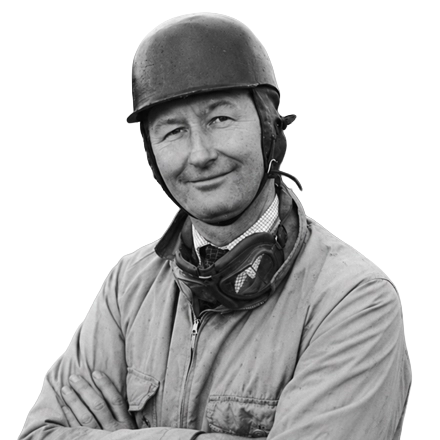
Peter Nield Whitehead (12 November 1914 – 21 September 1958) was a British racing driver from Menston, Yorkshire, and one of the most accomplished privateer racers of his generation. Cultured, widely travelled and particularly formidable in sports cars, Whitehead built a career that stretched from the great pre-war circuits to the early years of the Formula One World Championship. His achievements included victory in the 1938 Australian Grand Prix, a famous triumph at the 1951 24 Hours of Le Mans, two wins in the 12 Hours of Reims, and a Formula One World Championship podium.
His was also a career lived remarkably close to danger. Whitehead survived a serious aeroplane crash in 1948, only to lose his life ten years later while competing in the Tour de France Automobile. He was 43.
Driver Bio
| Nationality | British |
| Birthplace | Menston, England, UK |
| Born | 12 November 1914 |
| Died | 21 September 1958 |
| First Grand Prix | 1950 French Grand Prix |
| Last Grand Prix | 1954 British Grand Prix |
| Years Active | 1950–1954 |
| Current/Last Team | Privateer: Cooper |
Early life and pre-war racing
Born in Menston, Yorkshire, Whitehead came from a prosperous family whose wealth had been built through the wool industry. That comfortable background gave him the opportunity to indulge a growing enthusiasm for motor racing, and he began competing at just 19 years old, initially driving a Riley.
It did not take long for the machinery to become considerably more serious.
The following season Whitehead moved into an ERA B-Type, placing himself behind the wheel of one of Britain’s most important pre-war racing cars. He also became involved with Alta, delivering the manufacturer its first significant result when he finished third in the Limerick Grand Prix, a Formula Libre event.
By 1936, Whitehead was sharing his ERA with his friend and fellow racer Peter Walker. The partnership produced third place in the Donington Grand Prix, further establishing Whitehead as a driver capable of competing at a high level.
But even by the adventurous standards of pre-war racers, Whitehead was never particularly interested in staying close to home.
In 1938, business took him to Australia. Most businessmen might have packed suitable clothes and some paperwork. Whitehead took his ERA.
It proved an inspired decision.
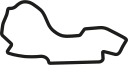
At Bathurst, he won the 1938 Australian Grand Prix, securing the first truly major victory of his career. He also captured the inaugural Australian Hillclimb Championship, making the trip spectacularly productive both professionally and competitively.
The Australian Grand Prix victory would remain one of the defining achievements of Whitehead’s career, even after his later international successes at Le Mans and elsewhere.
Back in Britain for 1939, he added another notable result with third place in the Nuffield Trophy.
Then Europe went to war, and motor racing stopped.
Post-war racing career
During the Second World War, Whitehead served as a pilot with the Royal Air Force.
When racing resumed, he wasted little time getting back into a competition car. His trusty ERA returned with him, and in the summer of 1947 Whitehead finished second in the British Empire Trophy, staged on the Douglas Circuit on the Isle of Man.
He also travelled to Switzerland for the Lausanne Grand Prix, where he finished sixth.
International travel had always been part of Whitehead’s life, but in 1948 it very nearly killed him.
He was travelling by air from Croydon Aerodrome to Milan, intending to arrange the purchase of a Ferrari 125, when the aircraft crashed.
Whitehead survived, but he was badly injured.
The injuries were severe enough to keep him out of motor racing for approximately a year. Given the nature of the accident, returning to competition at all was an achievement. Whitehead not only returned, he soon resumed racing at international level.
And the Ferrari he had been travelling to Italy to acquire would prove historically significant.
Grand Prix racer
In 1949, Whitehead and his close friend and sometime co-driver Dudley Folland became the first private customers to whom Enzo Ferrari sold a Formula One car.
The machine was a Ferrari 125.
Folland had it painted green rather than Ferrari’s familiar red, adding a red Welsh dragon to the bonnet in recognition of his Welsh background. It was certainly not the most conventional-looking Ferrari, but convention was never particularly important to this group of wealthy, adventurous privateer racers.
Whitehead soon put the car to excellent use.
He won the Czechoslovakian Grand Prix, becoming the first English driver since Richard Seaman to win a major international motor race outside the United Kingdom.
It was a significant achievement, particularly at a time when British drivers and constructors had yet to become the dominant forces they would be during the following decade.
Then, in 1950, the new Formula One World Drivers’ Championship arrived.
Whitehead entered the championship from its inaugural season. His first appearance came at Monaco, although he did not start the race.
His next Championship outing was considerably more memorable.
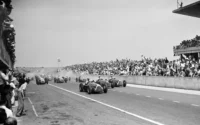
At the 1950 French Grand Prix, officially the Grand Prix de l’ACF, Whitehead produced what would become his finest World Championship performance. He was in contention for an even greater result until gearbox trouble slowed the Ferrari, but he kept going and eventually brought the car home in third place.
It was Whitehead’s only podium finish from 11 World Championship starts between 1950 and 1954, but it demonstrated what he could achieve when circumstances fell his way.
The World Championship represented only part of Formula One racing in those years, and Whitehead remained extremely active outside it.
During 1950, he won two non-championship Formula One events: the Jersey Road Race and the Ulster Trophy.
He also continued racing — and winning — in Formula Two throughout Europe, while his willingness to travel increasingly took him to major events far beyond the traditional European calendar.
New Zealand became particularly productive territory.
Whitehead won the Lady Wigram Trophy in 1954, driving a Ferrari, and returned to win the event again in 1956 and 1957.
Three Lady Wigram Trophy victories in four years demonstrated both his enduring speed and his effectiveness on the demanding temporary airfield circuit.
He added another significant international victory in 1956, winning the Rand Grand Prix in South Africa.
All four of those victories — his three Lady Wigram successes and the Rand Grand Prix — came at the wheel of Ferrari machinery. By then, however, Whitehead’s greatest achievements were increasingly being recorded not in single-seaters, but in sports cars.
Sports car racing
If Whitehead was an accomplished Grand Prix driver, sports-car racing was arguably where he was at his very best.
He made his first start in the 24 Hours of Le Mans in 1950, sharing a Jaguar XK120 with John Marshall. The pair completed the race and finished 15th. It was a respectable introduction.
Twelve months later, Whitehead returned with much more serious machinery — and produced the biggest victory of his career.
For the 1951 24 Hours of Le Mans, Whitehead was paired with his old friend Peter Walker in one of Jaguar’s new C-Types.
The C-Type was a purpose-built competition machine developed around Jaguar’s XK engine and represented a major step forward from the XK120 Whitehead had driven the previous year.
Whitehead and Walker made it count.
Together they won the 1951 24 Hours of Le Mans, averaging 93.112 mph (149.849 km/h) across the race.
For Whitehead, it was a career-defining victory. For Jaguar, it was the company’s first Le Mans triumph, beginning an extraordinary relationship with the French endurance classic that would produce a string of victories during the 1950s.
Whitehead had helped start it.
By 1953, he had decided to concentrate increasingly on sports-car competition, a move that immediately produced further major successes.
In July that year, he shared a Jaguar C-Type with Stirling Moss in the 12 Heures Internationales de Reims. They won.
The fast Reims circuit was ideally suited to powerful sports cars, and Whitehead’s victory alongside one of the greatest drivers of the era reinforced his reputation as an outstanding endurance racer.
Before that Reims success, Whitehead had also won the Hyères 12 Hours, making 1953 another particularly productive season.
He returned to Reims in 1954, this time with full Jaguar works support and the newer Jaguar D-Type. His co-driver was Ken Wharton. The result was the same.
Whitehead won the 12 Hours of Reims for a second consecutive year, giving him victories in the event with two different generations of Jaguar sports car.
Later that season, Whitehead and Wharton finished sixth in the RAC Tourist Trophy, continuing a sports-car programme that increasingly defined the latter part of his career.
There was a consistency to Whitehead’s success that stretched across continents, manufacturers and different forms of competition.
He had won a Grand Prix in Australia before the war, taken major Formula One victories outside the World Championship, reached a World Championship podium, won in Formula Two, conquered major races in New Zealand and South Africa and become a Le Mans winner with Jaguar.
He was exactly the sort of versatile international racer that flourished during the 1940s and ’50s — a driver capable of moving from a Grand Prix single-seater to an endurance sports car and immediately operating near the front.
Nor did advancing age appear to diminish his competitiveness.
In 1958, almost two decades after his Australian Grand Prix triumph, Whitehead remained capable of producing results at the very highest level.
At that year’s 24 Hours of Le Mans, he shared an Aston Martin DB3S with his half-brother Graham Whitehead. They finished second. It was one of Peter Whitehead’s finest late-career performances and, tragically, proved to be his last great result.
Death
Only a few months after their Le Mans podium, Peter and Graham Whitehead were racing together again, this time in the Tour de France Automobile.
On 21 September 1958, they were travelling through southern France in a Jaguar 3.4-Litre, with Graham driving, when disaster struck near Lasalle, close to Nîmes.
The Jaguar left the road, overturned twice and crashed from a bridge into a ravine approximately 30 feet (9.1 metres) deep.
Graham survived the accident with serious injuries, but they were not life-threatening. Peter was killed instantly. He was just 43 years old.
The crash brought to an abrupt end a racing career that had begun in 1935 and had survived both the interruption of a world war and the aeroplane accident that had nearly killed Whitehead a decade earlier.
His record was extraordinary in its variety. But it was in sports cars that his reputation became particularly formidable.
His life ended far too early, but by the time it did, Peter Whitehead had already packed more racing into 43 years than most drivers could and will ever have managed in a lifetime.
Grand Prix Stats
| Race Entries | 12 |
| Race Starts | 10 |
| Did Not Start | 1 |
| Best Race Start | 8th |
| Best Race Finish | 3rd |
| Retirements | 5 |
| First-Lap Retirements | 0 |
| Not Classified | 0 |
| Disqualified | 0 |
| Did Not Qualify | 1 |
Podiums
| Podiums | 1 |
| First Podium | 1950 French Grand Prix |
| Last Podium | 1950 French Grand Prix |
| 1st Place | 0 |
| 2nd Place | 0 |
| 3rd Place | 1 |
| Most Consecutive Podiums | 0 |
| Most Podiums in a Single Season | 1 |
| Seasons with Podiums | 1 |
Qualifying
| Qualifying Sessions | 12 |
| Reached Q3 | – |
| Q2 Eliminations | – |
| Q1 Eliminations | – |
| Did Not Qualify | 1 |
Points
| Points Scored | 4 |
| Points Finishes | 1 |
| Most Points in a Single Season | 4 |
| Seasons with Points | 1 |
Complete Formula One World Championship results
| Year | Entrant | Chassis | Engine | 1 | 2 | 3 | 4 | 5 | 6 | 7 | 8 | 9 | WDC | Points |
|---|---|---|---|---|---|---|---|---|---|---|---|---|---|---|
| 1950 | Peter Whitehead | Ferrari 125 | Ferrari V12 | GBR | MON DNS | 500 | FRA 3 | ITA 7 | 9th | 4 | ||||
| Scuderia Ferrari | Ferrari 125 | Ferrari V12 | SUI DNA | BEL | ||||||||||
| 1951 | Peter Whitehead | Ferrari 125 | Ferrari V12 | SUI Ret | 500 | BEL | FRA Ret | GER | ITA Ret | NC | 0 | |||
| Ferrari 375 | Ferrari V12 | ESP DNA | ||||||||||||
| G A Vandervell | Ferrari 375 Thinwall | Ferrari V12 | GBR 9 | |||||||||||
| 1952 | Peter Whitehead | Alta F2 | Alta Straight-4 | SUI | 500 | BEL | FRA Ret | NC | 0 | |||||
| Ferrari 125/166 | Ferrari V12 | GBR 10 | GER | NED | ITA DNQ | |||||||||
| 1953 | Atlantic Stable | Cooper T24 | Alta Straight-4 | ARG | 500 | NED | BEL | FRA | GBR 9 | GER | SUI | ITA | NC | 0 |
| 1954 | Peter Whitehead | Cooper T24 | Alta Straight-4 | ARG | 500 | BEL | FRA | GBR Ret | GER | SUI | ITA | ESP | NC | 0 |
Teammates & Qualifying Head-to-Head
| Teammate | Years | Races | Qualifying H2H |
|---|---|---|---|
| Raymond Sommer | 1950 | 1 | – |