

























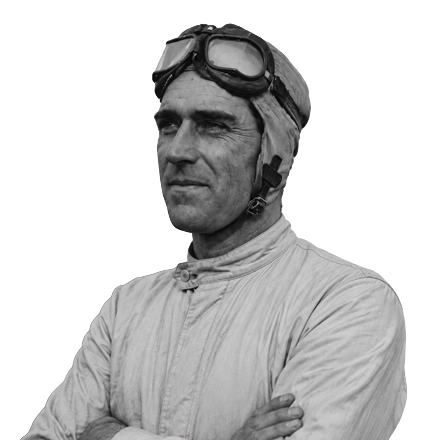
Peter Douglas Conyers Walker (7 October 1912 – 1 March 1984) was an English racing driver who proved quick in almost anything he was given, from Grand Prix machinery to hillclimb cars. It was in sports cars, however, that he made his greatest mark, winning the 1951 24 Hours of Le Mans for Jaguar and the 1955 Goodwood Nine Hours for Aston Martin. A serious accident at Le Mans in 1956 effectively brought his frontline career to an end.
Driver Bio
| Nationality | British |
| Birthplace | Huby, England, UK |
| Born | 7 October 1912 |
| Died | 1 March 1984 |
| First Grand Prix | 1950 British Grand Prix |
| Last Grand Prix | 1955 British Grand Prix |
| Years Active | 1950–1951, 1955 |
| Current/Last Team | Maserati, Connaught |
Born in Huby, Yorkshire, Walker was known throughout the paddock as “Skid” – an appropriate nickname for a driver whose spectacular, aggressive style made him a favourite with spectators.
Early life and pre-war racing
Walker’s serious involvement in motorsport began in 1935, when he formed a close association with fellow British racer Peter Whitehead. Before the Second World War, Walker competed successfully in both circuit racing and hillclimbing, frequently driving Whitehead’s ERA machinery.
He scored victories at venues including Brooklands and Donington Park and developed a reputation for throwing the car around with considerable commitment. Walker’s willingness to slide an ERA through corners was entertaining, effective and occasionally notorious – but subtlety was never really the point.
When racing resumed after the war, Walker was soon back behind the wheel.
Racing career
The experience accumulated during the 1930s made Walker an even more formidable competitor after the war. He became one of the relatively few drivers capable of extracting meaningful performance from the difficult ERA E-type and combined Grand Prix appearances with a busy programme of hillclimbs and sports-car events.
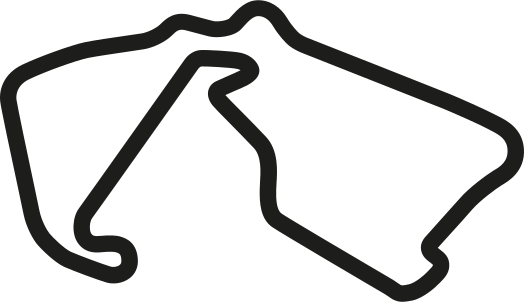
In 1948 he entered the inaugural British Grand Prix at RAF Silverstone. Walker was supposed to race an ERA E-type, but when the intended chassis wasn’t ready in time, he fell back on his older B-type.
It wasn’t the quickest solution, but it survived. In a race of heavy attrition, Walker reached the finish in 11th place, albeit 12 laps behind winner Luigi Villoresi.
Grand Prix racing
When the Formula One World Championship officially began in 1950, Walker was there from the very first race.
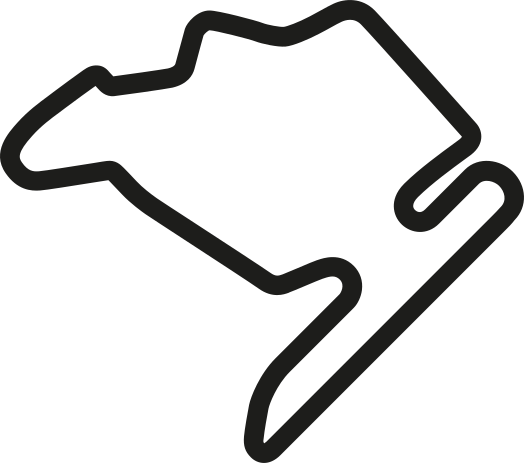
He entered his own ERA E-type for the British Grand Prix at Silverstone and qualified an impressive tenth. Walker started the race before handing the car to Tony Rolt after only two laps, but the promising qualifying speed wasn’t matched by reliability. Rolt retired on lap five with gearbox trouble.
That proved to be Walker’s only World Championship appearance of 1950.
His next came at Silverstone in 1951, just a month after the greatest victory of his career at Le Mans. This time he was driving one of the extraordinary supercharged 1.5-litre V16 BRM Type 15s.
Walker finished seventh, while teammate Reg Parnell took fifth, but both men paid a painful price. Heat pouring from the BRM’s engine and exhaust system badly burned their legs, leaving even the simple act of walking difficult afterwards.
Their determination to finish earned considerable praise. Contemporary journalist Gregor Grant credited Parnell and Walker with effectively saving the day for the ambitious British project by persevering through considerable pain and providing the team with the information needed to improve the car.
Despite that effort, Walker never raced the BRM again.
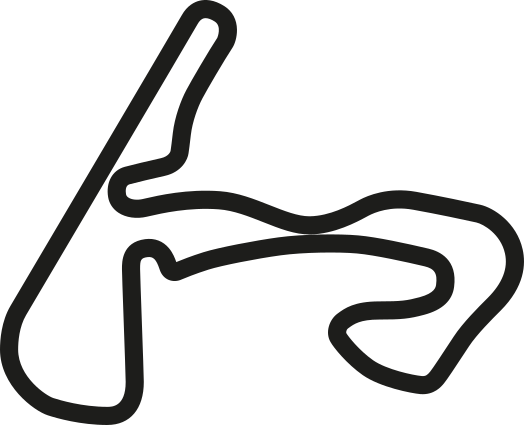
Four years passed before he returned to World Championship Formula One. In 1955 he drove Stirling Moss‘s Maserati 250F in the Dutch Grand Prix but retired with mechanical trouble.
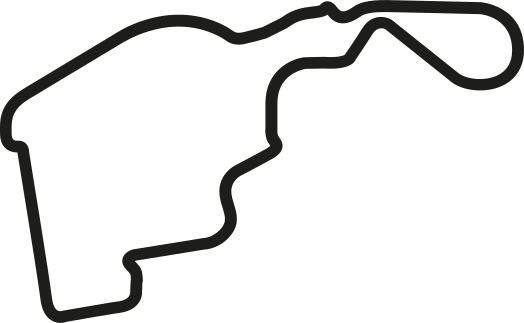
His final World Championship appearance came at the British Grand Prix at Aintree, where he shared a works Connaught Type B with his old partner Tony Rolt. Their race lasted only 19 of the scheduled 90 laps before a throttle failure forced the car out.
Grand Prix racing had given Walker some memorable machinery, but it was never where his greatest successes came.
Sports-car ace
Walker’s performances in hillclimbing attracted the attention of Jaguar competition manager Lofty England, who offered him a drive in the new Jaguar XK120 for the car’s first race at Silverstone in 1949.
Walker finished second.
Twelve months later he returned to the same meeting in a works-prepared, alloy-bodied XK120 and won.
That relationship would become one of the defining partnerships of his career.
Jaguar subsequently developed the XK120 into a purpose-built endurance racer, the XK120C – better known simply as the C-Type. The company’s ambition was clear: win the 24 Hours of Le Mans outright.
Walker was recruited for the programme and partnered his old friend Peter Whitehead for Jaguar’s first attempt in 1951.
The C-Type had been completed only weeks before the race, but it was immediately competitive. Jaguar’s three cars occupied the leading positions after four hours, although reliability gradually reduced the team’s numbers. After 50 laps, Walker and Whitehead’s machine was the only Jaguar still running.
Crucially, it kept running.
Walker and Whitehead went on to win the race outright, delivering Jaguar a sensational Le Mans victory at the C-Type’s first attempt. The result brought enormous publicity to the Coventry manufacturer and gave Walker the achievement with which his name would forever be associated.
Remarkably, his 1951 campaign wasn’t finished.
Still suffering from the burns inflicted by the BRM at the British Grand Prix, Walker headed to Dundrod for the RAC Tourist Trophy. He brushed the injuries aside as little more than an inconvenience and climbed back into a Jaguar C-Type.
Jaguar swept the podium, with Walker finishing second behind Stirling Moss.
Moss rated him highly, both as a driver and as a teammate. Walker was quick, uncomplicated and easy to work with – valuable qualities when two drivers had to share the same car for hours at a time.
The pair were teamed together for the 1953 24 Hours of Le Mans and immediately challenged for another Jaguar victory. Their C-Type ran at the front early on before engine trouble intervened.
Moss stopped on lap 20 and the mechanics began investigating. A second stop finally revealed the culprit: a blocked fuel filter.
The delay had cost them any realistic chance of victory, but Moss and Walker recovered to finish second, four laps behind the winning Jaguar of Tony Rolt and Duncan Hamilton. It was the closest Walker would come to winning Le Mans for a second time.
Moss and Walker were reunited for the Goodwood Nine Hours and dominated much of the race, leading comfortably for the opening eight hours before mechanical failure stopped them.
At the RAC Tourist Trophy, Walker demonstrated his speed again by breaking the lap record. Once more, however, the machinery intervened. Mechanical trouble delayed the car before Moss eventually brought it home in third.
Walker remained part of Jaguar’s sports-car line-up in 1954. At Le Mans he again partnered Moss, this time in the newer D-Type, but brake trouble forced them out during the 12th hour.
The relationship with Jaguar then came to an unfortunate end.
Lofty England wanted Walker to make himself available for pre-season testing ahead of 1955, but Walker failed to respond and instead joined Aston Martin. In hindsight, the timing could hardly have been worse: Jaguar was about to embark on a run of three consecutive Le Mans victories.
Still, Aston Martin provided some consolation.
Walker shared a DB3S with Dennis Poore in the 1955 Goodwood Nine Hours and produced one of the finest performances of his career, taking victory.
Lofty England remained convinced of Walker’s ability even after their professional relationship had ended. In his view, Walker had the speed to match even Stirling Moss on some of the faster circuits, and might have achieved considerably more had he been able to race full-time rather than appearing only a handful of times each season.
There would be little opportunity to find out.
Walker returned to Le Mans with Aston Martin in 1956 and was running strongly in a DB3S when, during the 16th hour, he made a mistake on the wet circuit near Dunlop Bridge.
The Aston Martin skidded off, struck the wall and eventually came to rest upside down on the track.
Walker suffered serious injuries in the accident, and although he survived, his career at the highest level was effectively over.
He did make a limited return. In 1957 he tested a Connaught Type B at Goodwood for Rob Walker’s team and subsequently drove the car in a one-off Syracuse Grand Prix appearance. Despite spinning and stalling late in the race, he was classified eighth.
It was a modest final chapter to a career that had included some of the most important races and machinery of the immediate post-war era.
Away from the track
Life after motor racing took Walker in some unexpected directions.
For a time he became involved with Lady Ripley in farming rabbits and chinchillas, although the venture ultimately came to little. He also designed his own type of cattle grid, another project that failed to develop into lasting commercial success.
His later years were difficult. Walker suffered from dementia and eventually developed pneumonia.
He died in Newtown, Worcestershire, on 1 March 1984, aged 71.
Among those who raced alongside him, however, Walker was remembered with considerable affection. Stirling Moss regarded him as one of motor racing’s genuinely good characters.
The results support the reputation, too. Walker competed in the very first Formula One World Championship Grand Prix, wrestled with the fearsome BRM V16, raced ERAs before and after the war and proved capable of matching some of Britain’s finest drivers.
But his lasting place in motorsport history was secured at Le Mans in 1951. In a brand-new Jaguar C-Type, Walker and Peter Whitehead gave Jaguar its first victory in the world’s greatest endurance race – the opening chapter in what would become one of Le Mans’ most celebrated manufacturer success stories.
Grand Prix Stats
| Race Entries | 4 |
| Race Starts | 4 |
| Did Not Start | 0 |
| Best Race Start | 10th |
| Best Race Finish | 7th |
| Retirements | 3 |
| First-Lap Retirements | 0 |
| Not Classified | 0 |
| Disqualified | 0 |
| Did Not Qualify | 0 |
Qualifying
| Qualifying Sessions | 4 |
| Reached Q3 | 0 |
| Q2 Eliminations | 0 |
| Q1 Eliminations | 0 |
| Did Not Qualify | 0 |
Stats by Season
| Year | Constructor | Entries | Starts | Wins | Podiums | Poles | Fastest Laps | Front Rows | DNF | Best Start | Best Result | Pts Finishes | Points | Championship |
|---|---|---|---|---|---|---|---|---|---|---|---|---|---|---|
| 1950 | Privateer: Peter Walker ERA | 1 | 1 | 0 | 0 | 0 | 0 | 0 | 1 | 10 | – | 0 | 0 | NC |
| 1951 | BRM | 1 | 1 | 0 | 0 | 0 | 0 | 0 | 0 | 19 | 7 | 0 | 0 | NC |
| 1955 | Privateer: Stirling Moss Maserati / Privateer: Rob Walker Racing Team Connaught | 2 | 2 | 0 | 0 | 0 | 0 | 0 | 2 | 10 | – | 0 | 0 | NC |
Stats by Constructor
| Constructor | Years | Entries | Starts | Wins | Podiums | Poles | Fastest Laps | Front Rows | DNF | Best Start | Best Result | Pts Finishes | Points |
|---|---|---|---|---|---|---|---|---|---|---|---|---|---|
| Privateer: Peter Walker ERA | 1950 | 1 | 1 | 0 | 0 | 0 | 0 | 0 | 1 | 10 | – | 0 | 0 |
| BRM | 1951 | 1 | 1 | 0 | 0 | 0 | 0 | 0 | 0 | 19 | 7 | 0 | 0 |
| Privateer: Stirling Moss Maserati | 1955 | 1 | 1 | 0 | 0 | 0 | 0 | 0 | 1 | 10 | – | 0 | 0 |
| Privateer: Rob Walker Racing Team Connaught | 1955 | 1 | 1 | 0 | 0 | 0 | 0 | 0 | 1 | – | – | 0 | 0 |
Teammates & Qualifying Head-to-Head
| Teammate | Years | Races | Qualifying H2H |
|---|---|---|---|
| Reg Parnell | 1951 | 1 | – |
| Tony Rolt | 1955 | 1 | – |