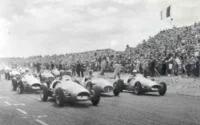
Nino Farina claimed victory at the 1951 Belgian Grand Prix driving a supercharged Alfa Romeo.
Race Guide
Season: 1951 F1 World Championship
Race date: Sunday, 17 June 1951
Race start time: Start time unconfirmed local time (UTC+01:00)
Circuit: Circuit de Spa-Francorchamps
Laps: 36 laps
Circuit length: 14.12 km
1950 winner: Juan Manuel Fangio
Previous race: 1951 Indianapolis 500
Next race: 1951 French Grand Prix
Despite only 13 cars starting the race, across three different manufacturers, the event drew a record crowd. There were three additional entries, including two Maseratis, that failed to make it to the event. Juan Manuel Fangio debuted a new suspension system equipped with specially designed concave wheels to accommodate the brake drums. The race would mark the only occasion in Fangio’s illustrious Formula 1 career, excluding retirements, where he finished outside the top four. Nevertheless, he earned a point for recording the fastest lap of the race. Although he placed ninth and only the top five finishers scored points, this result allowed him to maintain his record of scoring in every race he completed.
The Ferraris of Alberto Ascari and Luigi Villoresi finished second and third, respectively.
| Pole position | ||
|---|---|---|
| Driver | Juan Manuel Fangio | Alfa Romeo |
| Time | 4:25.000 | |
| Fastest lap | ||
| Driver | Juan Manuel Fangio | Alfa Romeo |
| Time | 4:22.100 on lap 10 | |
| Podium | ||
| First | Nino Farina | Alfa Romeo |
| Second | Alberto Ascari | Ferrari |
| Third | Luigi Villoresi | Ferrari |
Weekend Schedule
| Date | Session | Local Time |
|---|---|---|
| Before the race; individual dates unconfirmed | Timed practice and qualifying | Time unconfirmed |
| Sunday, 17 June 1951 | Race | Time unconfirmed |
Championship background
Juan Manuel Fangio arrived at round 3 leading the 1951 F1 World Championship on 9 points, with Lee Wallard on 9.
Race entries
A compact field brought together Alfa Romeo, Ferrari and Talbot-Lago. Fangio drove Alfa Romeo‘s latest de Dion car, while Ferrari supplied new machinery for Ascari and Villoresi. Pilette made his championship debut in a Talbot, giving the Belgian spectators a new local contender.
Timed practice and qualifying
Practice showed that tyre wear and fuel stops would be central to the race. Fangio’s Alfa Romeo used an unusual rear-wheel arrangement alongside its revised suspension, while Ferrari increased its rear tyre size. The leading Italian cars broke previous benchmarks, with Fangio taking pole. Villoresi joined the Alfas on the front row, demonstrating that Ferrari was close enough to threaten if pit work went its way.
Qualifying Classification
Timed practice set the grid. The consulted accounts do not establish a complete daily session timetable. Fastest lap earned a championship point regardless of finishing position, unlike later eligibility rules.
| Pos. | No. | Driver | Team | Best Time |
|---|---|---|---|---|
| 1 | 2 | Juan Manuel Fangio | Alfa Romeo | 4:25.000 |
| 2 | 4 | Nino Farina | Alfa Romeo | 4:28 |
| 3 | 10 | Luigi Villoresi | Ferrari | 4:29 |
| 4 | 8 | Alberto Ascari | Ferrari | 4:30 |
| 5 | 12 | Piero Taruffi | Ferrari | 4:32 |
| 6 | 6 | Consalvo Sanesi | Alfa Romeo | 4:36 |
| 7 | 14 | Louis Rosier | Talbot-Lago | 4:45 |
| 8 | 22 | Yves Giraud-Cabantous | Talbot-Lago | 4:52 |
| 9 | 18 | Louis Chiron | Talbot-Lago | 5:01 |
| 10 | 20 | Philippe Étancelin | Talbot-Lago | 5:04 |
| 11 | 16 | Johnny Claes | Talbot-Lago | 5:09 |
| 12 | 24 | André Pilette | Talbot-Lago | 5:16 |
| 13 | 26 | Pierre Levegh | Talbot-Lago | 5:17 |
| DNA | 28 | Prince Bira | Maserati | – |
| DNA | 30 | José Froilán González | Maserati | – |
| DNA | 32 | Reg Parnell | Ferrari | – |
What happened in the 1951 Belgian Grand Prix?
Farina established the lead, while Fangio increased his pace and set fastest lap. The contest changed when Fangio stopped: a rear wheel jammed on its hub, and mechanics eventually had to change the tyre with the assembly removed. More than fourteen minutes were lost.
Farina’s own stops were much more efficient. Ascari and Villoresi continued in pursuit, but could not erase his advantage. Sanesi and Taruffi retired, leaving the leading Talbots to contest the remaining points.
Farina won from Ascari and Villoresi. Rosier finished fourth and Giraud-Cabantous fifth, while Pilette took sixth on debut. Fangio finished ninth but still received the fastest-lap point.
After the race, Nino Farina headed the drivers’ standings with 12 points, followed by Juan Manuel Fangio on 10.
1951 Belgian Grand Prix race results
The 1951 Belgian Grand Prix was held on 17 June 1951.
| Pos. | No. | Driver | Team | Laps | Time / Retired | Pts. |
|---|---|---|---|---|---|---|
| 1 | 4 | Nino Farina | Alfa Romeo | 36 | 2:45:46.2 | 8 |
| 2 | 8 | Alberto Ascari | Ferrari | 36 | + 2:51.0 | 6 |
| 3 | 10 | Luigi Villoresi | Ferrari | 36 | + 4:21.9 | 4 |
| 4 | 14 | Louis Rosier | Talbot-Lago | 34 | + 2 Laps | 3 |
| 5 | 22 | Yves Giraud-Cabantous | Talbot-Lago | 34 | + 2 Laps | 2 |
| 6 | 24 | André Pilette | Talbot-Lago | 33 | + 3 Laps | 0 |
| 7 | 16 | Johnny Claes | Talbot-Lago | 33 | + 3 Laps | 0 |
| 8 | 26 | Pierre Levegh | Talbot-Lago | 32 | + 4 Laps | 0 |
| 9 | 2 | Juan Manuel Fangio | Alfa Romeo | 32 | + 4 Laps | 1 |
| Ret | 18 | Louis Chiron | Talbot-Lago | 28 | Engine | 0 |
| Ret | 6 | Consalvo Sanesi | Alfa Romeo | 11 | Radiator | 0 |
| Ret | 12 | Piero Taruffi | Ferrari | 8 | Transmission | 0 |
| Ret | 20 | Philippe Étancelin | Talbot-Lago | 0 | Transmission | 0 |
1 point for fastest lap
1951 Belgian Grand Prix Fastest Laps
| Pos. | No. | Driver | Team | Lap | Time |
|---|---|---|---|---|---|
| 1 | 2 | Juan Manuel Fangio | Alfa Romeo | 10 | 4:22.100 |
Only drivers with a recorded lap time appear. One championship point was awarded for fastest lap, divided equally when shared.
1951 Post-Race F1 Championship Standings
Championship standings after the 1951 Belgian Grand Prix.
1951 Post-Race F1 Drivers’ Championship Standings
There was no constructors’ championship in this season; the manufacturers’ competition began in 1958.
Drivers counted their best 4 results. The first five places earned 8–6–4–3–2 points, with one further point for fastest lap, shared equally when necessary. Points from shared drives were divided between the eligible drivers; individual allocations are shown in driver order.
1951 Formula 1 Race Calendar
Seen in: