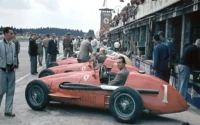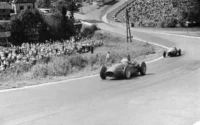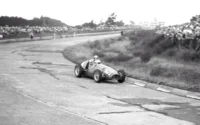
























Veritas was a post-war West German sports and racing car manufacturer that emerged from the wreckage of Europe after the Second World War and quickly became one of Germany’s most ambitious independent constructors. Based initially in Hausen am Andelsbach near Sigmaringen in Baden-Württemberg, the company later moved to Meßkirch, Muggensturm and eventually the Nürburgring.
| Nationality | German |
| Years Active | 1951–1953 |
| First Race | 1951 Swiss Grand Prix |
| Last Race | 1953 German Grand Prix |
| Race Entries | 6 |
| Race Starts | 6 |
| Wins | 0 |
| Podiums | 0 |
| Pole Positions | 0 |
| Fastest Laps | 0 |
| Points | 0 |
| Constructors’ Championships | 0 |
| Drivers’ Championships | 0 |
| Best Start | 7th |
| Best Finish | 7th |
| Did Not Start | 0 |
| Did Not Qualify | 0 |
| Retirements | 11 |
Veritas
Though never a large-volume manufacturer, Veritas built a reputation for speed, technical ingenuity and resilience. In the difficult economic climate of post-war Germany, the company managed to create race winners, stylish road cars and one of the most intriguing comeback stories in early European motorsport.
Founded on racing passion
Veritas was founded by Ernst Loof, Georg Meier and Lorenz Dietrich. In its earliest form, the business specialised in rebuilding and tuning pre-war BMW 328 sports cars using components supplied by customers.
These upgraded machines were initially known as BMW-Veritas cars. It was a practical and clever starting point: use proven pre-war engineering, refine it, lighten it and return it to competition.
The first of these cars was driven in 1947 by Karl Kling, who won at Hockenheim and went on to become the German 2-litre champion that same year. For a young company, it was a sensational launch.
After only a small number of BMW-Veritas machines had been built, BMW objected to the continued use of its name. The cars were therefore rebranded simply as Veritas—a name that soon earned its own prestige.
Racing reputation
In the immediate post-war years, Germany’s motorsport scene was rebuilding from almost nothing. Veritas became one of the leading domestic names by offering fast, competitive cars when many larger manufacturers were still recovering.
The company’s race cars, particularly the RS models, were admired for their agility and strong performance. Veritas quickly became synonymous with German privateer success, helping revive national competition at circuits such as Hockenheim and the Nürburgring.
For a brief period, Veritas stood as proof that post-war German engineering talent had lost none of its edge.
The Komet road car
In 1949, Veritas expanded into road-going production with the launch of the Komet coupé. This sleek machine was essentially a road-legal version of the Veritas RS racing car.
That gave buyers something rare: competition-bred performance wrapped in a body suitable for public roads. In an era when sports cars were often heavily compromised, the Komet offered a thrillingly direct link to motorsport.
Its styling and concept captured the optimism of post-war Europe, where speed and sophistication once again had a place in public life.
Saturn and Scorpion
The Komet was followed by more civilised grand touring models: the Saturn 2+2 coupé and the Scorpion cabriolet. Both were styled by designer Ben Bowden, bringing a touch of flair and elegance to the Veritas range.
These cars showed that Veritas was thinking beyond racing specials. It wanted to become a genuine German sports car manufacturer, blending engineering credibility with attractive coachwork and broader road appeal.
It was an ambitious vision—but ambition would soon meet harsh financial reality.
Muggensturm expansion and crisis
Later in 1949, the company moved to larger premises in Muggensturm. The relocation signalled growth, but Veritas remained dangerously undercapitalised.
New cars were developed around a 1998cc engine designed by Eric Zipprich and manufactured by Heinkel. Interest was strong: more than 200 orders were reportedly placed for the new model.
Yet success on paper could not solve cash flow problems. Veritas lacked the funds to purchase sufficient components for production, and manufacturing stalled in 1950. It was a classic tale of engineering promise outpacing financial backing.
Survival through coachbuilding
Although full-scale production faltered, Veritas did not vanish immediately. The company remained active until 1952 by building new bodies for Panhard cars.
This pivot demonstrated the business’s versatility. Even when unable to manufacture complete vehicles at scale, Veritas still possessed valuable expertise in design, fabrication and specialist coachwork.
Loof’s Nürburgring revival
Ernst Loof was not ready to give up. In 1950, he moved operations to the Nürburgring and rented the former Auto Union workshops—motorsport premises steeped in pre-war Grand Prix history.
There, he established Automobilwerke Ernst Loof GmbH and launched a fresh generation of Veritas cars. These models used the Heinkel-built engine and featured saloon or cabriolet coachwork by Spohn.
It was a bold second act: restart production beside Germany’s most famous circuit, surrounded by the echoes of Silver Arrows‘ history.
The final years
Once again, however, money proved the greatest opponent. Funding quickly ran short, and later examples were fitted with Ford or Opel engines as practical alternatives.
Production numbers from the Nürburgring era remain uncertain, but estimates suggest between six and twenty cars were completed. That scarcity has only increased their mystique among collectors and historians.
Though the dream of becoming a major manufacturer faded, Veritas had already done enough to secure its legend.
Legacy
Veritas occupies a special niche in European automotive history. It was not merely a car company—it was a symbol of post-war determination, built by racers and engineers who refused to wait for better times.
From Karl Kling’s championship-winning early success to stylish road cars like the Komet, Saturn and Scorpion, Veritas proved that innovation and passion could survive even the toughest circumstances.
Today, surviving Veritas cars are rare treasures. They represent a moment when Germany’s motorsport spirit was reborn through ingenuity, courage and a refusal to stand still.
Veritas Stats by Season
| Year | Engine | Drivers | Entries | Starts | Wins | Podiums | Poles | Fastest Laps | Front Rows | DNF | Best Start | Best Result | Points | Championship |
|---|---|---|---|---|---|---|---|---|---|---|---|---|---|---|
| 1951 | Veritas | Peter Hirt | 1 | 1 | 0 | 0 | 0 | 0 | 0 | 1 | 16 | – | – | – |
| 1952 | Veritas | Toni Ulmen, Arthur Legat, Adolf Brudes, Theo Helfrich, Hans Klenk, Josef Peters, Paul Pietsch, Fritz Riess | 3 | 3 | 0 | 0 | 0 | 0 | 0 | 5 | 7 | 7 | – | – |
| 1953 | Veritas | Arthur Legat, Erwin Bauer, Willi Heeks, Theo Helfrich, Hans Herrmann, Oswald Karch, Ernst Loof, Wolfgang Seidel | 2 | 2 | 0 | 0 | 0 | 0 | 0 | 5 | 14 | 9 | – | – |