

























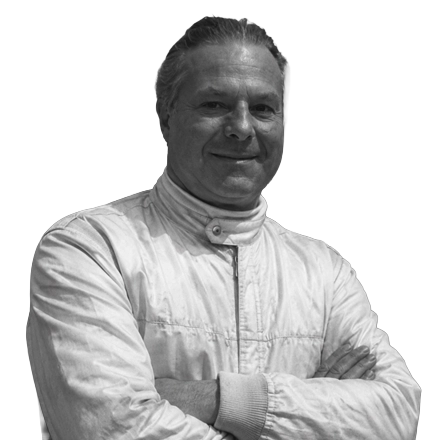
Anton “Toni” Ulmen (25 January 1906 – 4 November 1976) was a German motorcycle and racing driver from Düsseldorf whose career stretched from two wheels in the 1920s to the Formula One World Championship. One of Germany’s leading post-war competitors, he collected major victories in both motorcycle and car racing and became a four-time German sports-car and Formula Two champion between 1949 and 1952.
Driver Bio
| Nationality | German |
| Birthplace | Dusseldorf, Germany |
| Born | 25 January 1906 |
| Died | 4 November 1976 |
| First Grand Prix | 1952 Swiss Grand Prix |
| Last Grand Prix | 1952 German Grand Prix |
| Years Active | 1952 |
| Current/Last Team | Privateer: Toni Ulmen Veritas |
Craftsman, businessman and racer
Ulmen’s life outside racing began with engineering.
After leaving school, he completed an apprenticeship as a machinist at Motorradwerkstatt Hasenclever. Once qualified, he went into business with his brother Andreas, establishing Gebrüder Ulmen. The brothers subsequently became Opel representatives in Düsseldorf.
Motorsport entered the picture in 1925.
Ulmen made his competitive debut in the Großen Deutschland-Rundfahrt aboard a 250cc Velocette motorcycle. Two years later, now riding a 350cc Velocette, he achieved a particularly significant victory.
In 1927 he won the first Eifelrennen, claiming the Deutsche Tourist-Trophäe in the inaugural race meeting held at the newly opened Nürburgring.
Being a winner at the Nürburgring would become impressive enough in later decades. Being one of its very first winners gave Ulmen a special place in the circuit’s history.
Another major motorcycle success followed in 1929 when he won the 350cc class of the Eilenriederennen, staged on the temporary Eilenriede circuit near Hanover.
By 1930, Ulmen’s performances had earned him works status with NSU.
Post-war racing
After the Second World War, Ulmen made the transition from motorcycles to racing cars.
His return to serious competition came in sports cars, and he immediately showed that his ability transferred perfectly well to four wheels. Driving a BMW 328, he finished second in his first major post-war sports-car event at Karlsruhe-Durlach.
By 1947, Ulmen had done enough to be recognised as Germany’s leading sports-car driver of the year.
His career really gathered momentum in 1949.
Ulmen won nine races during the season, including victories in the Solituderennen and the DMV Grenzlandringrennen. Further successes came at Munich, the Nürburgring, Sachsenring and the Kölner Kurs.
As if nine victories were not enough, he also accumulated seven second places.
The results brought Ulmen the German championship and firmly established him as one of the country’s outstanding drivers during the difficult rebuilding years after the war.
He retained his title in 1950.
That season also featured the first post-war Großer Preis von Deutschland at the Nürburgring. Driving an open-wheel Veritas RS, Ulmen finished fourth.
International competition was also beginning to reopen to German drivers and machinery after the post-war restrictions that had previously prevented them from competing abroad.
Ulmen made good use of the opportunity.
At the Preis der Ostschweiz-Erlen in Switzerland, he produced a surprise third-place finish in his Veritas. Only the Ferraris of Luigi Villoresi and Roberto Vallone finished ahead of him.
Victories at Hockenheim, the Schauinsland hillclimb and the Grenzlandring further strengthened his record, and Ulmen emerged as the clear German champion in the two-litre sports-car category.
Formula One
Ulmen’s success eventually brought him into the Formula One World Championship in 1952.
He made his Championship debut on 18 May at the 1952 Swiss Grand Prix, driving his Veritas. His first appearance ended in retirement because of problems with the fuel tank.
His second and final World Championship start came at the 1952 German Grand Prix.
At the Nürburgring, Ulmen faced machinery considerably more powerful than his Veritas, but nevertheless brought the car home in eighth place.
His Formula One career therefore consisted of only two World Championship appearances, but Grand Prix racing was just one small part of a much broader season.
Ulmen again won the DMV Grenzlandringrennen in 1952 and remained deeply involved in the fight for Germany’s domestic Formula Two and sports-car honours.
The season was not without danger.
During practice at the Sachsenring, Ulmen suffered a major accident. Remarkably, he escaped the crash almost completely unharmed and was able to continue his championship campaign.
Everything came down to the final meeting of the season at AVUS.
Ulmen arrived leading both the Formula Two and two-litre sports-car classifications. On the high-speed Berlin circuit, he became locked in a dramatic slipstreaming battle with fellow Veritas driver Fritz Riess.
On the penultimate lap, Riess gained the advantage.
The result left the pair level on championship points. Under DMV regulations, Rieß was awarded the sports-car title because he had achieved the better result at the Eifelrennen.
Ulmen did, however, secure the Formula Two championship, despite being unable to participate in that particular race.
It was an appropriately dramatic conclusion to the most successful period of his car-racing career.
After 1952, Ulmen largely stepped away from regular competition.
Final races
Although he effectively retired at the beginning of 1953, Ulmen was soon tempted back behind the wheel for one particularly demanding event.
He teamed up with Herman Roosdorp in a Jaguar D-Type for the 24 Hours of Spa-Francorchamps.
It was Ulmen’s only 24-hour endurance race, and he made it count.
The pair finished third, giving Ulmen a podium result in one of Europe’s great endurance contests before he finally reduced his racing activities to occasional appearances.
Away from the track
Ulmen remained closely involved with German motorsport after hanging up his helmet.
He became president of the Deutscher Motorsport Verband, moving from competitor to administrator and helping represent the sport in which he had spent much of his life.
His achievements were also recognised at national level.
German President Theodor Heuss awarded Ulmen the Silbernes Lorbeerblatt, Germany’s highest sporting honour, in recognition of his achievements in motorsport.
Ulmen died on 4 November 1976.
His two Formula One appearances represent only a fraction of his story. He had begun racing motorcycles in 1925, won at the Nürburgring during its inaugural meeting, became a works motorcycle rider, successfully switched to cars after the war and emerged as one of Germany’s finest competitors of the late 1940s and early 1950s.
From Velocettes to BMWs, Veritas machinery and finally a Jaguar, Toni Ulmen’s career covered several very different eras of European motorsport – and he was successful in almost all of them.
Grand Prix Stats
| Race Entries | 2 |
| Race Starts | 2 |
| Did Not Start | 0 |
| Best Race Start | 15th |
| Best Race Finish | 8th |
| Retirements | 1 |
| First-Lap Retirements | 0 |
| Not Classified | 0 |
| Disqualified | 0 |
| Did Not Qualify | 0 |
Qualifying
| Qualifying Sessions | 2 |
| Reached Q3 | 0 |
| Q2 Eliminations | 0 |
| Q1 Eliminations | 0 |
| Did Not Qualify | 0 |
Stats by Season
| Year | Constructor | Entries | Starts | Wins | Podiums | Poles | Fastest Laps | Front Rows | DNF | Best Start | Best Result | Pts Finishes | Points | Championship |
|---|---|---|---|---|---|---|---|---|---|---|---|---|---|---|
| 1952 | Privateer: Toni Ulmen Veritas | 2 | 2 | 0 | 0 | 0 | 0 | 0 | 1 | 15 | 8 | 0 | 0 | NC |