

























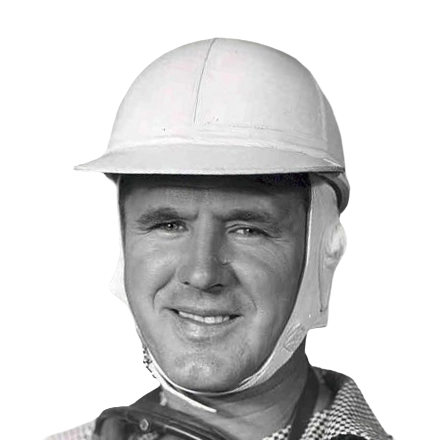
Duane Claude Carter was an American racing driver whose long career touched nearly every major form of U.S. oval racing. A winner in midget cars, sprint cars, and championship machinery, Carter became one of the most respected all-rounders of his generation. He was also a mentor, team figure, and later an administrator who helped shape American motorsport beyond his driving years.
Driver Bio
| Nationality | American |
| Birthplace | Fresno, California, USA |
| Born | 5 May 1913 |
| Died | 7 March 1993 |
| First Grand Prix | 1950 Indianapolis 500 |
| Last Grand Prix | 1960 Indianapolis 500 |
| Years Active | 1950–1955, 1959–1960 |
| Current/Last Team | Kuzma |
Born in Fresno, Carter grew up in the heart of California’s fertile Central Valley. While attending Fresno State University, he discovered racing and quickly found his natural home on dirt ovals.
He later died in Indianapolis, a fitting place for a man whose life became deeply tied to the Indianapolis 500.
Racing career
Midget cars
Carter began racing midgets at a one-fifth-mile dirt track on the west side of Fresno. Midget racing demanded bravery, rapid reflexes, and supreme car control, and it proved the ideal training ground for his talents.
In 1937, he was among six American drivers invited to race at Western Springs Stadium in Auckland. There, Carter won the first-ever midget car race held at the venue, giving him a permanent place in New Zealand speedway history. Remarkably, the car he drove still survives in a museum in Auckland.
By 1939, Carter was a consistent winner on the famous Nutley board track, where future motorsport journalist Chris Economaki served informally as his crew chief.
His success continued with the 1940 Detroit VFW Motor Speedway title and the 1942 championship at Sportsman Park in Cleveland. In 1947, he claimed a gruelling 500-lap victory at the Los Angeles Coliseum Motordome after an initial result was overturned. It was exactly the kind of hard-fought triumph that built his reputation.
Sprint cars
Carter graduated to sprint cars, where power and danger increased dramatically. He adapted seamlessly and won the 1950 Midwest Division championship, confirming that his skills were transferable across classes.
Sprint cars of the era were wild, demanding machines, and succeeding in them required nerve as much as talent. Carter had both.
Indy cars
Carter competed in the AAA Contest Board and later the USAC Championship Car series across the 1948–1955, 1959–1960, and 1963 seasons.
He made 47 starts, including multiple appearances in the Indianapolis 500. Over that span, he finished in the top ten 23 times—a testament to consistency in one of the most dangerous periods of open-wheel racing.
His best result came with second place at Phoenix Raceway in 1953. Though he never captured the Indianapolis 500 itself, Carter was widely respected as a dependable and fearless competitor who could be trusted to bring speed and professionalism to any team.
His final Indianapolis 500 appearance came in an innovative John Crosthwaite-designed Harvey Aluminium Special, nicknamed the “roller skate car.” It featured pioneering low-profile wide tyres and a stock Chevrolet engine—evidence that even late in his career Carter remained connected to racing innovation.
USAC director
Carter retired from active competition in 1956 to become Competition Director for USAC, helping administer the sport he had spent decades serving on track.
When Henry Banks took over the role, Carter returned to competition in 1959, proving that the desire to race had never truly left him.
Family and influence
Carter’s son Pancho Carter later became a prominent Indy car racer, extending the family’s motorsport legacy. He also helped raise Johnny Parsons, another major figure in American open-wheel history.
That dual legacy—as father and mentor—means Carter’s influence reached well beyond his own results.
Career awards
Carter’s contributions were recognised with induction into the National Midget Auto Racing Hall of Fame in 1989, the National Sprint Car Hall of Fame in 1991, and the Fresno County Athletic Hall of Fame in 1967.
Death and legacy
Duane Carter died on 7 March 1993 in Indianapolis at the age of 79.
He is remembered as one of American racing’s true craftsmen: tough enough for dirt tracks, fast enough for Indianapolis, and respected enough to help run the sport itself. Few careers covered so much ground—or so many laps.
Grand Prix Stats
| Race Entries | 8 |
| Race Starts | 8 |
| Did Not Start | 0 |
| Best Race Start | 4th |
| Best Race Finish | 3rd |
| Retirements | 1 |
| First-Lap Retirements | 0 |
| Not Classified | 0 |
| Disqualified | 0 |
| Did Not Qualify | 0 |
Podiums
| Podiums | 1 |
| First Podium | 1953 Indianapolis 500 |
| Last Podium | 1953 Indianapolis 500 |
| 1st Place | 0 |
| 2nd Place | 0 |
| 3rd Place | 1 |
| Most Consecutive Podiums | 1 |
| Most Podiums in a Single Season | 1 |
| Seasons with Podiums | 1 |
Qualifying
| Qualifying Sessions | 8 |
| Reached Q3 | – |
| Q2 Eliminations | – |
| Q1 Eliminations | – |
| Did Not Qualify | 0 |
Points
| Points Scored | 6.5 |
| Points Finishes | 3 |
| Most Points in a Single Season | 3 |
| Seasons with Points | 3 |
Stats by Season
| Year | Constructor | Entries | Starts | Wins | Podiums | Poles | Fastest Laps | Front Rows | DNF | Best Start | Best Result | Pts Finishes | Points | Championship |
|---|---|---|---|---|---|---|---|---|---|---|---|---|---|---|
| 1950 | Stevens | 1 | 1 | 0 | 0 | 0 | 0 | 0 | 0 | 13 | 18 | 0 | 0 | NC |
| 1951 | Deidt | 1 | 1 | 0 | 0 | 0 | 0 | 0 | 0 | 4 | 8 | 0 | 0 | NC |
| 1952 | Lesovsky | 1 | 1 | 0 | 0 | 0 | 0 | 0 | 0 | 6 | 4 | 1 | 3 | 13th |
| 1953 | Lesovsky / Kurtis Kraft | 1 | 1 | 0 | 1 | 0 | 0 | 0 | 0 | 27 | 3 | 1 | 2 | 13th |
| 1954 | Kurtis Kraft | 1 | 1 | 0 | 0 | 0 | 0 | 0 | 1 | 8 | 15 | 1 | 1.5 | 23rd |
| 1955 | Kuzma | 1 | 1 | 0 | 0 | 0 | 0 | 0 | 0 | 18 | 11 | 0 | 0 | NC |
| 1959 | Kurtis Kraft | 1 | 1 | 0 | 0 | 0 | 0 | 0 | 0 | 27 | 7 | 0 | 0 | NC |
| 1960 | Kuzma | 1 | 1 | 0 | 0 | 0 | 0 | 0 | 0 | 27 | 28 | 0 | 0 | NC |