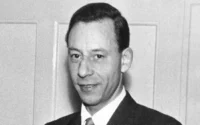

























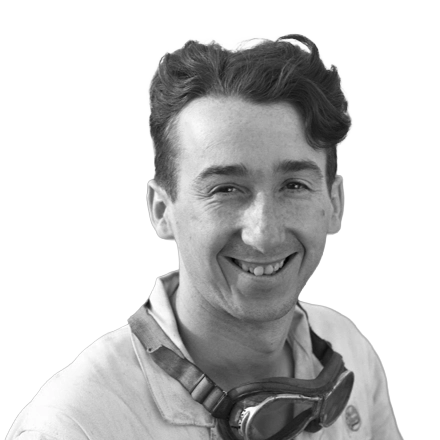
Born in England on June 14, 1913, but raised in Royal Oak, Michigan, Henry Banks grew into one of the defining figures of mid-century American open-wheel racing. Fiercely competitive behind the wheel and deeply respected off it, Banks built a career that stretched from dirt-track midgets to the Indianapolis Motor Speedway, before later helping shape the sport from the officials’ tower as a senior USAC administrator.
Driver Bio
| Nationality | American |
| Birthplace | Croydon, England, UK |
| Born | 14 June 1913 |
| Died | 18 December 1994 |
| First Grand Prix | 1950 Indianapolis 500 |
| Last Grand Prix | 1952 Indianapolis 500 |
| Years Active | 1950–1954 |
| Current/Last Team | Privateer: Lesovsky |
Racing was in his blood from the beginning. Banks was the son of an early European racing driver, and by the age of 19, he was already carving out a reputation in the fiercely competitive world of midget racing. Starting his career in 1932, he quickly proved himself.
When the Indianapolis Motor Speedway introduced its new qualifying “rookie test” in 1936, Banks made history by becoming the very first driver to pass it. It was an early sign that he possessed not only speed, but also the discipline and technical understanding needed to tackle America’s greatest race. Over the following years, he steadily built his Indy experience, serving as a relief driver in 1937, 1939 and 1940, while recording a 21st-place finish in the 1938 Indianapolis 500.
Before America’s racing scene was interrupted by World War II, Banks added another major achievement to his growing résumé by winning the 1941 American Racing Drivers Club (ARDC) championship in New England — one of the most respected midget racing titles of the era.
Like many drivers of his generation, Banks paused his racing career during the war years, working in Ford’s aero-engine division as part of the wartime industrial effort. But when racing resumed, he returned stronger than ever.
The late 1940s marked the peak of Banks’ driving career. In 1947 alone, he captured an astonishing 30 midget-car victories, establishing himself as one of the country’s premier short-track racers. That momentum carried into 1950, the defining season of his career. In a dramatic three-way fight that went down to the final race of the year, Banks secured the AAA National Championship — then regarded as the highest honour in American championship racing. As if that was not enough, he also finished runner-up in the AAA National Midget standings the same season, underlining his extraordinary versatility and consistency.
Banks also became part of Formula One history, albeit through a uniquely American route. Between 1950 and 1960, the Indianapolis 500 counted towards the FIA World Drivers’ Championship, meaning competitors at Indy were officially credited with Formula One World Championship appearances. Banks competed in three World Championship events at Indianapolis during this period. His best finish came with sixth place, although he did not score championship points.
Never one to lose interest in innovation, Banks remained closely connected to the technical side of the sport after retiring from frontline competition. In 1955, he tested the first turbine-powered car ever to run at Indianapolis — a groundbreaking project.
Away from the cockpit, Banks became one of the most influential administrators in American motorsport. He served as USAC Director of Competitions, helping oversee the sport during a transformative period and earning widespread respect for his calm authority, experience and racer’s perspective.
Banks also enjoyed brief appearances on the silver screen during the golden age of racing films. He featured in To Please A Lady, starring Clark Gable, and later appeared in Roar of the Crowd alongside Howard Duff — further evidence of his standing within the sport during the 1940s and 1950s.
His contribution to motorsport was recognised repeatedly throughout his life and beyond. Banks was inducted into numerous halls of fame, including the Michigan Motor Sports Hall of Fame, the Auto Racing Hall of Fame, the National Midget Auto Racing Hall of Fame, the Eastern Motorsports Press Association Hall of Fame, the USAC Hall of Fame, and, most recently, the Motorsports Hall of Fame of America in 2023. He also received the Automotive Hall of Fame Distinguished Service Citation in 1978 for his lasting impact on American racing.
Henry Banks died in Indianapolis on December 18, 1994, leaving behind a legacy that extended far beyond trophies and statistics. Whether winning championships on dirt ovals, helping pioneer new technology, or guiding the sport from behind the scenes, Banks embodied the toughness, adaptability and professionalism that defined American racing’s golden era.
Grand Prix Stats
| Race Entries | 5 |
| Race Starts | 3 |
| Did Not Start | 0 |
| Best Race Start | 12th |
| Best Race Finish | 6th |
| Retirements | 0 |
| First-Lap Retirements | 0 |
| Not Classified | 0 |
| Disqualified | 0 |
| Did Not Qualify | 2 |
Qualifying
| Qualifying Sessions | 5 |
| Reached Q3 | 0 |
| Q2 Eliminations | 0 |
| Q1 Eliminations | 0 |
| Did Not Qualify | 2 |
Stats by Season
| Year | Constructor | Entries | Starts | Wins | Podiums | Poles | Fastest Laps | Front Rows | DNF | Best Start | Best Result | Pts Finishes | Points | Championship |
|---|---|---|---|---|---|---|---|---|---|---|---|---|---|---|
| 1950 | Privateer: Maserati | 1 | 1 | 0 | 0 | 0 | 0 | 0 | 0 | 21st | 25th | 0 | 0 | NC |
| 1951 | Moore | 1 | 1 | 0 | 0 | 0 | 0 | 0 | 0 | 17th | 6th | 0 | 0 | NC |
| 1952 | Lesovsky | 1 | 1 | 0 | 0 | 0 | 0 | 0 | 0 | 12th | 19th | 0 | 0 | NC |