




















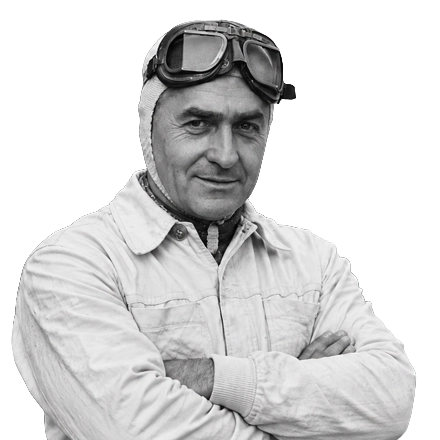
Louis Claude Rosier (5 November 1905 – 29 October 1956) was a French racing driver, team owner, automobile dealer and constructor. He competed in Formula One from 1950 until 1956, entering cars under his own Écurie Rosier banner as well as representing the works Talbot and Maserati teams.
Driver Bio
| Nationality | French |
| Birthplace | Chapdes-Beaufort, France |
| Born | 5 November 1905 |
| Died | 29 October 1956 |
| First Grand Prix | 1950 British Grand Prix |
| Last Grand Prix | 1956 German Grand Prix |
| Years Active | 1950–1956 |
| Current/Last Team | Privateer: Ecurie Rosier Maserati |
His defining achievement came at the 1950 24 Hours of Le Mans. Sharing a privateer Talbot-Lago T26C-GS with his son Jean-Louis, Rosier secured what remains the only father-and-son victory in the race’s history.
Racing career
Born in Chapdes-Beaufort in France’s Puy-de-Dôme department, Rosier became one of the country’s leading post-war drivers.
He made 38 Formula One World Championship appearances after debuting on 13 May 1950. Rosier scored 18 points and reached the podium twice, finishing third in consecutive races at the Swiss and Belgian Grands Prix during the inaugural World Championship season.
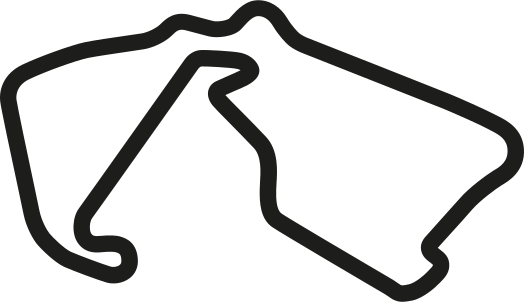
Before Formula One officially existed, Rosier was already producing strong Grand Prix results. He finished fourth in the 1948 RAC International Grand Prix at Silverstone, the first Grand Prix held in England since 1927.
At the 1949 British Grand Prix, he drove an unsupercharged 4.5-litre Talbot-Lago to third place. Rosier finished one lap behind the winner while averaging 76.21 mph.
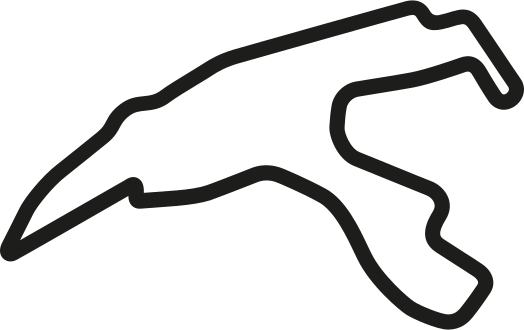
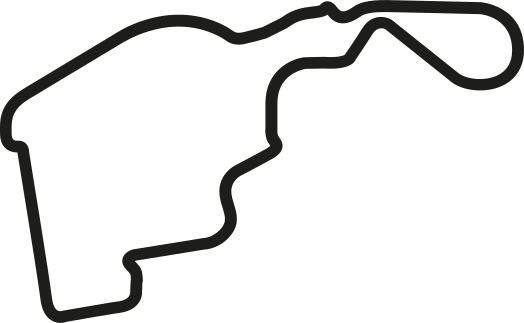
Another major victory arrived at Spa-Francorchamps in June 1949. Driving a Talbot in the 500-kilometre International Grand Prix, Rosier took the lead after 23 of the 32 laps and defeated Luigi Villoresi. He completed the race in three hours, 15 minutes and 17 seconds.
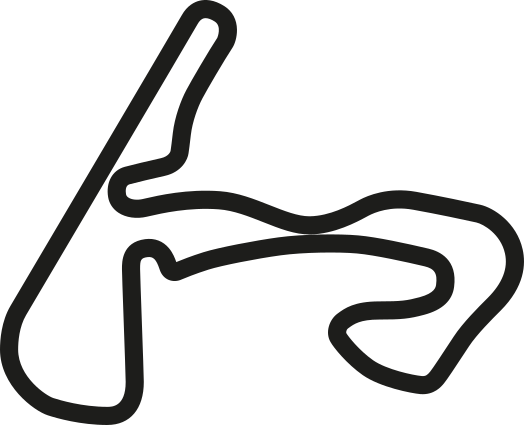
Rosier also won consecutive editions of the Dutch Grand Prix in 1950 and 1951, along with victories at Albi and in the Grand Prix de l’Albigeois.
Le Mans 1950
Rosier entered nine editions of the 24 Hours of Le Mans between 1938 and 1956.
His victory in 1950 was remarkable not merely for its family connection, but for the division of labour. Jean-Louis Rosier completed only two laps in their blue Talbot-Lago, leaving his father to drive virtually the entire race alone.
Louis brought the car home one lap ahead of Pierre Meyrat in another Talbot. The winning crew completed 256 laps and covered 2,163 miles in 23 hours, 54 minutes and 2.2 seconds.
No other father-and-son pairing has won Le Mans together.
Later results
Rosier continued competing successfully into the 1950s. In May 1953, he won the Grand Prix d’Albi in a Ferrari, completing the 18-lap, 160-kilometre final in 56 minutes and 36.8 seconds. His average speed was approximately 160 km/h.
Two months later, he finished second in another Ferrari at Aix-les-Bains.
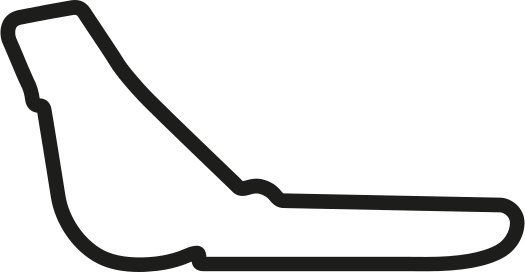
Rosier remained competitive near the end of his life. At Aintree in April 1956, he placed fourth in a 201-mile Formula One race won by Stirling Moss. He then finished fifth in the World Championship German Grand Prix at the Nürburgring in a Maserati.
In 2016, a mathematical study attempting to separate the influence of driver performance from machinery ranked Rosier as the 19th-best Formula One driver of all time.
Écurie Rosier
Rosier was not content simply to drive. He established and managed Écurie Rosier, initially to operate his Talbot-Lago T26 and provide occasional opportunities for guest racers.
The organisation gradually developed into a genuine Formula One team. It expanded beyond the Talbot to run Maserati 250Fs and Ferrari 500s, sometimes fielding one car for Rosier and another for a teammate.
Throughout the 1950s, Écurie Rosier provided Formula One opportunities to drivers including Henri Louveau, Georges Grignard, Louis Chiron, Maurice Trintignant, André Simon and Robert Manzon.
The team gave Rosier independence in a period when private entrants formed an essential part of Grand Prix racing. He could choose his machinery, organise his programme and create opportunities for other French drivers while continuing to compete himself.
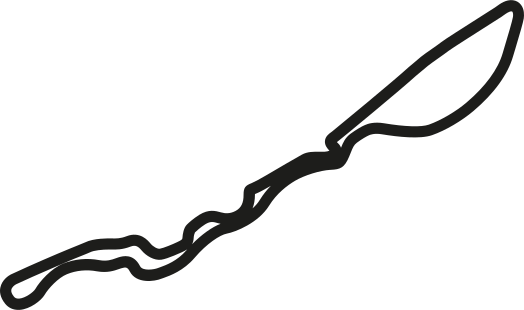
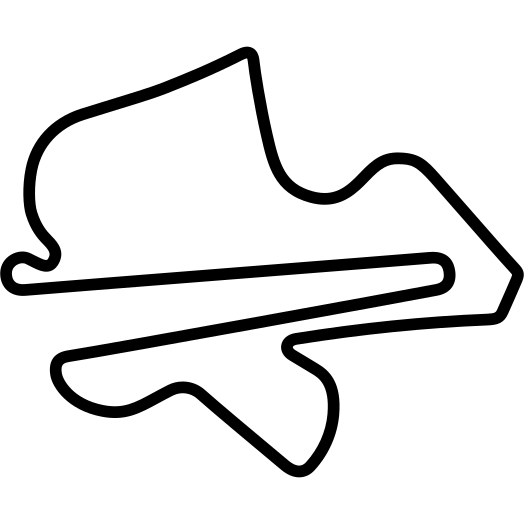
Circuit de Charade
Rosier also helped lay the foundations for one of France’s most spectacular racing circuits.
After the Second World War, he joined Jean Auchatraire, head of the competition section of the local automobile club, in promoting the creation of a permanent track near Clermont-Ferrand.
Early plans described a circuit between four and six kilometres long, set across the hills outside the city. It would include substantial parking and incorporate the latest thinking on spectator and driver safety.
The 1955 Le Mans disaster, which claimed 84 lives, halted the project. Racing events were suspended, temporary urban circuits faced new restrictions and proposed permanent venues were required to meet stricter safety standards.
Rather than abandon the idea, Rosier and Auchatraire refined it into a dedicated “mountain circuit,” unlike anything else in France. They worked with Raymond Roche, manager of Reims-Gueux, to secure political support before seeking finance.
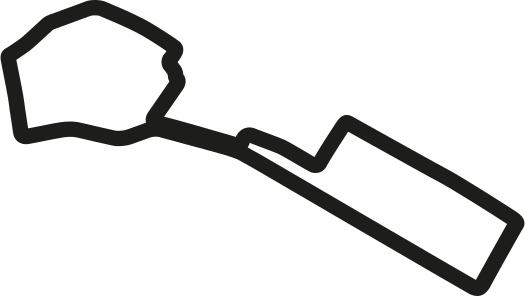
Rosier died before the project was completed. The circuit opened on 27 July 1958 and was officially named the Circuit de Charade Louis Rosier in recognition of his role.
Drivers including Stirling Moss later praised both the track and its dramatic surroundings.
Business and road cars
Away from competition, Rosier owned one of France’s largest Renault dealerships, based in Clermont-Ferrand. The company also sold industrial and agricultural equipment, although the building that housed the business was later demolished.
Rosier used the dealership and his racing knowledge as a base for his own automotive projects.
In 1951, he developed a prototype using Renault 4CV components. Two years later, he worked with Italian coachbuilder Rocco Motto on a small open cabriolet inspired by the barchetta-style car he had raced at Le Mans.
The design again relied on Renault 4CV mechanical assemblies. Approximately 200 examples were manufactured by Brissonneau, and the model was exhibited at a New York motor show.
Rosier later produced a more ambitious roadster using Renault Frégate components. Rocco Motto created its aluminium body, which sat on a multi-tubular chassis.
With extensive engine modifications and a lightweight structure, the finished car weighed approximately 950 kilograms and produced 80 horsepower.
Death
On 7 October 1956, Rosier entered the Coupe du Salon sports-car race at Montlhéry in a Ferrari 750 Monza.
He crashed during the event and suffered serious head injuries. Rosier remained alive for another three weeks but died from those injuries on 29 October 1956. He was 50.
His death ended the career of a man who had been far more than a successful driver. Rosier had won Le Mans almost single-handedly, operated his own Formula One team, built road cars, ran a major business and helped create the circuit that would carry his name.
Grand Prix Stats
| Race Entries | 38 |
| Race Starts | 38 |
| Did Not Start | 0 |
| Best Race Start | 6th |
| Best Race Finish | 3rd |
| Retirements | 13 |
| First-Lap Retirements | 2 |
| Not Classified | 0 |
| Disqualified | 0 |
| Did Not Qualify | 0 |
Podiums
| Podiums | 2 |
| First Podium | 1950 Swiss Grand Prix |
| Last Podium | 1950 Belgian Grand Prix |
| 1st Place | 0 |
| 2nd Place | 0 |
| 3rd Place | 2 |
| Most Consecutive Podiums | 2 |
| Most Podiums in a Single Season | 2 (1950) |
| Seasons with Podiums | 1 |
Points
| Points Scored | 18 |
| Points Finishes | 6 |
| Most Points in a Single Season | 13 (1950) |
| Seasons with Points | 3 |
Stats by Season
| Year | Constructor | Entries | Starts | Wins | Podiums | Poles | Fastest Laps | Front Rows | DNF | Best Start | Best Result | Pts Finishes | Points | Championship |
|---|---|---|---|---|---|---|---|---|---|---|---|---|---|---|
| 1950 | Privateer: Ecurie Rosier Talbot-Lago Talbot-Lago Privateer: Charles Pozzi Talbot-Lago | 6 | 6 | 0 | 2 | 0 | 0 | 0 | 2 | 6 | 3 | 4 | 13 | 4th |
| 1951 | Privateer: Ecurie Rosier Talbot-Lago | 7 | 7 | 0 | 0 | 0 | 0 | 0 | 1 | 7 | 4 | 1 | 3 | 12th |
| 1952 | Privateer: Ecurie Rosier Ferrari | 4 | 4 | 0 | 0 | 0 | 0 | 0 | 3 | 9 | 10 | 0 | 0 | NC |
| 1953 | Privateer: Ecurie Rosier Ferrari | 7 | 7 | 0 | 0 | 0 | 0 | 0 | 1 | 8 | 7 | 0 | 0 | NC |
| 1954 | Privateer: Ecurie Rosier Ferrari Maserati Privateer: Ecurie Rosier Talbot-Lago | 6 | 6 | 0 | 0 | 0 | 0 | 0 | 3 | 13 | 7 | 0 | 0 | NC |
| 1955 | Privateer: Ecurie Rosier Maserati | 3 | 3 | 0 | 0 | 0 | 0 | 0 | 1 | 12 | 9 | 0 | 0 | NC |
| 1956 | Privateer: Ecurie Rosier Maserati | 5 | 5 | 0 | 0 | 0 | 0 | 0 | 2 | 10 | 5 | 1 | 2 | 19th |
Teammates & Qualifying Head-to-Head
| Teammate | Years | Races | Qualifying H2H |
|---|---|---|---|
| Eugene Martin | 1950 | 1 | – |
| Yves Giraud-Cabantous | 1950 | 3 | – |
| Philippe Etancelin | 1950 | 1 | – |
| Raymond Sommer | 1950 | 1 | – |
| Henri Louveau | 1950, 1951 | 2 | – |
| Louis Chiron | 1951 | 6 | – |
| Maurice Trintignant | 1952, 1954 | 2 | – |
| Robert Manzon | 1954 | 4 | – |
| Luigi Musso | 1954 | 1 | – |
| Sergio Mantovani | 1954 | 1 | – |
| Roberto Mieres | 1954 | 1 | – |
| Luigi Villoresi | 1954 | 1 | – |