





























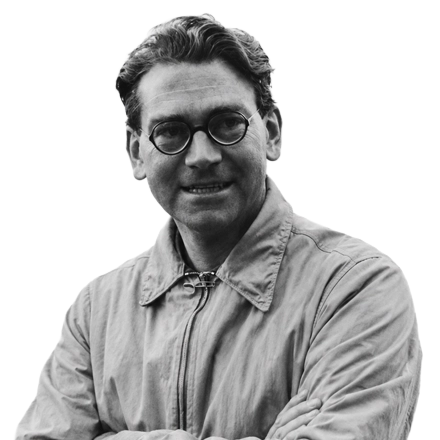
Frederick Roberts “Bob” Gerard (19 January 1914 – 26 January 1990) was an English racing driver, engineer and businessman whose career spanned the years either side of the Second World War and continued well into the post-war era. One of Britain’s most accomplished privateer racers, Gerard competed at the highest level of European motor racing and participated in eight Formula One World Championship Grands Prix. He never scored a championship point, although that statistic rather undersells a driver who twice finished sixth in the Championship’s inaugural season and had already been a British Grand Prix frontrunner before Formula One officially existed.
Driver Bio
| Nationality | British |
| Birthplace | Leicester, England, UK |
| Born | 19 January 1914 |
| Died | 26 January 1990 |
| First Grand Prix | 1950 British Grand Prix |
| Last Grand Prix | 1957 British Grand Prix |
| Years Active | 1950–1951, 1953–1954, 1956–1957 |
| Current/Last Team | Privateer: Bob Gerard Cooper |
Early career
Gerard was born in Leicester in 1914 into a family for whom machinery and transport were part of everyday life. The family business, Parr’s Ltd., had begun as a bicycle manufacturer before following the path taken by companies such as Triumph and moving into motor vehicles as the new industry developed around the turn of the 20th century.
Parr’s was not, however, concerned with glamorous sports cars or racing machinery. Its business was primarily haulage, meaning Gerard grew up around practical mechanical engineering rather than exotic competition cars.
There was nevertheless some sporting machinery in the family. His father was particularly fond of Riley, and it was behind the wheel of a Riley Nine that Gerard first tested himself in competition.
His motorsport debut came in the 1933 MCC Land’s End Trial, one of the demanding long-distance reliability trials that formed an important part of British competition at the time. Gerard could hardly have made a better start. Simply completing such an event was an achievement, but he went considerably further, performing strongly enough to collect a Premier Award at his very first attempt.
That result was even more remarkable because Gerard was severely short-sighted, hardly the most obvious physical advantage for somebody about to build a career around driving racing cars at considerable speed.
Throughout the remainder of the 1930s, Gerard continued competing in trials and sprint events. His ambitions soon expanded towards circuit racing, particularly after he acquired a 1½-litre Riley Sprite.
His local circuit was Donington Park, conveniently situated in the East Midlands, and Gerard quickly demonstrated that neither his relative inexperience nor the Riley’s modest engine capacity prevented him from troubling supposedly faster machinery. In early club races at Donington, he scored two victories against cars equipped with substantially larger engines.
He also finished an impressive ninth in the Donington TT, establishing himself as much more than an enthusiastic amateur.
Motor racing still had to fit around his responsibilities in the family business, but Gerard competed whenever circumstances allowed. He appeared in the Nuffield Trophy in 1938 and 1939, although neither attempt produced the sort of result he had enjoyed elsewhere.
In 1939, with Europe moving inexorably towards war, Gerard also took the Riley Sprite south to the legendary Brooklands circuit in Surrey. At the circuit’s Opening Meeting he finished a highly respectable third, and later that year he returned to win a Campbell circuit handicap race.
By then, however, motor racing was about to be interrupted by events far beyond the sport’s control.
Post-war racing career
As the Second World War approached its conclusion, Gerard was already planning his return to competition — and this time he wanted a proper Grand Prix racing car.
Towards the end of the war, he paid fellow racer Reg Parnell £1,000 for ERA R4A, one of the pre-war machines built by English Racing Automobiles. It was a significant step up from the Rileys with which Gerard had established himself before hostilities.
Getting the ERA running again required considerable work, but Gerard’s engineering background and almost obsessive attention to preparation proved invaluable. By using sister car R6B as a source of spare parts, he managed to have R4A operational in time for the Cockfosters demonstration in mid-1945.
Motor racing was very much a family affair. At the same event, Gerard’s wife Joan demonstrated the old Riley Sprite.
Before the 1946 season, Gerard decided that he needed something still more competitive. R4A remained in use, with both Bob and Joan Gerard taking a string of victories in hillclimbs and sprints, but another ERA was acquired for Gerard’s serious circuit ambitions: R14B.
Rather than simply racing the pre-war car as he found it, Gerard comprehensively rebuilt and developed it.
Among his most important modifications was the installation of a preselector gearbox, while the existing Zoller-type supercharger was replaced by a smaller but more efficient Murray-Jamieson unit. Gerard later altered the car’s appearance as well, replacing its traditional upright radiator arrangement with a much more steeply raked cowl and lowering the bonnet line to suit.
The result was a beautifully prepared old racing car that, in Gerard’s hands, remained astonishingly effective against increasingly modern opposition.
Over the next five years, R14B became the machine most closely associated with Gerard’s rise to the front rank of British racing.
He won the Empire Trophy three consecutive times and added two victories in the Jersey Road Race between 1947 and 1949. Just as importantly, Gerard developed a reputation for consistently bringing his machinery home, regularly finishing inside the top ten in events run to international standards.
Then came the British Grand Prix.
At the 1948 British Grand Prix, Gerard took his decade-old ERA into battle against considerably newer factory machinery. Against expectation, he finished a superb third, beaten only by the works Maserati 4CLT/48s driven by two of Italy’s leading stars, Luigi Villoresi and Alberto Ascari.
For a British private entrant driving machinery whose basic design dated from before the war, it was a remarkable performance.
A year later, Gerard did even better.
At the 1949 British Grand Prix, he brought the ERA home in second place, again beaten by a Maserati, this time driven by Swiss racer Toulo de Graffenried. Combined with two other victories and seventh place in the 1949 International Trophy at Silverstone, Gerard’s performances earned him one of British motor racing’s most prestigious honours: the BRDC Gold Star for 1949.
By this stage, Gerard had established himself as one of the outstanding British privateers of his era.
The following season brought a fundamental change to Grand Prix racing. In 1950, the FIA introduced the Formula One World Drivers’ Championship, and Gerard continued campaigning his faithful ERA R14B into this new age.
The problem was that R14B was getting decidedly elderly.
Grand Prix machinery was developing rapidly, with manufacturers investing heavily in newer and faster cars as the World Championship increased the prestige attached to Formula One success. Gerard could not compete with the major factories in terms of resources, but he had another weapon: preparation.
His cars were maintained with exceptional care, and Gerard placed enormous emphasis on reliability. While faster and more sophisticated machinery sometimes broke around him, the meticulously prepared ERA had a habit of continuing to circulate. As a result, Gerard frequently finished considerably higher than the outright pace of his machinery suggested should have been possible.
That quality was demonstrated perfectly at the very first Formula One World Championship race, the 1950 British Grand Prix at Silverstone.
Gerard qualified only 13th, but worked his way through the race and finished sixth. Under the scoring system of the time, only the first five finishers received conventional championship points, meaning Gerard had come agonisingly close to scoring at the first attempt.
Later that season he repeated the result at Monaco, this time driving ERA R4A. Starting all the way down in 16th place, Gerard again survived the race and climbed to sixth at the finish.
Twice in the first Formula One World Championship season, therefore, Gerard finished exactly one position away from the points.
Eventually, even Gerard’s engineering skill could no longer disguise the advancing age of the ERAs. By 1952, the pace of development in international racing meant something newer was required.
Remaining loyal to British machinery, Gerard purchased a Cooper T23-Bristol.
The Cooper became the basis of his Formula One and non-championship programme for several seasons, and he continued racing the T23 until 1957, when he upgraded to the newer mid-engined Cooper T43.
His World Championship results with the Coopers were less spectacular than his finest performances with the ERA. He managed only two further top-ten Championship finishes: one at the 1954 British Grand Prix and another in what proved to be his final World Championship appearance, the 1957 British Grand Prix.
But concentrating solely on Formula One results again gives a misleading impression of Gerard’s standing.
Throughout the 1950s, he remained an immensely formidable competitor on the British national racing scene. He won numerous races at circuits across the country and developed a reputation as one of those private entrants nobody could afford to underestimate.
Gerard’s combination of speed, mechanical sympathy and meticulous preparation was particularly effective in an era when simply getting a racing car to the finish could be half the battle. His machinery might not always have been the newest or fastest on the grid, but it was invariably beautifully prepared — and Bob Gerard was exceptionally good at making the most of it.
His connection with racing in his native Leicestershire became permanent thanks to Mallory Park. The circuit’s owners honoured Gerard by naming one of its most important corners Gerard’s, ensuring that his name became part of the vocabulary of British motor racing.
Even then, he wasn’t finished.
Gerard continued racing into the 1960s, competing in a Turner sports car after his single-seater heyday had passed. And when his own driving career finally wound down, he put decades of accumulated knowledge to use helping the next generation.
His expertise in preparing and entering racing cars made Gerard an invaluable figure behind the scenes. He became an entrant for a succession of promising young drivers and remained involved in that capacity right into the 1980s, extending a motorsport career that had begun almost half a century earlier.
Death
Bob Gerard died in South Croxton, Leicestershire, on 26 January 1990, exactly one week after celebrating his 76th birthday.
His official Formula One World Championship record — eight Grand Prix appearances and no points — captures remarkably little of what made him such an important figure in post-war British motor racing.
Before the World Championship even existed, Gerard had finished third and second in successive British Grands Prix, won the Empire Trophy three years running, twice conquered the Jersey Road Race and earned the 1949 BRDC Gold Star. When Formula One’s new championship arrived, he twice brought ageing ERA machinery home in sixth place, narrowly missing the points on both occasions.
More than anything, Gerard represented the great British privateer tradition. He was a businessman, engineer, preparer and racing driver rolled into one: somebody who could take an ageing machine, improve it in his own workshop and then use reliability, intelligence and considerable speed to embarrass far better-funded opposition.
Few tributes could be more appropriate than the one that remains at Mallory Park. Decades after Bob Gerard stopped racing, drivers still approach a fast Leicestershire corner carrying his name: Gerard’s.
Grand Prix Stats
| Race Entries | 8 |
| Race Starts | 8 |
| Did Not Start | 0 |
| Best Race Start | 10th |
| Best Race Finish | 6th |
| Retirements | 1 |
| First-Lap Retirements | 0 |
| Not Classified | 0 |
| Disqualified | 0 |
| Did Not Qualify | 0 |
Qualifying
| Qualifying Sessions | 8 |
| Reached Q3 | 0 |
| Q2 Eliminations | 0 |
| Q1 Eliminations | 0 |
| Did Not Qualify | 0 |
Stats by Season
| Year | Constructor | Entries | Starts | Wins | Podiums | Poles | Fastest Laps | Front Rows | DNF | Best Start | Best Result | Pts Finishes | Points | Championship |
|---|---|---|---|---|---|---|---|---|---|---|---|---|---|---|
| 1950 | Privateer: Bob Gerard ERA | 2 | 2 | 0 | 0 | 0 | 0 | 0 | 0 | 13 | 6 | 0 | 0 | NC |
| 1951 | Privateer: Bob Gerard ERA | 1 | 1 | 0 | 0 | 0 | 0 | 0 | 0 | 10 | 11 | 0 | 0 | NC |
| 1953 | Privateer: Bob Gerard Cooper | 2 | 2 | 0 | 0 | 0 | 0 | 0 | 1 | 12 | 11 | 0 | 0 | NC |
| 1954 | Privateer: Bob Gerard Cooper | 1 | 1 | 0 | 0 | 0 | 0 | 0 | 0 | 18 | 10 | 0 | 0 | NC |
| 1956 | Privateer: Bob Gerard Cooper | 1 | 1 | 0 | 0 | 0 | 0 | 0 | 0 | 22 | 11 | 0 | 0 | NC |
| 1957 | Privateer: Bob Gerard Cooper | 1 | 1 | 0 | 0 | 0 | 0 | 0 | 0 | 18 | 6 | 0 | 0 | NC |