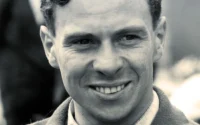


























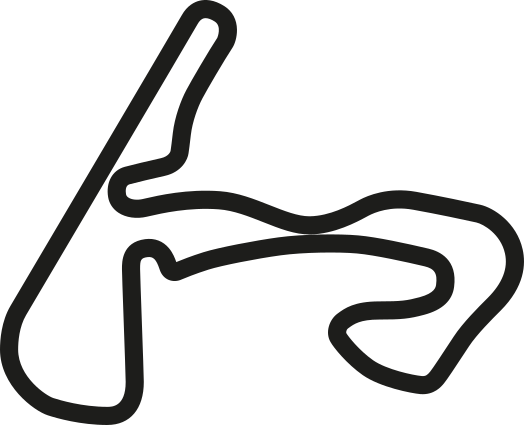

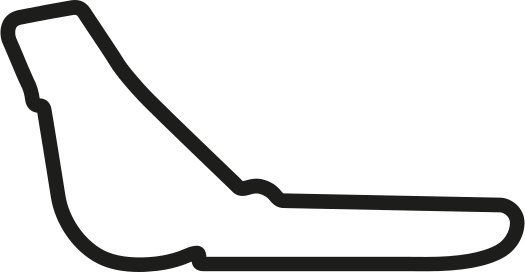
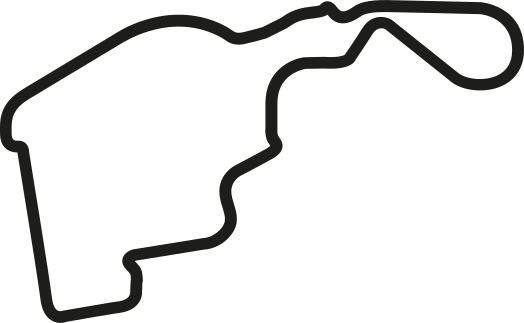

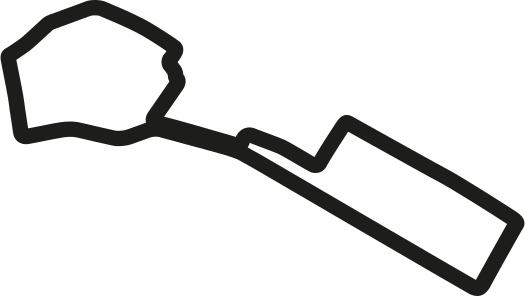
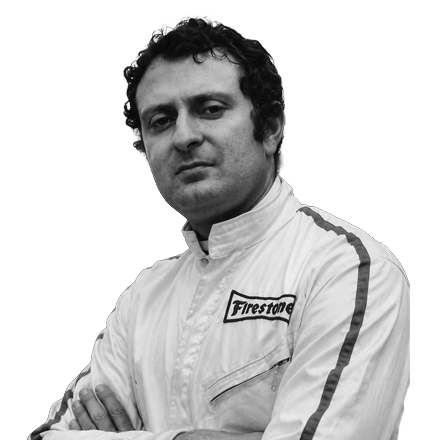
Antonino “Nino” Vaccarella (4 March 1933 – 23 September 2021) was an Italian racing driver from Sicily who became one of the great names of sports car racing. A winner at Le Mans, Sebring, and the Targa Florio, Vaccarella also made five Formula One World Championship appearances. Yet it was on the twisting mountain roads of his native Sicily that his reputation became legendary.
Driver Bio
| Nationality | Italian |
| Birthplace | Palermo, Italy |
| Born | 4 March 1933 |
| Died | 23 September 2021 |
| First Grand Prix | 1961 Italian Grand Prix |
| Last Grand Prix | 1965 Italian Grand Prix |
| Years Active | 1961–1962, 1965 |
| Current/Last Team | Ferrari |
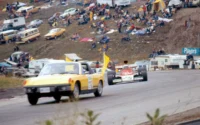
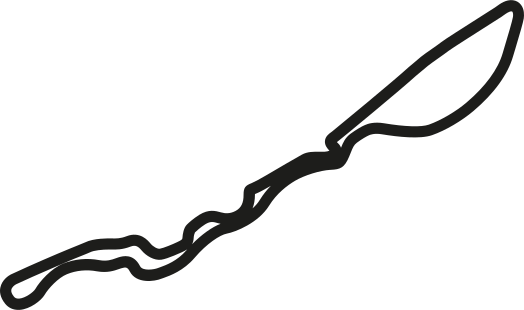
The Targa Florio was unlike almost anything else in motorsport. Established in 1906, its 72-kilometre lap threaded through Sicilian mountain roads, with hundreds of corners to learn. Local knowledge mattered, and few knew them better than Vaccarella. Fellow racer Vic Elford later said that Nino knew Sicily’s roads “like the back of his hand”.
Motor racing was only one side of Vaccarella’s life. He worked as a mathematics teacher and, following the early death of his father, became principal of a private Montessori school in Palermo. It earned him the affectionate nickname “Il Preside Volante” — the Flying Headmaster. Somehow, the school principal also found time to become one of Ferrari’s finest endurance racers.
Vaccarella made his Targa Florio debut in 1959, finishing tenth in a privately entered Maserati. The following year he partnered two-time winner Umberto Maglioli in Camoradi’s spectacular Maserati Tipo 61 “Birdcage”. They took the lead during the afternoon and held it for three laps before mechanical failure ended their challenge, leaving Joakim Bonnier and Hans Herrmann to win for Porsche.
His performances in Sicily helped launch Vaccarella onto the international stage. He finished second at the 12 Hours of Sebring, but his rise was interrupted by a frightening accident during practice for the 1963 Nürburgring 1000km. Vaccarella crashed a brand-new works Ferrari 250P, breaking his arm and being soaked in fuel. Twelve months later, he returned to the Nürburgring and won the race alongside Ludovico Scarfiotti for Ferrari.
Even bigger success followed in 1964. Sharing a Ferrari with Jean Guichet, Vaccarella won the 24 Hours of Le Mans, conquering the race he would later describe as his favourite. It placed the Sicilian firmly among the leading sports car drivers of his generation.
Then came the victory Sicily had been waiting for. Partnered by Lorenzo Bandini, Vaccarella won the 1965 Targa Florio, completing the race in 7 hours, 1 minute and 12.4 seconds at an average of 63.7mph. Vaccarella and Bandini looked capable of repeating the feat in 1966, leading much of the race before their Ferrari 330 was damaged beyond repair after seven laps.
Vaccarella continued to demonstrate his versatility away from Sicily. He and Maglioli finished fifth at the 1967 12 Hours of Sebring in a Ford GT40, while his Targa campaigns increasingly became the stuff of local folklore. When Ferrari stayed away in 1968 following regulation changes, Vaccarella represented Alfa Romeo against a formidable collection of Porsche 907s. Sicilian newspaper Giornale di Sicilia captured the mood with a headline effectively declaring that only Vaccarella could produce the miracle.
The miracle did not arrive at the Targa that year, but another major road-racing victory did. Vaccarella won the 1968 Mugello Grand Prix, held on the fearsome 38-mile public-road circuit. When Ferrari also missed the 1969 Targa Florio, he again raced an Alfa Romeo Tipo 33.
Vaccarella was back with Ferrari for another memorable campaign in 1970. He qualified eighth for the 24 Hours of Daytona in a Ferrari 512S and then shared victory at the 12 Hours of Sebring with Ignazio Giunti and Mario Andretti, Andretti producing a remarkable late charge after being switched into their car. Vaccarella also wrestled the mighty V12 Ferrari 512S around the Targa Florio that season, mounting a heroic challenge before damaging the car late in the race.
In 1971, the Flying Headmaster finally conquered the Targa again. Sharing an Alfa Romeo with Toine Hezemans, Vaccarella won by more than a minute from fellow Alfa drivers Andrea de Adamich and Gijs van Lennep. The result also snapped Porsche’s run of five consecutive Targa Florio victories. He remained part of Alfa Romeo’s sports car programme, partnering Nanni Galli in an Alfa Romeo 33/3TT at the 1972 Sebring 12 Hours, where they qualified fifth.
There was one final home triumph still to come. In 1975, Vaccarella won the Targa Florio for a third time, driving an Alfa Romeo 33TT12. By then the event had lost its World Championship status and had become a shorter Italian national race, with its extraordinary public-road format increasingly difficult to justify on safety grounds.
That victory provided a fitting conclusion to Vaccarella’s racing career. His son Giovanni had been born in 1972, and Vaccarella decided that surviving to raise him mattered more than continuing to race in one of motorsport’s most dangerous eras. Interestingly, despite forever being associated with the slow and intricate Targa Florio, Vaccarella later admitted that he actually preferred fast circuits such as Le Mans, Monza and Spa to places like the Targa, Monaco and the Nürburgring.
Formula One formed a smaller chapter of his story. Vaccarella made his World Championship debut on 10 September 1961 and eventually contested five Grands Prix without scoring a championship point. Enzo Ferrari selected him for Ferrari’s Formula One squad alongside drivers including John Surtees, Mike Parkes, Willy Mairesse, Lorenzo Bandini and Ludovico Scarfiotti, and Vaccarella also appeared in several non-championship Formula One races.
Grand Prix statistics, however, tell very little of Nino Vaccarella’s story. He was a Le Mans winner, a Sebring winner and three-time Targa Florio victor; a teacher and school principal who could spend his working week in Palermo before taking on the finest racing drivers in the world. On the roads of Sicily in particular, “Il Preside Volante” became something more than a successful driver — he became a local motorsport hero.
Grand Prix Stats
| Race Entries | 5 |
| Race Starts | 4 |
| Did Not Start | 0 |
| Best Race Start | 14th |
| Best Race Finish | 9th |
| Retirements | 2 |
| First-Lap Retirements | 0 |
| Not Classified | 0 |
| Disqualified | 0 |
| Did Not Qualify | 1 |
Qualifying
| Qualifying Sessions | 5 |
| Reached Q3 | 0 |
| Q2 Eliminations | 0 |
| Q1 Eliminations | 0 |
| Did Not Qualify | 1 |
Stats by Season
| Year | Constructor | Entries | Starts | Wins | Podiums | Poles | Fastest Laps | Front Rows | DNF | Best Start | Best Result | Pts Finishes | Points | Championship |
|---|---|---|---|---|---|---|---|---|---|---|---|---|---|---|
| 1961 | Privateer: Scuderia Serenissima De Tomaso | 1 | 1 | 0 | 0 | 0 | 0 | 0 | 1 | 20 | – | 0 | 0 | NC |
| 1962 | Privateer: Scuderia SSS Republica di Venezia Lotus / Porsche | 3 | 2 | 0 | 0 | 0 | 0 | 0 | 0 | 14 | 9 | 0 | 0 | NC |
| 1965 | Ferrari | 1 | 1 | 0 | 0 | 0 | 0 | 0 | 1 | 15 | 12 | 0 | 0 | NC |
Stats by Constructor
| Constructor | Years | Entries | Starts | Wins | Podiums | Poles | Fastest Laps | Front Rows | DNF | Best Start | Best Result | Pts Finishes | Points |
|---|---|---|---|---|---|---|---|---|---|---|---|---|---|
| Privateer: Scuderia Serenissima De Tomaso | 1961 | 1 | 1 | 0 | 0 | 0 | 0 | 0 | 1 | 20 | – | 0 | 0 |
| Privateer: Scuderia SSS Republica di Venezia Lotus | 1962 | 2 | 1 | 0 | 0 | 0 | 0 | 0 | 0 | 14 | 9 | 0 | 0 |
| Privateer: Scuderia SSS Republica di Venezia Porsche | 1962 | 1 | 1 | 0 | 0 | 0 | 0 | 0 | 0 | 15 | 15 | 0 | 0 |
| Ferrari | 1965 | 1 | 1 | 0 | 0 | 0 | 0 | 0 | 1 | 15 | 12 | 0 | 0 |
Teammates & Qualifying Head-to-Head
| Teammate | Years | Races | Qualifying H2H |
|---|---|---|---|
| Maurice Trintignant | 1961 | 1 | – |
| Jo Bonnier | 1962 | 1 | – |
| Lorenzo Bandini | 1965 | 1 | – |
| John Surtees | 1965 | 1 | – |