





















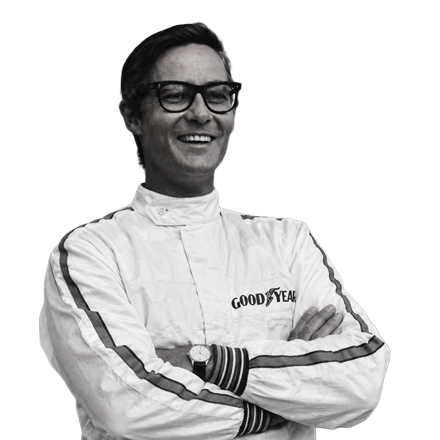
Masten Gregory (29 February 1932 – 8 November 1985) was an American racing driver who competed in Formula One from 1957 to 1965. Nicknamed the “Kansas City Flash,” he became the first American to reach a Formula One World Championship podium and later won the 1965 24 Hours of Le Mans with Jochen Rindt.
Driver Bio
| Nationality | American |
| Birthplace | Kansas City, Missouri, USA |
| Born | 29 February 1932 |
| Died | 8 November 1985 |
| First Grand Prix | 1957 Monaco Grand Prix |
| Last Grand Prix | 1965 Italian Grand Prix |
| Years Active | 1957–1963, 1965 |
| Current/Last Team | Privateer: Scuderia Centro Sud BRM |
Gregory entered 43 World Championship Grands Prix, usually with private teams, and appeared in numerous non-Championship events. His single-seater victory record included the 1962 Kanonloppet, but sports cars supplied his greatest success.
He contested the 24 Hours of Le Mans 16 times between 1955 and 1972, culminating in victory with the North American Racing Team’s Ferrari 250 LM.
Early life
Gregory was born in Kansas City, Missouri, as the youngest of three children.
His elder brother, Riddelle L. Gregory Jr, also raced cars. Their sister, Nancy Lee Gregory, later married Anglo-American fashion designer Charles James.
Gregory’s father died when he was three, and his parents had already separated. He inherited part of the family’s insurance fortune and became instantly recognisable around racing paddocks through his youthful appearance and thick spectacles, required because of his poor eyesight.
He attended Pembroke-Country Day School but left before completing his final year. At 19, Gregory married Luella Simpson.
Early racing career
Gregory used his inheritance to purchase a Mercury-powered Allard and entered his first race in November 1952, an SCCA event over 50 miles at Caddo Mills, Texas.
A failed head gasket ended his debut. Gregory replaced the Mercury engine with a Chrysler Hemi for Sebring in 1953, only for the rear suspension to fail.
Victory arrived in just his third race, at Stillwater, Oklahoma.
After switching to Jaguar machinery, Gregory collected several American wins. These included the Guardsmen’s Trophy at Golden Gate Park in San Francisco and an event held at Offutt Air Force Base near Omaha, Nebraska.
His first international sports-car invitation came at the end of 1953. Gregory entered the 1954 Buenos Aires 1000 Kilometres but finished 14th after water-pump trouble.
Moving to Europe
Gregory competed extensively in Europe during 1954 and 1955, usually driving Ferraris.
His programme included the Tourist Trophy at Dundrod and his first 24 Hours of Le Mans. Co-driver Mike Sparken retired their car before Gregory had an opportunity to take the wheel.
At the end of 1954, Gregory won the inaugural Nassau Trophy during Bahamas Speed Week.
He returned to the United States for 1956 and became a regular winner in SCCA competition. Another visit to Argentina in 1957 produced a breakthrough result: victory in the Buenos Aires 1000 Kilometres.
That performance secured him a Formula One drive with Guglielmo Dei’s Scuderia Centro Sud, a private team operating the Maserati 250F.
Formula One
Immediate impact
Gregory made his World Championship debut at the 1957 Monaco Grand Prix and finished third. The result made him the first American driver to stand on a Formula One podium.
He followed it with eighth place in Germany and fourth-place finishes at both Pescara and Monza.
Despite entering only half of the season’s championship races, Gregory finished sixth in the final standings.
Injuries and Cooper
His 1958 Formula One season was reduced to four Grands Prix after a serious accident in a sports car at Silverstone.
Gregory had developed a habit of jumping from cars when a crash appeared unavoidable. The Silverstone escape left him injured, but he returned to finish fourth at the Italian Grand Prix and sixth in Morocco.
For 1959, Gregory joined Cooper alongside Jack Brabham and Bruce McLaren.
He finished third in the Dutch Grand Prix and achieved his career-best World Championship result with second place in Portugal. Another pre-emptive leap from a crashing car caused injuries that ruled him out of the final two rounds.
Gregory ended the season eighth in the Drivers’ Championship. Brabham won the title, while Cooper secured its first Constructors’ Championship.
At the non-Championship Aintree 200, Gregory started from pole position and established a circuit record. Even so, Cooper did not renew his contract for 1960.
A dangerous reputation
Gregory’s early career featured a daunting number of accidents, often caused by forcing inferior machinery beyond its comfortable limits.
He rolled a Maserati during the 1957 Venezuelan Grand Prix, although its roll bar protected him. Two sports cars were destroyed in 1958 and another two—the Lister-Jaguar and Tojeiro-Jaguar—in 1959.
One of those crashes left Gregory with a broken leg and shoulder, costing him further Formula One starts.
During practice for the Formula Two 1960 German Grand Prix at the Nürburgring, Gregory lost control of an outdated Cooper-Maserati and was thrown clear.
His approach changed after this period. The spectacular accidents became less frequent, and Gregory developed a new reputation as a smooth, considerate and technically sensitive driver.
Privateer years
Gregory remained in Formula One through 1965, although most of his later drives came with private teams lacking the resources to challenge the leading constructors.
His strongest championship result during those years was sixth for BRM at the 1962 United States Grand Prix, driving a Lotus 24.
The French Grand Prix offered a tantalising glimpse of what better reliability might have delivered. Gregory was running fourth, close behind eventual winner Dan Gurney, when ignition trouble forced him to retire.
He did win the non-Championship Kanonloppet at Karlskoga in 1962 for British Racing Partnership, although none of Formula One’s leading factory teams attended.
Sports-car career
Gregory returned his attention increasingly towards sports cars after leaving Cooper.
At the 1960 24 Hours of Le Mans, he set the fastest lap of the race. The following year, he partnered Lloyd “Lucky” Casner in Camoradi’s Maserati Tipo 61 and won the Nürburgring 1000 Kilometres.
Gregory also finished fifth at Le Mans in 1961, sharing a Porsche RS61 Spyder.
In 1962, he drove a Lotus 19-Climax to victory in the Canadian Grand Prix sports-car race at Mosport Park.
His 1964 Le Mans entry came in one of the early Ford GT40s. Gearbox failure ended the car’s race during the fifth hour.
Le Mans victory
Gregory returned in 1965 with the North American Racing Team and shared its Ferrari 250 LM with Austrian driver Jochen Rindt, who would later become the 1970 Formula One world champion.
The pair won outright, giving Gregory the defining victory of his career. Their success also became the final overall Le Mans win achieved by Ferrari for almost six decades.
That same year, Gregory entered the Indianapolis 500. Starting at the rear of the field, he climbed to fifth before engine failure forced his retirement.
Final racing years
Gregory gradually reduced his schedule after 1965 but continued making selected international sports-car appearances.
His later results included second place in the 1966 Monza 1000 Kilometres alongside John Whitmore.
Gregory’s close friend Jo Bonnier was killed at Le Mans in 1972. The loss persuaded him to stop racing altogether.
He settled in Amsterdam and entered the diamond trade before later operating a glassware business.
Death and honours
Gregory died in his sleep after suffering a heart attack on 8 November 1985. He was staying at his winter home in Porto Ercole, Italy, and was 53.
He had four children: Masten Jr, Debbie, Scott and Michael.
Gregory was inducted into the Missouri Sports Hall of Fame in 2005 and the Kansas City Central Auto Racing Boosters Hall of Fame in 2007. Further recognition came through the Watkins Glen Walk of Fame in 2012 and the Motorsports Hall of Fame of America in 2013.
Triple Crown distinction
Gregory belongs to a select group of drivers who contested all three events generally associated with motorsport’s Triple Crown: the Monaco Grand Prix, Indianapolis 500 and 24 Hours of Le Mans.
He is one of 19 drivers to have entered all three and won at least one, courtesy of his Le Mans victory.
The others are Louis Chiron, Jack Brabham, Jim Clark, Graham Hill, Dan Gurney, Jochen Rindt, Mario Andretti, Mark Donohue, Jackie Stewart, Denny Hulme, Danny Sullivan, Vern Schuppan, Stefan Johansson, Michele Alboreto, Eddie Cheever, Jacques Villeneuve, Juan Pablo Montoya and Fernando Alonso.
Hill remains the only driver to have won all three. Rindt won Le Mans and Monaco, while Montoya and Alonso also claimed two of the events.
Grand Prix Stats
| Race Entries | 43 |
| Race Starts | 38 |
| Did Not Start | 2 |
| Best Race Start | 3rd |
| Best Race Finish | 2nd |
| Retirements | 17 |
| First-Lap Retirements | 1 |
| Not Classified | 0 |
| Disqualified | 0 |
| Did Not Qualify | 3 |
Podiums
| Podiums | 3 |
| First Podium | 1957 Monaco Grand Prix |
| Last Podium | 1959 Portuguese Grand Prix |
| 1st Place | 0 |
| 2nd Place | 1 |
| 3rd Place | 2 |
| Most Consecutive Podiums | 0 |
| Most Podiums in a Single Season | 2 (1959) |
| Seasons with Podiums | 2 |
Points
Complete Formula One World Championship results
| Year | Entrant | Chassis | Engine | 1 | 2 | 3 | 4 | 5 | 6 | 7 | 8 | 9 | 10 | 11 | WDC | Pts |
|---|---|---|---|---|---|---|---|---|---|---|---|---|---|---|---|---|
| 1957 | Scuderia Centro Sud | Maserati 250F | Maserati 250F1 2.5 L6 | ARG | MON 3 | 500 | FRA | GBR | GER 8 | PES 4 | ITA 4 | 6th | 10 | |||
| 1958 | Scuderia Centro Sud | Maserati 250F | Maserati 250F1 2.5 L6 | ARG DNA | MON | BEL Ret | FRA | NC | 0* | |||||||
| H.H. Gould | NED Ret | 500 | ||||||||||||||
| Owen Racing Organisation | BRM P25 | BRM P25 2.5 L4 | GBR DNA | GER | POR | |||||||||||
| Temple Buell | Maserati 250F | Maserati 250F1 2.5 L6 | ITA 4* | MOR 6 | ||||||||||||
| 1959 | Cooper Car Company | Cooper T51 | Climax FPF 2.5 L4 | MON Ret | 500 | NED 3 | FRA Ret | GBR 7 | GER Ret | POR 2 | ITA | USA | 8th | 10 | ||
| 1960 | Camoradi International | Behra-Porsche RSK | Porsche 547/6 1.5 F4 | ARG 12 | NC | 0 | ||||||||||
| Scuderia Centro Sud | Cooper T51 | Maserati 250S 2.5 L4 | MON DNQ | 500 | NED DNS | BEL | FRA 9 | GBR 14 | POR Ret | ITA | USA | |||||
| 1961 | Camoradi International | Cooper T53 | Climax FPF 1.5 L4 | MON DNQ | NED DNS | BEL 10 | FRA 12 | GBR 11 | GER DNA | NC | 0 | |||||
| UDT Laystall Racing Team | Lotus 18/21 | ITA Ret | USA Ret | |||||||||||||
| 1962 | UDT Laystall Racing Team | Lotus 18/21 | Climax FPF 1.5 L4 | NED Ret | 18th | 1 | ||||||||||
| Lotus 24 | BRM P56 1.5 V8 | MON DNQ | BEL Ret | FRA Ret | ITA 12 | USA 6 | RSA | |||||||||
| Climax FWMV 1.5 V8 | GBR 7 | GER | ||||||||||||||
| 1963 | Tim Parnell | Lotus 24 | BRM P56 1.5 V8 | MON | BEL | NED | FRA Ret | ITA Ret | NC | 0 | ||||||
| Reg Parnell Racing | GBR 11 | GER | ||||||||||||||
| Lola Mk4A | Climax FWMV 1.5 V8 | USA Ret | MEX Ret | RSA | ||||||||||||
| 1965 | Scuderia Centro Sud | BRM P57 | BRM P56 1.5 V8 | RSA | MON | BEL Ret | FRA | GBR 12 | NED | GER 8 | ITA Ret | USA | MEX | NC | 0 |