


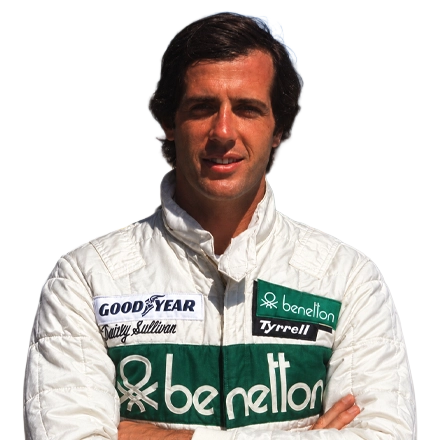
Daniel John “Danny” Sullivan III (born 9 March 1950) is an American former racing driver whose career ranged from Formula One to Indy cars, NASCAR, DTM and sports cars. He won 17 CART Indy Car races, captured the 1985 Indianapolis 500, became 1988 CART champion, and also scored a victory in IROC. Before all of that, he had one season in Formula One with Tyrrell, where he scored two World Championship points.
Driver Bio
| Nationality | American |
| Birthplace | Louisville, Kentucky, USA |
| Born | 9 March 1950 |
| First Grand Prix | 1983 Brazilian Grand Prix |
| Last Grand Prix | 1983 South African Grand Prix |
| Years Active | 1983 |
| Current/Last Team | Tyrrell |
Before racing
Sullivan was born in Louisville, Kentucky, the son of a building contractor.
His path into motorsport was hardly conventional. He attended the Kentucky Military Institute and, before racing became a full-time career, worked a string of very different jobs. Among them were spells as a lumberjack and, most famously, as a New York City cab driver.
His first serious introduction to racing came as a 21st-birthday present: a course at the Jim Russell Racing Drivers School at Snetterton in England.
That gift changed the direction of his life.
Sullivan went on to compete in Formula Ford, Formula Three and Formula Two in Europe before eventually returning to the United States.
From 1980 to 1981, he raced for Garvin Brown Racing in the SCCA Can-Am series. His breakthrough came at the end of the 1981 campaign when he won the Caesars Palace Grand Prix.
Formula One
Sullivan made his Indy car debut in 1982, but his European experience soon pulled him back across the Atlantic.
For 1983, he was recruited by Tyrrell for the Formula One World Championship. Primary sponsor Benetton was keen for the team to field an American driver, and Sullivan was handed a full-season opportunity alongside Michele Alboreto.
He competed in all 15 rounds of the championship.
His strongest World Championship result came at Monaco, where he finished fifth and collected two points. Those would be the only points of his Formula One career, leaving him 17th in the final Drivers’ Championship standings.
Sullivan also produced one of his best Formula One performances away from the championship itself.
At the 1983 Race of Champions at Brands Hatch, he held off an early challenge from 1980 World Champion Alan Jones and went on to finish second behind reigning champion Keke Rosberg.
After 40 laps, Sullivan crossed the line just half a second behind Rosberg’s Williams.
Even so, Alboreto remained the more established force within Tyrrell. The Italian won the Detroit Grand Prix that year – the final Formula One victory in Tyrrell’s history – while Sullivan was not retained for 1984.
His Grand Prix adventure had lasted only one season, but his biggest successes were still ahead.
Return to CART
Sullivan returned to North America for 1984 and immediately became one of the leading drivers in CART.
He joined Shierson Racing and won three races during the season, including the prestigious Pocono 500. He finished fourth in the championship and attracted the attention of Team Penske.
For 1985, Sullivan moved to Roger Penske’s powerhouse operation.
The partnership delivered one of the most famous Indianapolis 500 victories of all time.
The “Spin and Win”
At the 1985 Indianapolis 500, Sullivan became immortalised in Speedway folklore.
While battling Mario Andretti for the lead, Sullivan attempted a pass and lost control, completing a full 360-degree spin without hitting the wall. Remarkably, he kept the car running, recovered and later passed Andretti again.
This time he stayed in front.
Sullivan went on to win the race, creating the moment forever known as the “Spin and Win.”
It remains one of the defining images of Indianapolis 500 history and transformed Sullivan from a successful Indy car driver into one of American racing’s best-known stars.
He remained a championship contender with Penske and finished third in the CART standings in 1986.
1988 CART champion
The 1988 season would become Sullivan’s finest in Indy cars.
At Indianapolis, Penske swept the front row with Rick Mears on pole, Sullivan second and Al Unser Sr. alongside them.
Sullivan controlled much of the early race, leading 91 of the first 101 laps.
His hopes of a second Indy victory disappeared shortly after halfway when a wing adjuster failed, sending the car into the outside wall at Turn One.
Rather than allowing the disappointment to derail his season, Sullivan responded with a remarkable run of consistency.
Over the next six races he never finished lower than fourth, winning at Portland and then taking the Michigan 500.
Victory at Michigan completed the classic Indy car Triple Crown for Sullivan: wins at Indianapolis, Pocono and Michigan.
He finished the season in equally strong fashion, recording five consecutive top-five finishes over the final five races, including two victories.
At Laguna Seca, the penultimate round, Sullivan delivered a near-perfect weekend. He took pole position, led the most laps and won the race.
With one event still remaining, his advantage had grown to an unbeatable 35 points.
Danny Sullivan was the 1988 CART champion.
It was his first major championship title and Penske’s first CART crown since 1985.
Penske years
Sullivan’s title defence in 1989 was disrupted when he broke an arm in a practice crash ahead of the Indianapolis 500, forcing him to miss two races.
He still recovered strongly.
In August, he won the Pocono 500 for a second time and added another victory during the season, eventually finishing seventh in the championship.
The 1990 season became his final year with Penske.
Sullivan won twice, including the season finale at Laguna Seca.
His final race for Roger Penske could hardly have been more emphatic: Sullivan qualified on pole and led from start to finish.
Patrick Racing and Galles
For 1991, Sullivan joined Patrick Racing’s Alfa Romeo programme.
The package was badly uncompetitive and he failed to win a race during the season. Sullivan and Patrick parted company at the end of the year.
He then moved to Galles-Kraco Racing for 1992 and 1993.
Sullivan returned to Victory Lane twice during those two seasons.
One of the most controversial victories came at Long Beach, where he delivered the first CART win for the Galmer chassis.
With fewer than four laps remaining, Sullivan made contact with teammate and race leader Al Unser Jr. on the backstretch before going on to take the victory.
The incident created serious tension within the team, and Sullivan’s stint at Galles later became remembered as a particularly difficult chapter of his career.
By the end of 1993, inconsistent results and strained circumstances had pushed him towards semi-retirement.
Television, games and pop culture
By this point, Sullivan’s profile extended well beyond the racetrack.
In 1986 he guest-starred in an episode of Miami Vice titled “Florence Italy,” playing a racing driver accused of murdering a prostitute.
Several scenes were filmed around the pit lane at the Miami Grand Prix, while Sullivan’s longest stretch of dialogue came during a police interrogation scene.
His name also entered the world of video games.
In 1991, Leland Corporation released the arcade racer Danny Sullivan’s Indy Heat, using Sullivan’s likeness and name.
1994: a year away from Indy cars
After being released by Galles very late following the 1993 season, Sullivan found most competitive CART seats already occupied.
He therefore took a sabbatical from Indy car racing in 1994.
During the year he joined ABC and ESPN as a colour commentator while also sampling several other forms of motorsport.
Sullivan attempted a number of NASCAR Winston Cup events but qualified for only one – the inaugural Brickyard 400 at Indianapolis.
Driving for a heavily underfunded team, he finished 33rd.
He also made guest appearances for Alfa Romeo in the DTM, driving the dramatic 155 V6 TI.
His biggest result of the season came in endurance racing.
At the 24 Hours of Le Mans, Sullivan shared a Dauer 962 LM with Thierry Boutsen and Hans-Joachim Stuck.
The trio finished third overall, giving Sullivan a podium at one of the world’s great endurance races.
Final CART season
Sullivan returned to CART for one last campaign in 1995.
His season came to a premature end following a serious accident at Michigan International Speedway.
He suffered a broken pelvis and other injuries in the crash.
While recovering, Sullivan announced his retirement from open-wheel racing.
He subsequently returned to television with ABC, working there from 1996 through 1998.
Life after racing
Sullivan remained heavily involved in motorsport and business after leaving full-time competition.
He became a paid celebrity endorser for Danny Sullivan Lexus in Jacksonville, Florida. Despite the name, the dealership was primarily owned by members of the Davis family, founders of the Winn-Dixie supermarket chain.
He also played a significant role in the Red Bull Driver Search, an initiative created to identify and develop an American driver capable of reaching Formula One.
The programme helped advance the career of California’s Scott Speed, who eventually raced for Scuderia Toro Rosso in Formula One during 2006 and 2007.
Sullivan later returned to Grand Prix racing in an official capacity as a drivers’ representative on the Formula One stewards’ panel.
He served in that role at the 2010 German and Singapore Grands Prix, the 2012 Hungarian Grand Prix, the 2013 Australian Grand Prix, the 2014 Spanish Grand Prix, the 2017 Azerbaijan Grand Prix and the Bahrain, Chinese and Monaco Grands Prix in 2018.
He also maintained a range of commercial interests.
Sullivan became a senior adviser to Tempus Jets and its parent company, Orion Air Group, and developed business relationships involving brands and organisations including Lexus, ABC/ESPN, CBS, Red Bull, Acura and Toyota.
Honours
Sullivan’s achievements have been recognised by several major motorsport institutions.
On 5 April 2010, he and Michael Andretti were inducted into the Motorsports Walk of Fame along the route of the Long Beach Grand Prix – fittingly, a race both men had won during their careers.
Sullivan was inducted into the Motorsports Hall of Fame of America in 2012.
A decade later, he received another major honour when he was inducted into the Indianapolis Motor Speedway Hall of Fame in 2022.
From driving taxis through New York to racing at Monaco, winning Indianapolis, conquering the CART championship and standing on the Le Mans podium, Sullivan’s career covered an extraordinary amount of ground.
His 17 CART victories and 1988 title alone would have secured his place in American racing history. Add the Formula One season, the Indy 500’s legendary “Spin and Win,” an Indy car Triple Crown and successful excursions into endurance racing, and Danny Sullivan emerged as one of the most versatile American drivers of his generation.
Grand Prix Stats
| Race Entries | 15 |
| Race Starts | 15 |
| Did Not Start | 0 |
| Best Race Start | 9th |
| Best Race Finish | 5th |
| Retirements | 7 |
| First-Lap Retirements | 1 |
| Not Classified | 0 |
| Disqualified | 1 |
| Did Not Qualify | 0 |
Qualifying
| Qualifying Sessions | 15 |
| Reached Q3 | 0 |
| Q2 Eliminations | 0 |
| Q1 Eliminations | 0 |
| Did Not Qualify | 0 |
Points
| Points Scored | 2 |
| Points Finishes | 1 |
| Most Points in a Single Season | 2 |
| Seasons with Points | 1 |
Stats by Season
| Year | Constructor | Entries | Starts | Wins | Podiums | Poles | Fastest Laps | Front Rows | DNF | Best Start | Best Result | Pts Finishes | Points | Championship |
|---|---|---|---|---|---|---|---|---|---|---|---|---|---|---|
| 1983 | Tyrrell | 15 | 15 | 0 | 0 | 0 | 0 | 0 | 7 | 9 | 5 | 1 | 2 | 17th |
Stats by Constructor
| Constructor | Years | Entries | Starts | Wins | Podiums | Poles | Fastest Laps | Front Rows | DNF | Best Start | Best Result | Pts Finishes | Points |
|---|---|---|---|---|---|---|---|---|---|---|---|---|---|
| Tyrrell | 1983 | 15 | 15 | 0 | 0 | 0 | 0 | 0 | 7 | 9 | 5 | 1 | 2 |
Teammates & Qualifying Head-to-Head
| Teammate | Years | Races | Qualifying H2H |
|---|---|---|---|
| Michele Alboreto | 1983 | 15 | 2-13 |

