






































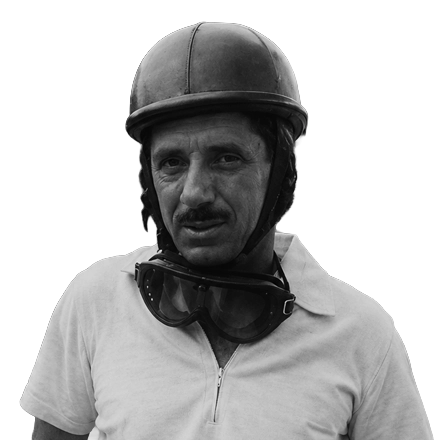
Francisco “Chico” Sacco Landi was one of the true pioneers of Brazilian motorsport — a fearless racer, self-made mechanic and national sporting hero who helped lay the foundations for Brazil’s future love affair with Formula One. Born in São Paulo on 14 July 1907 to a modest middle-class family of Italian heritage, Landi rose from the backstreets of the city’s garages to become the first Brazilian driver to compete in — and score points in — the Formula One World Championship.
Driver Bio
| Nationality | Brazilian |
| Birthplace | Sao Paulo, Brazil |
| Born | 14 July 1907 |
| Died | 7 June 1989 |
| First Grand Prix | 1951 Italian Grand Prix |
| Last Grand Prix | 1956 Argentine Grand Prix |
| Years Active | 1951–1953, 1956 |
| Current/Last Team | Maserati |
Long before Brazil became synonymous with names like Fittipaldi, Piquet and Senna, it was Chico Landi who carried the country’s flag onto the international racing stage.
Landi’s route into motorsport was anything but glamorous. His father owned a small garage in São Paulo, and young Chico left school at just eleven years old to work as a mechanic. By night, he became involved in illegal street races around the city, regularly attracting the attention of local police as his reputation for speed and daring quickly grew.
By the mid-1930s, Landi had emerged as one of the central figures in Brazilian motor racing alongside Manuel de Teffé and Irineu Corrêa, helping transform the sport from a niche curiosity into a national spectacle. Unlike some of his wealthier contemporaries, Landi represented the working-class racer — gritty, relatable and unmistakably Brazilian — which made him hugely popular with fans.
He made his major racing debut at the 1934 Rio Grand Prix and immediately showed his potential, leading the race until mechanical failure struck just eight laps from the finish. When fellow Brazilian star Irineu Corrêa was killed during the opening lap of the following year’s event, Landi effectively became the leading figure of pre-war Brazilian racing.
Determined to test himself against international competition, Landi travelled to Europe in 1938 and finished eighth at Bern in what is widely regarded as the first appearance by a Brazilian driver in a major European Grand Prix event. It marked an important milestone for Brazilian motorsport at a time when South American drivers were still rare on the world stage.
His first major home victory came in the 1941 Rio de Janeiro Grand Prix, cementing his status as Brazil’s premier racing driver during the era.
Landi’s international breakthrough arrived after the Second World War. In 1948, driving for Ferrari, he won the Bari Grand Prix — run to Formula Two regulations that season — becoming the first Brazilian driver ever to win a Grand Prix race in Europe. It was a landmark achievement, not only for Landi personally, but for Brazilian motorsport as a whole.
He continued to impress internationally in the years that followed, including a strong second-place finish at the 1952 Albi Grand Prix in a Ferrari 375.
Formula One
When Formula One’s World Championship era began, Landi again made history. He debuted in the championship on 16 September 1951 and went on to compete in six World Championship Grands Prix. In the 1956 Argentine Grand Prix, he shared a drive with Italian racer Gerino Gerini to finish fourth, earning 1.5 championship points. That result made Chico Landi the first Brazilian ever to score points in Formula One history.
Even as newer generations emerged, Landi remained competitive well into the 1960s. One of his final major successes came in the 1960 Mil Milhas Brasil, where he partnered Christian “Bino” Heins to victory in an Alfa Romeo JK 2000. The triumph carried extra significance because it marked the first time a Brazilian-built car had won the prestigious endurance race, defeating the American-based “Carretera” specials that had traditionally dominated the event.
More than simply a racing driver, Chico Landi became a symbol of Brazilian motorsport’s emergence onto the world stage. Tough, charismatic and endlessly resourceful, he inspired generations of drivers who followed him into international racing. By the time of his death on 7 June 1989, Landi was widely regarded not just as a competitor, but as one of the founding fathers of Brazilian Grand Prix racing.
Grand Prix Stats
| Race Entries | 6 |
| Race Starts | 6 |
| Did Not Start | 0 |
| Best Race Start | 11th |
| Best Race Finish | 4th |
| Retirements | 3 |
| First-Lap Retirements | 0 |
| Not Classified | 0 |
| Disqualified | 0 |
| Did Not Qualify | 0 |
Qualifying
| Qualifying Sessions | 6 |
| Reached Q3 | 0 |
| Q2 Eliminations | 0 |
| Q1 Eliminations | 0 |
| Did Not Qualify | 0 |
Points
| Points Scored | 1.5 |
| Points Finishes | 1 |
| Most Points in a Single Season | 1.50 |
| Seasons with Points | 1 |
Complete Formula One World Championship results
| Year | Entrant | Chassis | Engine | 1 | 2 | 3 | 4 | 5 | 6 | 7 | 8 | 9 | WDC | Points |
|---|---|---|---|---|---|---|---|---|---|---|---|---|---|---|
| 1951 | Francisco Landi | Maserati 4CLT/48 | Maserati Straight-4 | SUI | 500 | BEL | FRA | GBR | GER DNA | ESP DNA | NC | 0 | ||
| Ferrari 375/50 | Ferrari V12 | ITA Ret | ||||||||||||
| 1952 | Escuderia Bandeirantes | Maserati A6GCM | Maserati Straight-6 | SUI | 500 | BEL | FRA DNA | GBR | GER | NED 9† | ITA 8 | NC | 0 | |
| 1953 | Escuderia Bandeirantes | Maserati A6GCM | Maserati Straight-6 | ARG | 500 | NED | BEL | FRA | GBR | GER | SUI Ret | NC | 0 | |
| Scuderia Milano | ITA Ret | |||||||||||||
| 1956 | Officine Alfieri Maserati | Maserati 250F | Maserati Straight-6 | ARG 4* | MON | 500 | BEL | FRA | GBR | GER | ITA | 25th | 1.5 | |
* Indicates Shared Drive with Gerino Gerini
Teammates & Qualifying Head-to-Head
| Teammate | Years | Races | Qualifying H2H |
|---|---|---|---|
| Eitel Cantoni | 1952 | 1 | – |
| Jan Flinterman | 1952 | 1 | – |
| Gino Bianco | 1952 | 2 | – |
| Birabongse Bhanudej | 1953 | 1 | – |
| Gerino Gerini | 1956 | 1 | – |
| Carlos Menditeguy | 1956 | 1 | – |
| Jean Behra | 1956 | 1 | – |
| Stirling Moss | 1956 | 1 | – |
| Jose Froilan Gonzalez | 1956 | 1 | – |