

























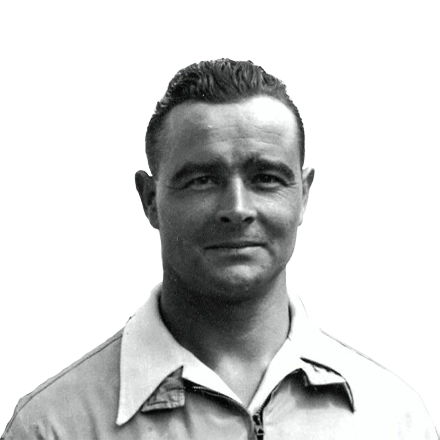
Élie Marcel Bayol was a French racing driver whose career spanned Formula One, Formula Two, endurance racing, and hillclimbs. Competing for teams such as O.S.C.A. and Gordini, he was best known for his achievements in sports car racing, most notably winning the Index of Performance and the 750cc class at the 24 Hours of Le Mans in 1954 with a DB-Panhard.
Driver Bio
| Nationality | French |
| Birthplace | Marseille, France |
| Born | 28 February 1914 |
| Died | 25 May 1995 |
| First Grand Prix | 1952 Italian Grand Prix |
| Last Grand Prix | 1956 Monaco Grand Prix |
| Years Active | 1952–1956 |
| Current/Last Team | Gordini |
Racing career
Early years: ingenuity and endurance: 1950
Bayol began racing in 1950, competing in small-capacity DB-Panhards across France in races and hillclimbs. That same year, he made his debut at Le Mans alongside DB co-founder René Bonnet.
In one of the more remarkable moments of his career, Bayol’s engine failed overnight while leading the Index of Performance category. Guided by Bonnet, he carried out a roadside repair using tools from the car itself—managing to nurse the engine back to the pits on a single cylinder. Although time was lost, the car was repaired, and they were classified as finishers—an early display of Bayol’s resourcefulness and determination.
Formula Two struggles and persistence: 1951–1952
In 1951, Bayol entered Formula Two racing with DB’s own car. It was heavily underpowered compared to its rivals, but its agility made it competitive on tight circuits. He also returned to Le Mans, though stronger opposition limited his results.
The following year, he moved to an OSCA MT4 and later debuted the more competitive OSCA 20 Formula Two car. He showed improved pace, particularly on technical tracks like Pau, and made his Formula One World Championship debut at the 1952 Italian Grand Prix. After qualifying tenth, his race ended almost immediately due to a gearbox failure.
Despite setbacks, he achieved a notable sixth-place finish at the Modena Grand Prix—best among private entrants.
Breakthroughs and setbacks: 1953
Remaining with OSCA in 1953, Bayol competed alongside veteran Louis Chiron. Results were mixed, though he showed flashes of speed—taking pole at Albi before retiring due to clutch failure.
He also ventured into larger machinery at Le Mans, driving a Talbot-Lago, but retired early. Back in Formula racing, he achieved a milestone by giving OSCA its first Formula Two victory at Aix-les-Bains. However, World Championship outings remained difficult, with retirements continuing to limit his impact.
Formula One points and Le Mans glory: 1954
With Formula One regulations returning in 1954, Bayol joined Gordini. He made an immediate impression by finishing fifth at the Argentine Grand Prix—his only points-scoring finish in the World Championship.
However, the season was not without controversy. In a Formula Libre race in Buenos Aires, Bayol crashed into the crowd on the opening lap, tragically killing a spectator and injuring a police officer. Later in the year, he was dismissed by Gordini after refusing team orders to hand over his car to teammate Jean Behra during a race.
Yet 1954 also brought his greatest triumph. Returning to Le Mans with Bonnet in a DB-Panhard, Bayol delivered a near-perfect performance. The pair won the Index of Performance, the 750cc class, and the Biennial Cup—finishing tenth overall against far more powerful competition.
Accidents and decline: 1955–1956
In 1955, Bayol rejoined Gordini as lead driver following Behra’s departure. Driving the ageing Gordini Type 16, he entered five Formula One races but retired from all of them.
That year’s Le Mans proved disastrous. After a chaotic build-up involving a collision with Stirling Moss in the pits, Bayol later suffered a severe crash while avoiding spectators crossing the track. He sustained a fractured skull and broken vertebrae—injuries that ended his season.
He continued racing in 1956 with Gordini, though results were limited. His final Formula One appearance came at Monaco, where he handed over his car mid-race to André Pilette, who finished sixth.
Grand Prix Stats
| Race Entries | 8 |
| Race Starts | 7 |
| Did Not Start | 1 |
| Best Race Start | 10th |
| Best Race Finish | 5th |
| Retirements | 5 |
| First-Lap Retirements | 1 |
| Not Classified | 0 |
| Disqualified | 0 |
| Did Not Qualify | 0 |
Qualifying
| Qualifying Sessions | 8 |
| Reached Q3 | 0 |
| Q2 Eliminations | 0 |
| Q1 Eliminations | 0 |
| Did Not Qualify | 0 |
Points
| Points Scored | 2 |
| Points Finishes | 1 |
| Most Points in a Single Season | 2 |
| Seasons with Points | 1 |
Complete Formula One results
| Year | Entrant | Chassis | Engine | 1 | 2 | 3 | 4 | 5 | 6 | 7 | 8 | 9 | WDC | Points |
|---|---|---|---|---|---|---|---|---|---|---|---|---|---|---|
| 1952 | Élie Bayol | O.S.C.A. 20 | O.S.C.A. Straight-6 | SUI | 500 | BEL | FRA | GBR | GER | NED | ITA Ret | NC | 0 | |
| 1953 | Élie Bayol | O.S.C.A. 20 | O.S.C.A. Straight-6 | ARG | 500 | NED | BEL | FRA Ret | GBR | GER | SUI DNS | NC | 0 | |
| O.S.C.A. | ITA Ret | |||||||||||||
| 1954 | Equipe Gordini | Gordini Type 16 | Gordini Straight-6 | ARG 5 | 500 | BEL | FRA | GBR | GER | SUI | ITA | ESP | 19th | 2 |
| 1955 | Equipe Gordini | Gordini Type 16 | Gordini Straight-6 | ARG Ret | MON Ret | 500 | BEL | NED | GBR | ITA | NC | 0 | ||
| 1956 | Gordini | Gordini Type 32 | Gordini Straight-8 | ARG | MON 6* | 500 | BEL | FRA | GBR | GER | ITA | NC | 0 |
Teammates & Qualifying Head-to-Head
| Teammate | Years | Races | Qualifying H2H |
|---|---|---|---|
| Jesus Iglesias | 1954, 1955 | 2 | – |
| Jean Behra | 1954 | 1 | – |
| Pablo Birger | 1955 | 1 | – |
| Jacques Pollet | 1955 | 1 | – |
| Robert Manzon | 1955, 1956 | 2 | – |
| Hermano da Silva Ramos | 1956 | 1 | – |
| Andre Pilette | 1956 | 1 | – |