






























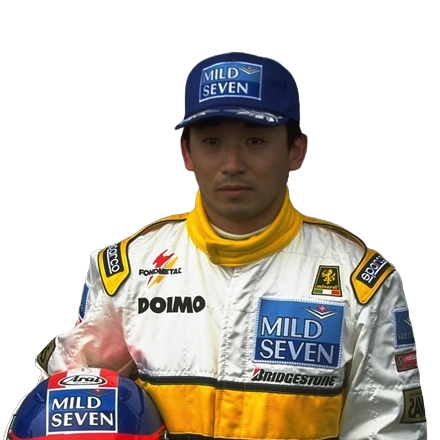
Ukyo Katayama is a Japanese former Formula One driver, endurance racer, team owner, broadcaster, and elite mountaineer whose career has spanned some of the world’s toughest sporting arenas. Best known internationally for his six seasons in Formula One during the 1990s, Katayama became one of Japan’s most recognisable racing drivers thanks to his fearless driving style, relentless determination, and larger-than-life personality.
Driver Bio
| Nationality | Japanese |
| Birthplace | Tokyo, Japan |
| Born | 29 May 1963 |
| First Grand Prix | 1992 South African Grand Prix |
| Last Grand Prix | 1997 European Grand Prix |
| Years Active | 1992–1997 |
| Current/Last Team | Minardi |
Born in Tokyo, Katayama developed his racing career at a time when Japanese motorsport was rapidly growing onto the world stage. Before reaching Formula One, he spent three years racing in France, sharpening his skills in the highly competitive European junior categories. Returning to Japan in 1988, he entered Japanese Formula 3000, then regarded as one of the strongest feeder championships outside Europe.
Katayama quickly established himself as a serious talent. He scored three podium finishes in 1990 before delivering a championship-winning campaign in 1991, taking two victories and three second-place finishes to secure the title and attract international attention.
Formula One Debut
Katayama’s rise to Formula One came through backing from Japan Tobacco and its Cabin cigarette brand, which secured him a seat with the Larrousse team for the 1992 season.
He made his Grand Prix debut at the 1992 South African Grand Prix and immediately gained a reputation as an aggressive, committed driver willing to push difficult machinery to its limits. The Larrousse was unreliable and rarely competitive against the front-running teams, while teammate Bertrand Gachot often received the majority of the squad’s limited resources.
Despite the challenges, Katayama showed flashes of genuine speed. One of his standout performances came at the Canadian Grand Prix, where he ran in fifth place before engine failure ended his race. His best official finishes that season were a pair of ninth places, but his pace and fighting spirit earned respect throughout the paddock.
Tyrrell and the Breakthrough Year
In 1993, Japan Tobacco arranged for Katayama to move to Tyrrell, one of Formula One’s most historic teams. Unfortunately, Tyrrell was enduring a difficult period competitively. The interim Tyrrell 020C was effectively an outdated design, while its replacement, the 021, struggled badly against newer rivals.
Katayama’s best result that year was tenth place at the Hungarian Grand Prix, but 1994 would prove to be a turning point both for him and for Tyrrell.
The arrival of the Tyrrell 022 transformed the team’s competitiveness, and Katayama responded with the strongest season of his Formula One career. He consistently impressed with his outright speed, often outperforming his more experienced and highly rated teammate Mark Blundell in qualifying and race pace.
Throughout the season, Katayama became a regular contender for points finishes. However, the car’s reliability was fragile, and he suffered 12 retirements. One of the cruelest moments came at the German Grand Prix, where he was running in third position before a stuck throttle forced him out of contention.
Even so, the races he did finish showed just how competitive he could be. Katayama scored two fifth-place finishes, a sixth place, and a seventh place during the season, earning all five of his Formula One World Championship points in 1994.
To this day, it remains the defining campaign of his Grand Prix career.
The Hidden Battle Behind the Scenes
Following his breakthrough 1994 season, Katayama was reportedly offered an opportunity to join Benetton for 1995 alongside reigning World Champion Michael Schumacher — a move that could have completely transformed his Formula One career.
But the deal never happened.
Years later, Katayama revealed the deeply personal reason why. In 1994, he was diagnosed with cancer in his back. While the condition was not considered life-threatening, it caused him significant pain, and his demanding Formula One schedule delayed treatment.
Remarkably, Katayama kept the diagnosis completely private throughout his racing career. He later explained that he never wanted sympathy from fans or the media to become an excuse for poor performances. The revelation added a new layer of admiration for what he achieved during some of the toughest seasons of his career.
Final Years in Formula One
Katayama remained with Tyrrell through 1995 and 1996, but both driver and team struggled to replicate the promise shown in 1994. Formula One regulation changes introduced higher cockpit sides following the death of Ayrton Senna in 1994, and Katayama was believed to be heavily disadvantaged by the new designs.
At the same time, Tyrrell’s competitiveness faded further, and Katayama was increasingly outpaced by rookie teammate Mika Salo. Despite several determined drives, his best results over the next two seasons were two seventh-place finishes in attrition-heavy races.
One unusual statistic from his Formula One career came at the 1996 Belgian Grand Prix, where he finished on the lead lap for the only time in his entire Grand Prix career.
In 1997, Katayama moved to Minardi with backing from Mild Seven, another Japan Tobacco brand. However, Minardi was also struggling near the back of the grid, and two tenth-place finishes became his best results of the season.
At his home Japanese Grand Prix, an emotional Katayama announced his retirement from Formula One after 97 Grand Prix starts, making him one of the most experienced Japanese drivers in the history of the sport.
Le Mans Heartbreak and Endurance Racing
Although his Formula One chapter had ended, Katayama remained hugely popular in Japan and continued competing in sports cars and endurance racing.
One of the defining moments of his post-F1 career came at the 1999 24 Hours of Le Mans. Driving the spectacular Toyota GT-One alongside fellow Japanese drivers Keiichi Tsuchiya and Toshio Suzuki, Katayama helped lead Toyota’s challenge for overall victory.
In the closing stages of the race, Katayama was rapidly catching the leading BMW while navigating heavy traffic. Victory appeared possible — until disaster struck. A tyre blowout forced him to limp the damaged GT-One back to the pits, destroying Toyota’s hopes of winning Le Mans outright.
Despite the heartbreak, the car still finished second overall and won the GTP class, giving Katayama one of the strongest endurance racing results of his career.
In 2008, he briefly returned to high-level competition as part of the Speedcar Series, joining several other former Formula One drivers in the championship.
Team UKYO and Life as a Team Owner
In 2000, Katayama founded Team UKYO, a motorsport organisation that would eventually become one of Japan’s most respected racing operations.
The team initially competed in the Japanese GT Championship, later Super GT, in collaboration with Cerumo. Katayama himself drove for the team alongside future team owner and singer Masahiko Kondo.
After stepping away from the series, Team UKYO returned in 2011 to oversee Goodsmile Racing’s GT300 programme. Under Katayama’s leadership, the team captured GT300 championships in 2011, 2014, and 2017.
The organisation also competed in the Dakar Rally between 2002 and 2005, as well as in 2007, showcasing Katayama’s passion for motorsport far beyond traditional circuit racing.
In 2012, Team UKYO expanded into professional cycling, launching a UCI Continental road cycling team that Katayama continues to manage.
The Mountaineer
Away from motorsport, Katayama developed a second reputation as an accomplished mountaineer. His love of climbing began during his Formula One years and eventually became one of the defining passions of his life.
In 2001, he successfully climbed Cho Oyu, the world’s sixth-highest mountain. Five years later, he achieved a lifelong ambition by summiting Manaslu, the eighth-highest mountain on Earth, after an earlier failed attempt in 2004.
Katayama’s climbing career nearly ended in tragedy in December 2009 while ascending Mount Fuji with two companions. During severe conditions, the group became stranded, prompting a major search-and-rescue operation. Katayama was eventually found alive, but both of his fellow climbers lost their lives.
Despite the traumatic experience, Katayama continued mountaineering and by the end of 2010 had completed six of the famed Seven Summits: Mont Blanc, Kilimanjaro, Elbrus, Denali, Aconcagua, and Vinson Massif.
Media Career and Public Profile
Following his retirement from full-time racing, Katayama became a prominent media personality in Japan. He worked as a Formula One commentator for Fuji TV and later co-hosted the motoring programme Samurai Wheels for NHK World.
His popularity also led to appearances outside motorsport, including a guest judging role on the cult television show Iron Chef in 1996.
Katayama remained known for his distinctive racing helmet design — primarily blue, with red-and-white striping that formed a stylised oblique “T” across the sides and rear.
Legacy
Ukyo Katayama’s Formula One 97 race statistics only tell part of his story; his legacy stretches well beyond F1. Whether competing at Le Mans, managing championship-winning racing teams, climbing some of the world’s most dangerous mountains, or helping grow Japanese motorsport and cycling, Katayama remains one of Japan’s most respected and multifaceted sporting figures.
Grand Prix Stats
| Race Entries | 97 |
| Race Starts | 95 |
| Did Not Start | 0 |
| Best Race Start | 5th |
| Best Race Finish | 5th |
| Retirements | 63 |
| First-Lap Retirements | 4 |
| Not Classified | 0 |
| Disqualified | 1 |
| Did Not Qualify | 1 |
Qualifying
| Qualifying Sessions | – |
| Reached Q3 | – |
| Q2 Eliminations | – |
| Q1 Eliminations | – |
| Did Not Qualify | 1 |
Points
Stats by Season
| Year | Constructor | Entries | Starts | Wins | Podiums | Poles | Fastest Laps | Front Rows | DNF | Best Start | Best Result | Pts Finishes | Points | Championship |
|---|---|---|---|---|---|---|---|---|---|---|---|---|---|---|
| 1992 | Larrousse | 16 | 14 | 0 | 0 | 0 | 0 | 0 | 9 | 11 | 9 | 0 | 0 | NC |
| 1993 | Tyrrell | 16 | 16 | 0 | 0 | 0 | 0 | 0 | 11 | 13 | 10 | 0 | 0 | NC |
| 1994 | Tyrrell | 16 | 16 | 0 | 0 | 0 | 0 | 0 | 12 | 5 | 5 | 3 | 5 | 17th |
| 1995 | Tyrrell | 16 | 16 | 0 | 0 | 0 | 0 | 0 | 12 | 11 | 7 | 0 | 0 | NC |
| 1996 | Tyrrell | 16 | 16 | 0 | 0 | 0 | 0 | 0 | 9 | 12 | 7 | 0 | 0 | NC |
| 1997 | Minardi | 17 | 17 | 0 | 0 | 0 | 0 | 0 | 10 | 15 | 10 | 0 | 0 | NC |
Stats by Constructor
| Constructor | Years | Entries | Starts | Wins | Podiums | Poles | Fastest Laps | Front Rows | DNF | Best Start | Best Result | Pts Finishes | Points |
|---|---|---|---|---|---|---|---|---|---|---|---|---|---|
| Larrousse | 1992 | 16 | 14 | 0 | 0 | 0 | 0 | 0 | 9 | 11 | 9 | 0 | 0 |
| Tyrrell | 1993–1996 | 64 | 64 | 0 | 0 | 0 | 0 | 0 | 44 | 5 | 5 | 3 | 5 |
| Minardi | 1997 | 17 | 17 | 0 | 0 | 0 | 0 | 0 | 10 | 15 | 10 | 0 | 0 |
Teammates & Qualifying Head-to-Head
| Teammate | Years | Races | Qualifying H2H |
|---|---|---|---|
| Bertrand Gachot | 1992 | 16 | 4-12 |
| Andrea de Cesaris | 1993 | 16 | 7-9 |
| Mark Blundell | 1994 | 16 | 11-5 |
| Mika Salo | 1995, 1996 | 32 | 9-23 |
| Jarno Trulli | 1997 | 7 | 1-6 |
| Tarso Marques | 1997 | 10 | 8-2 |