








































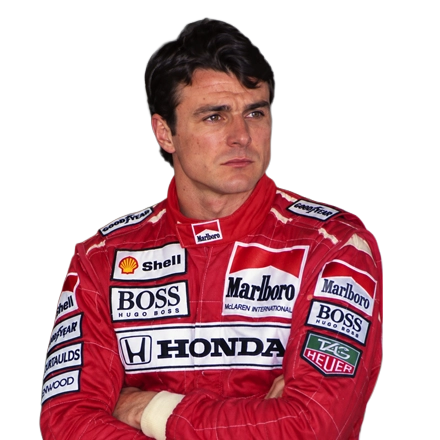
Mark Blundell’s career took him from teenage motorcycle racing to a Le Mans victory, Formula One podiums and three CART wins. Later, British television viewers came to know him as an F1 analyst, while his driver-management work helped guide another generation of competitors.
Driver Bio
| Nationality | British |
| Birthplace | Barnet, England, UK |
| Born | 8 April 1966 |
| First Grand Prix | 1991 United States Grand Prix |
| Last Grand Prix | 1995 Australian Grand Prix |
| Years Active | 1991, 1993–1995 |
| Current/Last Team | McLaren |
Born in Barnet on 8 April 1966, Blundell began racing motorcycles at fourteen before switching to Formula Ford at seventeen. He quickly became a front-runner, finishing runner-up in two junior championships during his first season. Further success in Formula Ford 1600, including the Esso and Snetterton series, helped establish his reputation.
A victory in the BBC Grandstand Formula Ford 2000 series and fourth in European Formula Ford 1600 demonstrated his progress. In 1986 he won the European Formula Ford 2000 championship, then stepped into Formula 3000 in 1987 while also racing Formula Three machinery for TOM’S Toyota. Sixth in the 1988 F3000 standings with the works Lola team was another step towards international recognition.
Sports cars soon supplied a breakthrough. Blundell joined Nissan’s works programme in 1989 while also testing for Williams. At Le Mans in 1990, driving the Nissan R90CK, he took pole position by an extraordinary 6.040 seconds. It was a spectacular lap and made him the youngest driver to have claimed pole for the race at that time.
Formula One racing followed in 1991 with Brabham, using Yamaha engines. Sixth at the Belgian Grand Prix delivered a point, and he continued to test for Williams, but the race seat did not survive into 1992. Wanting to race rather than remain solely a tester, he declined a return to Williams testing and told Damon Hill about the vacancy.
Blundell instead became a McLaren test driver in 1992 and won the Le Mans 24 Hours with Peugeot. The endurance victory was a major career achievement during a year without a Grand Prix race seat, underlining the value of maintaining a programme beyond F1.
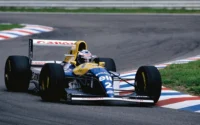
He returned to the championship with Ligier in 1993 and immediately found more competitive opportunities.
For the first time, his Formula One season brought podium finishes as well as the prospect of occasional points. Third places in South Africa and Germany helped him finish tenth in the drivers’ standings. A move to Tyrrell in 1994 brought another podium, in Spain, which would prove to be the team’s last in Formula One.
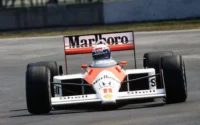
Financial considerations cost him the Tyrrell seat, but McLaren provided another chance in 1995. Initially he stood in because Nigel Mansell did not fit the car comfortably. When Mansell subsequently left the team, Blundell returned alongside Mika Häkkinen for the remainder of the season.
Five points-scoring finishes put him tenth in the championship. He also finished fourth at Le Mans that year, keeping his endurance credentials active alongside the F1 programme. His Grand Prix career ended with three podiums and 32 points from 61 starts. Later discussions about a Prost testing role in 2001 did not produce a return.
For 1996 Blundell moved to CART with PacWest, partnering Maurício Gugelmin. A major accident in Rio de Janeiro interrupted the season, with the impact recorded at 122g. Injuries included a brain haematoma, damage to his foot and ankle and internal injuries, and he missed three races while recovering.
He returned to record top-six finishes at the US 500, Detroit and Michigan, ending third in the rookie standings. It had been a difficult introduction to American racing, but the following year would show what he could achieve with a more complete campaign.
Detroit in 1997 almost produced his first CART victory, only for fuel to run out within sight of the finish. At Portland, he made amends in dramatic fashion, passing Gil de Ferran and winning by just 0.027 seconds. Further wins at Toronto and Fontana helped him finish sixth in the championship and earn the Autosport British Competition Driver of the Year award.
The three wins established Blundell as a serious contender in a highly competitive series. His American career was nevertheless interrupted again in 1999, when a testing accident at Gateway forced him to miss eight races. In 2000 he finished 21st with eighteen points, and he and PacWest parted company.
He returned to endurance racing with the MG-Lola programme at Le Mans in 2001. The car showed strong pace but failed to finish. Other activities included testing for Dale Coyne Racing to assist preparations involving Darren Manning at Rockingham and an appearance in Britain’s World Rally Championship round.
Bentley’s Le Mans programme then brought another outstanding result. In 2003, Blundell shared with Johnny Herbert and David Brabham to finish second in the 24 Hours, adding a further overall podium to his 1992 victory. The same year also brought third at Sebring, confirming that his endurance speed remained undiminished.
Television became an increasingly prominent part of his career. From 2002 to 2008 he worked on ITV’s Formula One coverage, continuing until the rights moved to the BBC. His experience with several teams, and in racing beyond F1, supplied a useful perspective on the sport he was now analysing.
Viewers saw a former driver able to discuss both the demands inside the cockpit and the uncertainty of building a career around short contracts. His own route had included testing, several changes of F1 team, major injury in America and a successful return to endurance racing, giving him direct experience of many of the situations being discussed.
In 2004 he and Martin Brundle established the 2MB driver-management business. Brundle later stepped away, while Blundell continued working with young and established competitors. Drivers associated with his management activities over the years included Gary Paffett, Mike Conway, Callum Ilott, Tom Blomqvist, Jordan King, Kiern Jewiss and Patrick Kibble.
The driving itself did not disappear completely. In 2019 he returned to the British Touring Car Championship with Trade Price Cars Racing, taking on a fresh challenge more than two decades after his final F1 season. It was another reminder that his career had never followed a single-category path.
His helmet became a familiar visual signature: a yellow base with three red bands, blue around the chin and crown, and gold initials. The phrase “The Will to Win” honoured his grandfather. Away from racing, he married Deborah in 1995 and became the father of sons Mark Jr and Callum.
In October 2025, Blundell received a six-month driving ban and five penalty points following a speeding offence on 30 November 2024. He had been recorded at 96mph on a 70mph section of the A14. It was a road-driving matter separate from the competition career that had made his name.
From the huge margin of his Nissan Le Mans pole to the tiny margin of his Portland CART victory, Blundell’s best moments covered the full range of racing drama. The wins, podiums and subsequent work in broadcasting and driver development gave him a lasting place in British motorsport well beyond his five seasons as a Formula One race driver.
Grand Prix Stats
| Race Entries | 63 |
| Race Starts | 61 |
| Did Not Start | 0 |
| Best Race Start | 4th |
| Best Race Finish | 3rd |
| Retirements | 32 |
| First-Lap Retirements | 3 |
| Not Classified | 0 |
| Disqualified | 0 |
| Did Not Qualify | 1 |
Podiums
| Podiums | 3 |
| First Podium | 1993 South African Grand Prix |
| Last Podium | 1994 Spanish Grand Prix |
| 1st Place | 0 |
| 2nd Place | 0 |
| 3rd Place | 3 |
| Most Consecutive Podiums | 0 |
| Most Podiums in a Single Season | 2 (1993) |
| Seasons with Podiums | 2 (1993, 1994) |
Qualifying
| Qualifying Sessions | 63 |
| Reached Q3 | 0 |
| Q2 Eliminations | 0 |
| Q1 Eliminations | 0 |
| Did Not Qualify | 1 |
Points
| Points Scored | 32 |
| Points Finishes | 13 |
| Most Points in a Single Season | 13 (1995) |
| Seasons with Points | 4 (1991, 1993, 1994, 1995) |
Stats by Season
| Year | Constructor | Entries | Starts | Wins | Podiums | Poles | Fastest Laps | Front Rows | DNF | Best Start | Best Result | Pts Finishes | Points | Championship |
|---|---|---|---|---|---|---|---|---|---|---|---|---|---|---|
| 1991 | Brabham | 16 | 14 | 0 | 0 | 0 | 0 | 0 | 9 | 11 | 6 | 1 | 1 | 18th |
| 1993 | Ligier | 16 | 16 | 0 | 2 | 0 | 0 | 0 | 8 | 4 | 3 | 3 | 10 | 10th |
| 1994 | Tyrrell | 16 | 16 | 0 | 1 | 0 | 0 | 0 | 10 | 7 | 3 | 3 | 8 | 12th |
| 1995 | McLaren | 15 | 15 | 0 | 0 | 0 | 0 | 0 | 5 | 6 | 4 | 6 | 13 | 10th |
Teammates & Qualifying Head-to-Head
| Teammate | Years | Races | Qualifying H2H |
|---|---|---|---|
| Martin Brundle | 1991, 1993 | 32 | 17-15 |
| Ukyo Katayama | 1994 | 16 | 5-11 |
| Mika Hakkinen | 1995 | 14 | 2-12 |
| Jan Magnussen | 1995 | 1 | 1-0 |