


























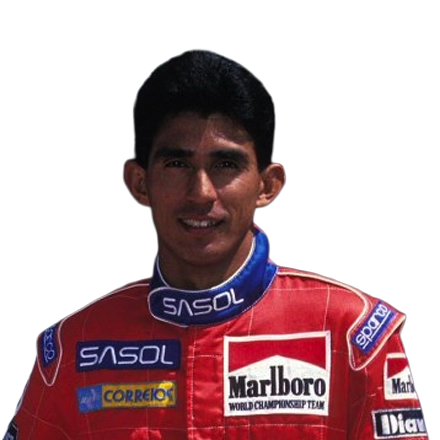
Aguri Suzuki is a Japanese former racing driver, team owner, and motorsport executive whose career helped open doors for future generations of Asian racers. He competed in Formula One between 1988 and 1995, entering 88 Grand Prix and becoming the first Asian driver to stand on a Formula One podium with a historic third-place finish at the 1990 Japanese Grand Prix.
Driver Bio
| Nationality | Japanese |
| Birthplace | Tokyo, Japan |
| Born | 8 September 1960 |
| First Grand Prix | 1988 Japanese Grand Prix |
| Last Grand Prix | 1995 Pacific Grand Prix |
| Years Active | 1988–1995 |
| Current/Last Team | Ligier |
Beyond Formula One, Suzuki was a champion in Japanese Formula 3000, a winner in top-level GT racing, a Le Mans podium finisher, and later one of Japan’s most influential team owners through ARTA and Super Aguri F1.
Early life
Suzuki was born in Tokyo on 8 September 1960. His father, Masashi Suzuki, was of mixed Japanese and Martinican ancestry and worked as an aircraft technician for Honda Airways before opening a kart shop in 1973.
Motorsport was never far away. Growing up around engines, tools, and racing machinery, Suzuki naturally gravitated toward karting.
He studied science at Josai University, though racing soon became the priority and he did not complete his degree.
Early racing career
Suzuki began karting in 1972 at the age of 12 and quickly emerged as one of Japan’s brightest young talents.
He won the Japanese Kart Championship in 1978, then stepped into single-seaters the following year in All-Japan Formula Three. He continued balancing karts and car racing, reclaiming the national kart title in 1981.
By 1983, Suzuki finished runner-up in Japanese Formula Three, driving a Hayashi-Toyota.
He then broadened his skillset by switching to touring cars, where he drove for the factory-backed Nissan team and won the Japanese Touring Car title in 1986.
That same year, he also debuted in Japanese Formula Two and made his first appearance at the 24 Hours of Le Mans—showing the versatility that would define his career.
In 1987, he finished runner-up in Japanese Formula 3000, winning at Suzuka Circuit. One year later, driving a March-Yamaha, he captured the 1988 Japanese Formula 3000 Championship with three victories.
Formula One career
Debut and difficult beginnings
Suzuki first entered Formula One in 1988, making his Grand Prix debut at his home race after replacing the ill Yannick Dalmas at Larrousse.
In 1989, he joined Zakspeed, whose Yamaha-powered car proved deeply uncompetitive. Suzuki failed to pre-qualify for every race that season—a frustrating campaign, but one that tested his resilience.
Larrousse return and historic podium
Suzuki returned to Larrousse for 1990 and 1991, where his Formula One fortunes improved dramatically.
He scored three sixth-place finishes and consistently outperformed expectations in midfield machinery. Then came the defining moment of his Formula One career.
At the 1990 Japanese Grand Prix at Suzuka, Suzuki drove superbly to finish third, becoming the first Asian driver ever to score a podium in F1 history.
For Japanese motorsport fans, it was a landmark moment. At home, in front of a passionate crowd, Suzuki delivered one of the most celebrated results in the nation’s racing history.
He also set the second-fastest lap of the race—further proof the podium was earned on pace, not luck.
Footwork years
In 1992 and 1993, Suzuki joined Footwork, partnering with veterans Michele Alboreto and, later, Derek Warwick.
Results were harder to come by, and although experienced teammates generally had the edge, Suzuki remained a dependable and respected presence on the grid.
Final season with Ligier
After a year away, Suzuki returned to Formula One in 1995 with Ligier, sharing driving duties with Martin Brundle.
He scored one championship point during the season, but the year ended painfully. A heavy crash during practice for the 1995 Japanese Grand Prix caused a neck injury that ruled him out of the race.
Shortly afterwards, Suzuki announced his retirement from Formula One.
Across 88 starts, he scored eight championship points and retired as one of Japan’s most successful Grand Prix drivers.
Sports cars and GT success
Suzuki’s racing career continued strongly after Formula One.
He competed in the All Japan Grand Touring Car Championship (later Super GT), where he became a race winner, and in 1998, he finished third overall at Le Mans, an outstanding result in one of world motorsport’s toughest events.
His ability to succeed in Formula One, touring cars, GT racing, and endurance competition underlined his adaptability as a driver.
Team ownership and driver development
Suzuki’s greatest long-term impact may have come as a team owner.
ARTA
In partnership with Autobacs, he founded Autobacs Racing Team Aguri (ARTA) in 1997.
ARTA became one of Japan’s most successful racing teams, competing mainly in Super GT and winning championships in both GT500 and GT300 categories.
Super Aguri F1
In 2005, Suzuki launched Super Aguri F1 with backing from Honda.
Built in just a few months, the team joined the Formula One grid in 2006. Against the odds, it became a fan favourite.
In 2007, Takuma Sato scored two top-eight finishes, earning the team its first championship points and helping Super Aguri finish ninth in the Constructors’ standings.
Financial pressures eventually forced the team to withdraw in 2008, but its achievements on limited resources earned widespread admiration.
Formula E
Suzuki later founded Team Aguri, which competed in Formula E from 2014 to 2016, extending his influence into electric motorsport.
Grand Prix Stats
| Race Entries | 88 |
| Race Starts | 64 |
| Did Not Start | 2 |
| Best Race Start | 6th |
| Best Race Finish | 3rd |
| Retirements | 40 |
| First-Lap Retirements | 2 |
| Not Classified | 0 |
| Disqualified | 0 |
| Did Not Qualify | 22 |
Podiums
| Podiums | 1 |
| First Podium | 1990 Japanese Grand Prix |
| Last Podium | 1990 Japanese Grand Prix |
| 1st Place | 0 |
| 2nd Place | 0 |
| 3rd Place | 1 |
| Most Consecutive Podiums | 0 |
| Most Podiums in a Single Season | 1 (1990) |
| Seasons with Podiums | 1 |
Qualifying
| Qualifying Sessions | 88 |
| Reached Q3 | 0 |
| Q2 Eliminations | 0 |
| Q1 Eliminations | 0 |
| Did Not Qualify | 22 |
Points
| Points Scored | 8 |
| Points Finishes | 5 |
| Most Points in a Single Season | 6 (1990) |
| Seasons with Points | 3 |
Stats by Season
| Year | Constructor | Entries | Starts | Wins | Podiums | Poles | Fastest Laps | Front Rows | DNF | Best Start | Best Result | Pts Finishes | Points | Championship |
|---|---|---|---|---|---|---|---|---|---|---|---|---|---|---|
| 1988 | Larrousse | 1 | 1 | 0 | 0 | 0 | 0 | 0 | 0 | 20 | 16 | 0 | 0 | NC |
| 1989 | Zakspeed | 16 | 0 | 0 | 0 | 0 | 0 | 0 | 0 | – | – | 0 | 0 | NC |
| 1990 | Larrousse | 16 | 16 | 0 | 1 | 0 | 0 | 0 | 10 | 9 | 3 | 3 | 6 | 12th |
| 1991 | Larrousse | 16 | 11 | 0 | 0 | 0 | 0 | 0 | 10 | 19 | 6 | 1 | 1 | 18th |
| 1992 | Footwork | 16 | 14 | 0 | 0 | 0 | 0 | 0 | 5 | 11 | 7 | 0 | 0 | NC |
| 1993 | Footwork | 16 | 16 | 0 | 0 | 0 | 0 | 0 | 11 | 6 | 7 | 0 | 0 | NC |
| 1994 | Jordan | 1 | 1 | 0 | 0 | 0 | 0 | 0 | 1 | 20 | – | 0 | 0 | NC |
| 1995 | Ligier | 6 | 5 | 0 | 0 | 0 | 0 | 0 | 2 | 13 | 6 | 1 | 1 | 17th |
Stats by Constructor
| Constructor | Years | Entries | Starts | Wins | Podiums | Poles | Fastest Laps | Front Rows | DNF | Best Start | Best Result | Pts Finishes | Points |
|---|---|---|---|---|---|---|---|---|---|---|---|---|---|
| Larrousse | 1988, 1990– 1991 | 33 | 28 | 0 | 1 | 0 | 0 | 0 | 21 | 9 | 3 | 4 | 7 |
| Zakspeed | 1989 | 16 | 0 | 0 | 0 | 0 | 0 | 0 | 0 | – | – | 0 | 0 |
| Footwork | 1992–1993 | 32 | 30 | 0 | 0 | 0 | 0 | 0 | 16 | 6 | 7 | 0 | 0 |
| Jordan | 1994 | 1 | 1 | 0 | 0 | 0 | 0 | 0 | 1 | 20 | – | 0 | 0 |
| Ligier | 1995 | 6 | 5 | 0 | 0 | 0 | 0 | 0 | 2 | 13 | 6 | 1 | 1 |
Teammates & Qualifying Head-to-Head
| Teammate | Years | Races | Qualifying H2H |
|---|---|---|---|
| Philippe Alliot | 1988 | 1 | 0-1 |
| Bernd Schneider | 1989 | 16 | 3-13 |
| Eric Bernard | 1990, 1991 | 31 | 12-19 |
| Bertrand Gachot | 1991 | 1 | 1-0 |
| Michele Alboreto | 1992 | 16 | 2-14 |
| Derek Warwick | 1993 | 16 | 8-8 |
| Rubens Barrichello | 1994 | 1 | 0-1 |
| Olivier Panis | 1995 | 6 | 0-6 |